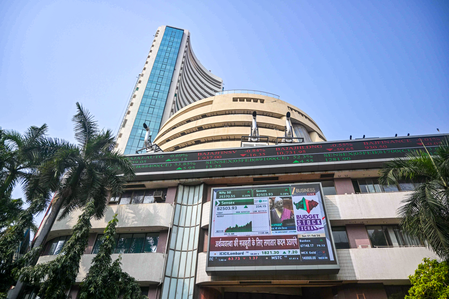
Stock markets end lower for 6th straight week over West Asia...
03 Apr 2026



Synopsis
Building a Rs 2-crore retirement corpus requires a strategic approach to combat inflation and market volatility. Experts recommend a systematic investment plan with annual increases, a gradual shift from equity to debt as retirement nears, and a bucket strategy for managing withdrawals. Avoiding premature exits during market downturns is crucial for long-term wealth preservation and growth.
A Rs 2-crore retirement corpus may seem like a decent sum, but inflation can really erode its worth over 20 years. Similarly, having a solid equity-heavy portfolio just months before retirement can be risky; a market slowdown or correction for just a few months can derail your retirement plan. So, it’s crucial to keep inflation and market crash in mind while planning your retirement.
ET Wealth Online spoke to financial experts Ravi Singh, chief research officer (advisory & research) – Master Capital Services Limited, Ankit Patel, co-founder & partner at – Arunasset Investment Services, and Jiral Mehta, senior manager, research, FundsIndia, to know how one can create a Rs 2-core retirement corpus that can beat both inflation and market crash.
Singh says a target of Rs 2 crore as a retirement corpus sounds substantial until inflation quietly dismantles its purchasing power.
“At a sustained rate of 5% annually, that same standard of living will demand roughly Rs 5.25 crore in 20 years, Rs 6.75 crore in 25 years and Rs 8.5 crore in 30 years,” reveals Singh.
Singh suggests starting retirement planning with a step systematic investment plan (SIP) strategy and increase the amount every year by 10%.
Investment strategy by Ravi Singh (Master Capital)
Investment Horizon
Starting Monthly SIP
Assumptions
20 years
₹ 35,000
12% CAGR, 10% annual SIP step-up
25 years
₹ 21,000
12% CAGR, 10% annual SIP step-up
30 years
₹ 14,000
12% CAGR, 10% annual SIP step-up
According to Patel, in a volatile landscape like it is at present, the strategy is clear: focus on time in the market to make most of the power of compounding.
Patel says if someone invests for 30 years instead of 20, they can reduce their monthly SIP commitment considerably, effectively neutralising inflation’s erosion of your future wealth.
Mehta points out that the key is not to start with a huge amount, but to increase the investment amount every year.
“Over a long time frame (i.e., 20 years), your portfolio value doubles when you increase your SIP every year by 10%. This strategy allows you to gradually boost your contributions over time as your income and savings capacity grow,” says Mehta.
Though a lot of market experts suggest a 10% SIP increase every year, many investors may find it difficult to follow. Still, it makes sense for you to boost the increase in your payout.
How your retirement corpus can survive market crash
If you have an equity-heavy retirement corpus, the threat of market crash can’t be overlooked. Market volatility of a few months can derail the retirement planning badly. Just have look at the performance of key indices from January 1, 2026 to April 2, 2026.
Key indices’ performance from January 1 to April 2, 2026
Index
Change (%)
Nifty 50
-13.13%
Nifty 100
-10.87%
Nifty Midcap 150
-11.46%
Nifty Smallcap 250
-11.66%
Average
-11.78%
A near 12% fall in your Rs 2-crore portfolio means it will be cut to nearly Rs 1.77 crore in three months. As an investor, what can be your strategy to minimise the market crash’s impact?
Singh suggests a goal-based planning that includes a glide path as well bucket strategy. In the glide path, a few years before retirement, you should reduce your corpus’ equity exposure step by step and invest that amount in fixed income or debt assets.
As per the bucket strategy, you allocate your retirement corpus into three buckets, where you keep money required for a) immediate needs (0-3 years) in saving accounts or liquid funds; b)for medium term (3-7 years) in moderate risk-level assets such as debt funds, hybrid funds or short-duration bonds; and c)for long term (7+) years in equity mutual funds and index funds.
Patel too advocates the bucket strategy during the withdrawal phase. “If you maintain two years of target cash flow in a liquid bucket, it will ensure you aren't forced to liquidate equities during a 20% drawdown.”
Asset allocation strategy for Rs 2-crore corpus (by Ankit Patel of Arunasset Investment Services)
Mehta explains that according to his back test, a 4-5% annual withdrawal rate for a portfolio with 60% equity exposure is feasible over the long term and it will also allow your monthly withdrawal amount to increase while managing to grow your original corpus.
Asset allocation strategy for Rs 2 crore corpus (by Jiral Mehta of FundsIndia)
Mistakes to avoid in retirement phase
According to Patel, stopping SIPs during a crash is the ultimate wealth-killer as in a volatile market, it converts temporary fluctuations into permanent capital loss.
“Equally fatal is the safety Trap—being too conservative ensures you miss the 15% CAGR needed to outpace rising costs,” says Patel.
Singh advises avoiding excessive conservatism while completely overlooking inflation. “An investor who parks a long-term retirement corpus in fixed deposits, earning 6–7% against a 5–6% inflation rate, is barely breaking even in real terms,” says Singh.
Over time, purchasing power will erode and the corpus that looked sufficient will not be able to provide financial security, Singh suggests.




)