Aakash Shah, Technical Research Analyst at Choice Equity Broking, said, The increase in STT, especially in futures and options, is likely to act as a marginal negative for foreign portfolio investor FPI flows in the near term, particularly for high-frequency and derivative-focused global funds. He added that according to post-Budget updates, STT on futures has been raised from 0.02 per cent to 0.05 per cent, and on options premiums from 0.10 per cent to 0.15 per cent, which meaningfully increases transaction costs for active strategies.
Brokerage stocks tanks over 18 pc as Budget hikes STT on commodity futures
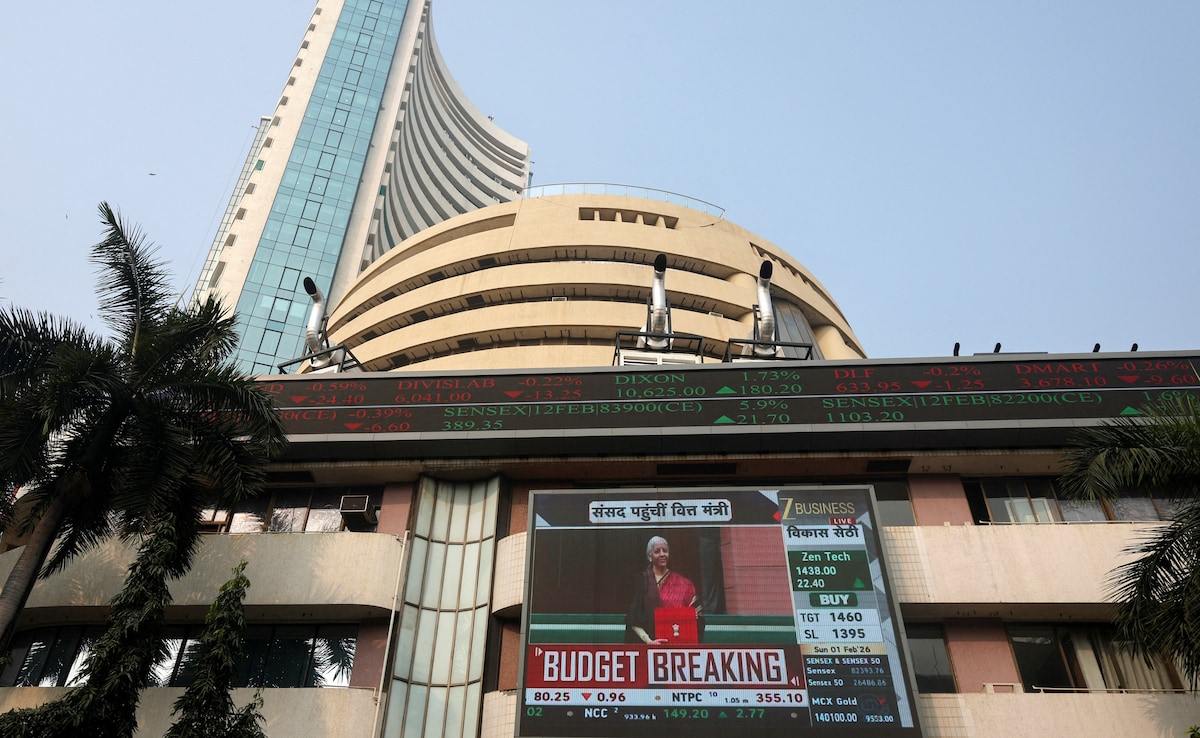
Shares of brokerage-related companies nosedived 18 per cent on Sunday after Finance Minister Nirmala Sitharaman proposed raising securities transaction tax on commodity futures to 0.05 per cent from 0.02 per cent in the Union Budget 2026-27. On the BSE, shares of Multi Commodity Exchange (MCX) tumbled 18.08 per cent to Rs 2,068.40, while Billionbrains Garage Ventures, the parent company of Groww, plunged 13 per cent to Rs 154, and IIFL Capital Services declined 10.4 per cent to Rs 296.10 apiece. Angel One's stock dropped 11.84 per cent to Rs 2,237.95, and Anand Rathi Share And Stock Brokers depreciated 8.05 per cent to Rs 532.15. The scrip of BSE Ltd also came under heavy selling pressure, diving 15 per cent to Rs 2,377.40 on the NSE. Meanwhile, the 30-share BSE Sensex tumbled 911.30 points, or 1.11 per cent, to 81,358.48, while the broader NSE Nifty fell 282.85 points, or 1.12 per cent, to 25,037.80 in the mid-session trade. The sell-off came after Finance Minister Sitharaman on Sunday proposed raising Securities Transaction Tax (STT) to 0.05 per cent on commodity futures from 0.02 per cent. Analysts said the move is aimed to mobilise additional revenue but seen by traders as a potential dampener for market volumes. Aakash Shah, Technical Research Analyst at Choice Equity Broking, said, ''The increase in STT, especially in futures and options, is likely to act as a marginal negative for foreign portfolio investor (FPI) flows in the near term, particularly for high-frequency and derivative-focused global funds.'' He added that according to post-Budget updates, STT on futures has been raised from 0.02 per cent to 0.05 per cent, and on options premiums from 0.10 per cent to 0.15 per cent, which meaningfully increases transaction costs for active strategies. Recent data already shows that FPIs have been cautious, with equity outflows of over Rs 41,000 crore in January 2026 alone, reflecting global risk-off sentiment, elevated US bond yields, and currency pressures. Shah noted that a higher STT further reduces post-tax returns, making India relatively less competitive for short-term and derivative-oriented foreign flows. ''However, for long-only, fundamentally driven FPIs, the STT hike is unlikely to be a deal-breaker. Their investment decisions are more influenced by earnings visibility, currency stability, and policy predictability. ''That said, at the margin, higher transaction costs could tilt some global allocators towards other Asian markets, especially at a time when India is already facing pressure from AI-led capital shifts to the US, Taiwan and Korea,'' Shah said. Overall, while the STT hike may help boost tax collections, it risks dampening trading volumes and could slow tactical FPI participation. To meaningfully revive sustained FPI inflows, investors will be looking more closely at macro stability, rupee movement, and consistency in tax policy rather than just growth optics, he added.
(This story has not been edited by Devdiscourse staff and is auto-generated from a syndicated feed.)