India's federal budget unveils a massive $133 billion investment for infrastructure and manufacturing. The plan aims to boost sectors from textiles to electronics. Taxes on equity futures are increased to curb speculation. The budget focuses on economic resilience amid global uncertainty. Key sectors like pharmaceuticals and electronics are set to benefit from new initiatives.
Budget 2026: Who gains or loses in India infrastructure push, derivatives tax?
Synopsis
India's federal budget unveils a massive $133 billion investment for infrastructure and manufacturing. The plan aims to boost sectors from textiles to electronics. Taxes on equity futures are increased to curb speculation. The budget focuses on economic resilience amid global uncertainty. Key sectors like pharmaceuticals and electronics are set to benefit from new initiatives.
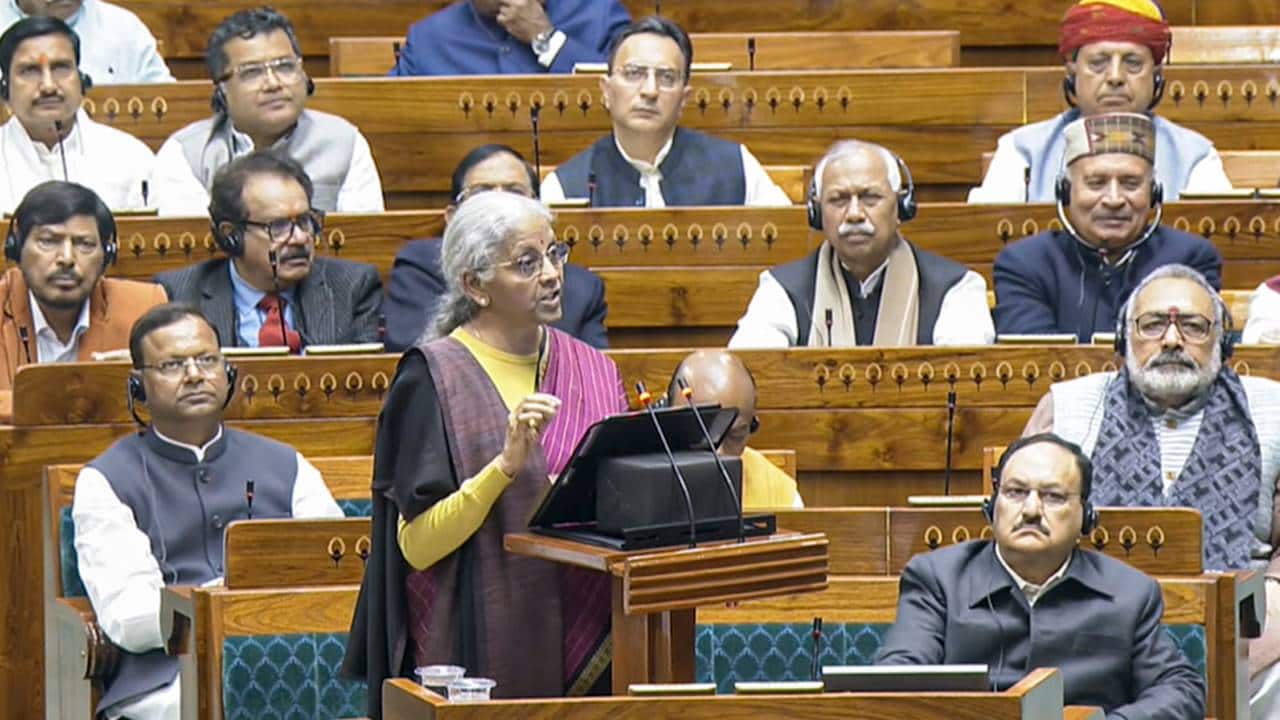
New Delhi: In her Budget 2026 speech on Sunday, Finance Minister Nirmala Sitharaman proposed the creation of an Infrastructure Risk Guarantee Fund aimed at providing partial credit guarantees to lenders, a move designed to strengthen risk management for private infrastructure developers. “We face an external environment in which trade and multilateralism are imperiled and access to resources and supply chains are disrupted,” Sitharaman said while presenting the budget in Parliament.
Budget 2026 Live
Budget 2026: Catch all the live action here
Income Tax Budget 2026 Live Updates
Stock Market Live Updates
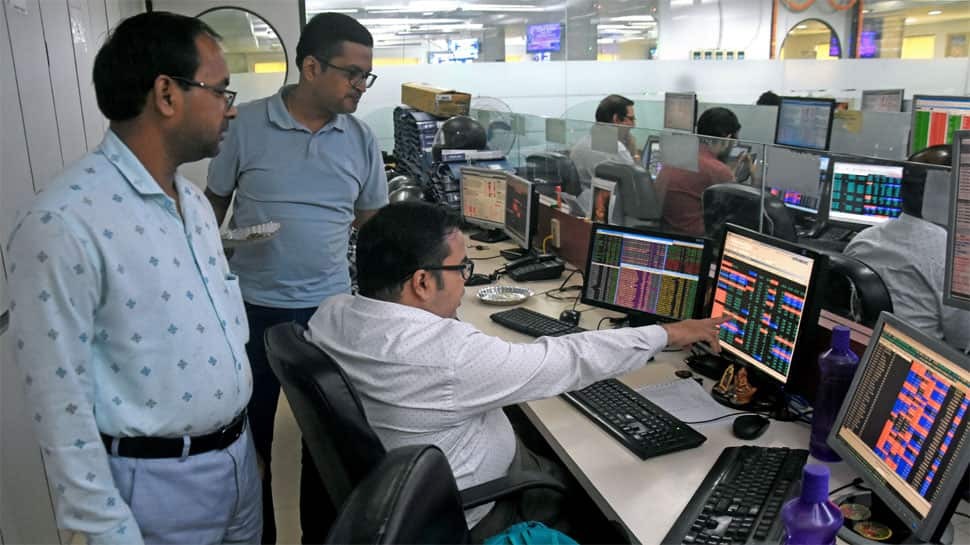
While plans to boost manufacturing, data centers and exports boosted some shares, higher transaction tax on equity derivatives led to investors shunning brokerage stocks. The NSE Nifty 50 Index fell as much as 3% after the announcement, before paring the decline partially.
Sitharaman further detailed plans to unlock the economic potential of urban regions by mapping city economic regions (CERs) tailored to their unique growth drivers. “An allocation of Rs 5,000 crore per CER over five years is proposed for implementing their plans through a challenge mode with a reform-cum-results based financing mechanism,” she said.
India announced measures to invest nearly $133 billion to turbocharge its infrastructure overhaul and boost manufacturing for sectors from textiles to electronic components in its federal budget. It also raised taxes on equity futures to curb speculative trading.
The 90-minute long speech by India’s Finance Minister Nirmala Sitharaman on Sunday to protect the economy at a time of global uncertainty and continuing 50% US tariffs while the trade deal with the country remains elusive.
Live Events
India’s small businesses were also given a 100-billion-rupees growth fund as well as 20-billion-rupees top up on a 2021 self-reliant fund.
While further details are awaited on these announcements, here’s a quick look at sectors which are likely to benefit and lose out:
WINNERS
Pharmaceuticals
India announced an outlay of $1.1 billion over the next five years to boost the production and research for biologics and biosimilar drugs. India wants to be a biopharma manufacturing hub, Sitharaman said, especially as more Indians are diagnosed with non-communicable diseases including diabetes and cancer.
Nifty Pharma Index surged after the announcement, with major players like Sun Pharmaceutical Industries Ltd. and Biocon Ltd. jumping as much as 3.8% and 2.9%, respectively.
Textiles
The apparel makers who have been pummeled by Donald Trump administration’s 50% tariffs, are likely to benefit from a number of policy measures announced, including plans to set up ‘mega textile parks.’
Raymond Ltd. and Trident Ltd. surged more than 8% during trading in Mumbai on Sunday, before giving up some of those gains.
Electronic Manufacturing
India announced a $4.3 billion outlay for electronic components manufacturing to propel an industry which has become a focus area as firms such as Apple Inc. boost their manufacturing in India.
The high-tech pursuits of most of India’s leading conglomerates, such as the Tata Group, Adani Group, Reliance Industries Ltd. and the Godrej Group, are expected to benefit. Shares of local electronics component makers including Amber Enterprises India Ltd., Dixon Technologies India Ltd. and Kaynes Technology India Ltd. gained.
Data Centers
A proposal offering tax holiday for foreign companies providing cloud services globally from India-based data centers through 2047 is a boost for cloud infrastructure companies.
As Alphabet Inc.’s Google and other US tech behemoths pledge billions of dollars to build artificial intelligence infrastructure in India, investors are racing to identify local firms set to benefit from the wave of investments.
Shares of Anant Raj Ltd., which is heavily investing in data centers, jumped as much as 14.2%.
Infrastructure
Shipping stocks gained after the finance minister announced a ship-repair ecosystem and incentives for seaplanes in the annual budget, with Shipping Corp. of India rising as much as 4.3%. Others like Essar Shipping Ltd. and Dredging Corp. of India surged more than 9%.
Additionally, firms like Container Corp. of India Ltd. are set to benefit from cargo and transport sector reforms after India’s federal budget proposed allocations for initiatives including new dedicated freight corridor and high-speed city rail corridors.
LOSERS
Brokers
The government hiked the securities transaction tax on equity futures to 0.05% from 0.02%. The levy on options premium and on the exercise of options was increased to 0.15%.
Shares of the BSE — India’s second-largest stock exchange — and stock brokers including Angle One Ltd. tumbled.
The move marks India’s determination to curb speculative trading after an influx of retail traders made the country the world’s top destination for such products by contracts traded.
State-Owned Banks
Investors and industry leaders were expecting an announcement around consolidation of state-run banks in the budget, as well as a relaxation in foreign shareholding cap in these lenders.
India’s proposal to sell a record amount of bonds in the year starting April 1 could also affect state-run banks, as it risks hurting their treasury incomes.
Shares of banks, including State Bank of India, tumbled with the NSE Nifty PSU Bank Index falling by as much as 7%.
Clean Energy
Clean energy industry had anticipated a rationalization of the tax regime, including lower customs duties for critical components, to accelerate the transition to a net carbon zero economy.
However, as the speech unfolded, these fiscal measures remained elusive, leaving the industry disappointed.India’s largest conglomerates including the Adani, Tata and Reliance groups have invested in the sector.
With inputs from Bloomberg
(You can now subscribe to our Economic Times WhatsApp channel)
Hindustan Zinc has a silver lining. But for how long?
EU trade pact: Should Tata, Mahindra worry about ‘European invasion’?
JSW Infra’s INR1,200-crore shopping of three promoter firms raises eyebrows
Can long-stranded gas plants still save Digital India’s power needs?
Fly91’s bumpy climb mirrors why genuine airline startups struggle in India
Budget & the Stock Market: These 8 budget words & numbers are critical for the stock market – both in the short and long terms
1
2
3