
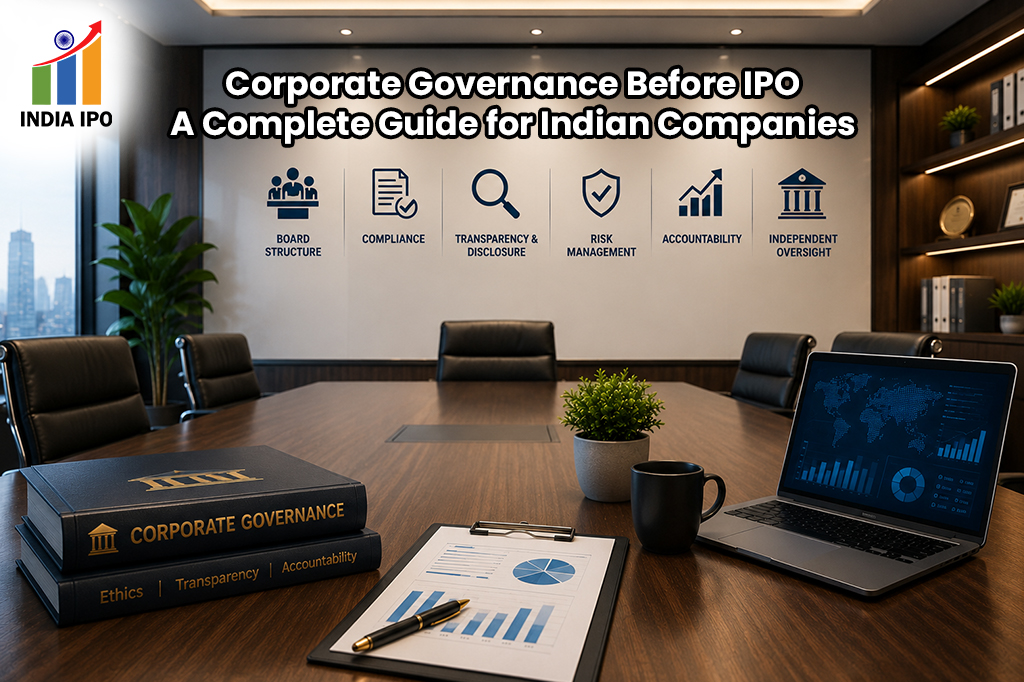
Corporate governance before IPO is one of the most decisive yet underestimated strategic investments a company can make on its journey to the public markets. At its core, corporate governance is the system of rules, practices and processes by which a company is directed and controlled, balancing the interests of founders, shareholders, management and regulators. In simple terms, it defines who decides what, who is accountable to whom and how a company behaves when no one is watching.
Corporate governance before an IPO in India is becoming increasingly important, as SEBI is intensifying oversight of Draft Red Herring Prospectuses. From the very instant you submit it, all your company’s internal matters – board structure, internal control mechanisms, related party dealings and disclosures – come under the regulatory radar, alongside due diligence by the institutional investors and scrutiny by the financial markets.
The connection between governance, valuations and investor confidence is quite clear. Companies with pre-IPO corporate governance practices exhibit lower business risks and greater transparency, resulting in higher valuation multiples during the price discovery phase. Beginning your governance process 12 to 18 months before submitting the IPO prospectus has become a necessity.
IPO readiness corporate governance impacts three essential pillars of a successful listing: investor confidence, valuation premium and risk reduction.
Investor confidence and institutional participation rest heavily on the strength of your governance infrastructure. Domestic mutual funds, FPIs, and anchor investors undertake stringent governance due diligence before allocating capital. Board independence, an effective audit committee and related party transactions are non-negotiable criteria. A company perceived as run by promoters with limited governance oversight struggles to attract high-quality anchor investors, which negatively affects subscription momentum.
The valuation premium is the tangible economic benefit of good governance. Good governance lowers agency risk. Institutional investors are willing to pay higher price earnings ratios for companies where there is alignment of interest between founders and public shareholders and whose accounts are credible. Fulfilling governance requirements before IPO comprehensively positions you to earn a valuation premium over governance deficient companies.
Risk reduction and compliance signalling complete the picture. A governance-ready company signals to SEBI and the market that it is prepared for public market scrutiny. This helps avoid multiple rounds of queries from SEBI when reviewing DRHP, expedites listing and insulates from post listing enforcement proceedings.
Understanding corporate governance requirements for IPO companies in India begins with three regulatory pillars that every pre-IPO company must internalise.
The SEBI (Listing Obligations and Disclosure Requirements) Regulations, 2015, serve as the primary governance code applicable to all listed companies, and their requirements become effective upon filing an IPO. Provisions 15 to 27 are concerned with the composition of the board of directors, duties of committees, disclosure requirements, and related party transactions. There have been considerable changes in the SEBI corporate governance regulations in 2024-2025 with respect to LODR. These changes introduced stricter governance norms, integrated reporting requirements for equity-listed entities and extended governance obligations to entities with listed non-convertible debt securities.
The Companies Act, 2013, lays down the basic statutory governance framework. The Companies Act 2013, under Section 149(4), requires that at least one-third of the directors of a listed company be independent directors. SEBI LODR Regulation 17(1)(b), however, stipulates that where the chairman of a company is a promoter or associated with a promoter, a minimum of 50% of directors should be independent, which is the practical benchmark followed by most Indian companies seeking to go public. This Act requires at least one woman director on the boards of all listed companies.
For both NSE and BSE listings, proof of compliance with SEBI LODR regulations is mandatory. This includes governance disclosures in the prospectus, the establishment of a functioning audit committee and a nomination and remuneration committee, a code of conduct, and the appointment of a Company Secretary. For SME IPOs on NSE Emerge or BSE SME, upfront compliance would include a minimum of 3 years of audited accounts, proper board composition for IPO companies, and 100% dematerialised pre-IPO shares.
Board structure before IPO India is the core of your governance policy. Your governance message will depend upon a well-known, independent and professionally diverse board of directors.
Independent directors IPO requirements under Section 149(4) of the Companies Act, 2013 and SEBI LODR Regulation 17 are clear: There should be a minimum of one-third independent directors on the board. The minimum ratio shall be increased to 50% if the chairperson is also a promoter. Independent directors must not have any relationship or financial interest with the company and its promoters. They should mandatorily register themselves in the Independent Directors Databank of the Ministry of Corporate Affairs.
Separation of Chairman and CEO/Managing Director is the best governance practice recommended by SEBI. However, when the same person serves as both chairman and MD/CEO, the need for independent directors increases.
A skills matrix ensures the board is functionally effective, not just nominally compliant:
|
Role |
Regulatory Requirement |
Governance Purpose |
|
Managing Director / CEO |
Executive; not counted as independent |
Drives operational strategy |
|
Independent Director |
Min. 1/3; 50% if promoter is Chairperson |
Provides objective oversight, checks conflicts |
|
Woman Director |
Mandatory for all listed companies |
Promotes diversity and inclusion |
|
Nominee Director |
As per shareholder/investor agreements |
Represents institutional interests |
|
Chairperson |
Preferably non-executive, non-promoter |
Leads board; ideally separated from CEO role |
Directors need to cover financial reporting, compliance, key business sectors, risk management, and technology so that decisions are based on true competency.
The formation of board committees that actually work is essential to a corporategovernance framework for IPO compliance, especially when going public. These should be operational committees with clear charters, minute books, and competent members, not paper entities created to satisfy a checklist.
|
Committee |
Key Responsibilities |
Mandatory? |
|
Audit Committee |
Financial statement review, internal audit oversight, RPT approvals, auditor independence |
Yes - SEBI LODR Reg. 18 |
|
Nomination & Remuneration Committee |
Director/KMP appointment criteria, performance evaluation, remuneration policy |
Yes - SEBI LODR Reg. 19 |
|
Stakeholders Relationship Committee |
Investor grievance redressal, share transfer, dividend processing |
Yes - SEBI LODR Reg. 20 |
|
Risk Management Committee |
Enterprise risk identification, monitoring and mitigation strategy |
Mandatory for top 1,000 listed cos.; best practice pre-IPO for all |
|
CSR Committee |
CSR policy formulation and spending oversight |
Mandatory if CSR applicability threshold is met |
The audit committee role in IPO compliance during an IPO cannot be stressed enough. As per SEBI LODR Regulation 18, members must possess financial acumen, with at least one holding qualifications in accounting and finance. Committee meetings should be held at least 4 times a year, with no more than 120 days between successive meetings. An efficient Audit Committee is the most significant attribute an IPO-bound company can demonstrate to SEBI and other institutional investors.
This corporate governance checklist before IPO India is a practical readiness assessment tool for companies 6–12 months before filing.
This corporate governance roadmap before IPO, follows a sequential timeline. By following these governance steps before IPO India eliminates sudden governance issues at the time of filing and establishes the corporate governance history that institutional investors require.
12–18 Months Before IPO
9–12 Months Before IPO
6–9 Months Before IPO
3–6 Months Before IPO: Final Readiness
Founders who treat pre-IPO governance best practices India as a mere formality continue to be penalised through delayed listing, valuation discounts, or regulatory action post-listing.
Last-minute compliance rush: Creating a full-fledged corporate governance framework for IPO in 90 days to meet requirements results in inadequate and inconsistent practices that cannot satisfy SEBI guidelines. Several queries triggered by SEBI due to deficiencies in corporate governance can postpone listing for months.
Top 7 Mistakes to Avoid During an SME IPO Filing
Zomato had excellent corporate governance before IPO. Notably, it filed the DRHP despite consistently incurring losses and having only 6 months of cash runway in 2021. Zomato focused more on high-quality disclosures than hiding information from the public. The prospectus was widely appreciated for its detailed information on risks, governance, and business model disclosure. The governance model was so effective that the institutional investors gave Zomato a significant premium despite losses, making the stock 38 times oversubscribed. In summary, corporate governance earns trust even when financial numbers are poor.
Nykaa had one of the best governance structures before its IPO in terms of audit, nomination and remuneration committee (NRC), risk management, stakeholders relationship, CSR and ESG and an IPO committee. The governance structure enabled it to build strong institutions during its 2021 IPO. However, the company faced backlash following the bonus share issue in 2022. Notably, 79.4% of institutional investors rejected the proposal, which was ultimately approved using promoters' votes. The lesson is that when going public, corporate governance should include a long-term governance model.
India's one of the largest IPOs worth ₹18,300 crore serves as the classic case in point to understand the need for the neglected corporate governance guidelines applicable to IPOs in India. The issue related to the structure of the company's board of directors, Regulation 17 issues, the lack of separation of governance between Paytm and Paytm Payments Bank, and the murky related-party structure caused Paytm to collapse immediately after listing. This was further confirmed when the RBI acted against Paytm Payments Bank due to its failure to adhere to guidelines. In summary, governance shortcuts never stay hidden; they surface at the worst possible moment.
SME IPO governance India is embedded within a unique yet inflexible system of compliance. Corporations seeking to be listed on NSE Emerge or BSE SME need to demonstrate governance preparedness in line with corporate governance standards for IPO companies, proportionate to their size.
|
Aspect |
SME IPO |
|
|
Board independence |
50% IDs if promoter is chairperson |
At least 2 independent directors |
|
Risk Management Committee |
Mandatory for top 1,000 listed cos. |
Best practice; not mandated |
|
Mandatory Committees |
Full set from Day 1 |
Audit, NRC, SRC mandatory |
|
IND-AS compliance |
Full IND-AS required |
Applicable based on threshold |
|
Disclosure norms |
Comprehensive LODR compliance |
Simplified but SEBI-aligned |
The most difficult issue regarding corporate governance for SME IPOs is the transition from family-dominated boards to independent boards. Other consistent issues include: a lack of internal audit processes; a lack of documentation of related-party transactions involving promoters; ad hoc and informal approaches to human resources and remuneration issues that will not pass regulatory muster; and, finally, a complete lack of risk management process documentation. The key is that SMEs that commit to corporate governance before an IPO do much better.
How to prepare corporate governance before IPO in India is ultimately a question of mindset before it is a question of compliance. For most Indian founders, governance feels like a constraint on the control they've exercised throughout the company's growth phase. The required shift is fundamental: governance is not about surrendering control, it is about earning the credibility to exercise it at a far larger scale, with far greater accountability.
From control to accountability: The founders of listed companies must make decisions with accountability through board oversight, audit committee oversight, and market oversight. The level of accountability, once internalised, will become the firm's strongest reputation asset. What institutional investors and public shareholders invest in is not only your model but also your governance.
Long-term governance mindset: Pre-IPO corporate governance built only to satisfy SEBI will fracture under post-listing pressure. The founders who build enduring public companies are those who internalise governance as an operating philosophy where board meetings are forums for genuine strategic debate, risk committees identify real exposures and independent directors are selected for their willingness to challenge, not their willingness to comply.
|
Category |
Readiness |
|
Board - Composition compliant, IDs appointed, woman director, skills matrix documented |
✔ |
|
Committees - Audit, NRC, SRC, Risk Management constituted with charters and minutes |
✔ |
|
Policies - Code of Conduct, Insider Trading, Whistle-blower, RPT Policy adopted |
✔ |
|
Financial Systems - IND-AS financials (3 years), internal audit operational, ICFR documented |
✔ |
|
Compliance - Company Secretary appointed, secretarial audit done, legal due diligence complete |
✔ |
|
Disclosures - CG report drafted, DRHP governance disclosures reviewed, litigations disclosed |
✔ |
Corporate governance before IPO is not a compliance checkbox; it is a strategic investment that can make all the difference to how you perform in the public markets. The data is irrefutable in India's very own IPO market: companies that invest in developing a sound IPO readiness corporate governance infrastructure ahead of time enjoy a premium valuation, attract more institutional interest and face fewer regulatory hurdles en route to listing.
Paytm is an example of what can go wrong if you do not have strong governance from day one through many years. Zomato has shown that even without profits, pricing power is possible when the market trusts your system and your people.
The message to each Indian founder who seeks to launch his or her company into a public market listing could not be more straightforward: start laying out your corporate governance before IPO in India at least 12 to 18 months before filing your DRHP. With every passing month dedicated to improving your board and committee processes, internal controls, and disclosures, your chances of minimising execution risks, maximising valuation, and succeeding as a publicly held company improve by leaps and bounds
Read More About : SEBI's Vision 2030
The INDIA IPO Publication is managed by an editorial team that includes highly experienced finance journalists, market researchers and professionals from the capital markets industry who strive to create high-quality content based on credible sources. Our editors write about IPOs, capital markets, corporate news, capital-raising strategies, regulations and other business matters to ensure our audience stays updated with the latest information. We conduct detailed research and fact-check all information before publishing any content to ensure credibility.
Next Reading
Strategic IPO Planning
Join hundreds of founders who scaled their vision with India's most trusted public listing advisory network.
Verify EligibilityQuick IPO Resources
Trending News