
The history of the capital market in India over the last five years has not been gradual but an evolution so radical that it altered how participants function and how companies accessed capital, while changing India's position relative to the world's best listing options. The story of SEBI IPO regulations in India over the last decade begins with figures: there has been a sixfold jump from 36 million demat accounts in 2019 to over 224+ million by Q1, 2026. A new record for the addition of demat accounts by domestic brokerages in a year was set in FY 2025, with 41.1 million accounts added. Over 365 IPOs worth ₹1.95 lakh crore were made in India in 2025, compared to a record of ₹1.90 lakh crore raised from 336 IPOs in 2024.
By way of background, India was far ahead of all the European stock exchanges in terms of volume of IPOs by 2025, with even the mainboard raising ₹1.75 lakh crore via 103 IPOs, making the goal of SEBI Vision 2030 to be among the top three exchanges of the world a reality and the next step forward after being in the fourth position.
This is not market momentum. This is a civilisational shift.
And in this background, even SEBI has changed to the same extent over time. The evolution of SEBI's IPO norms over the years is simple: from an enforcement-first police officer to what can only be termed a market architect. This institution determines exactly how capital flows, who gets access to it, and under what conditions trust naturally develops between companies and public investors.
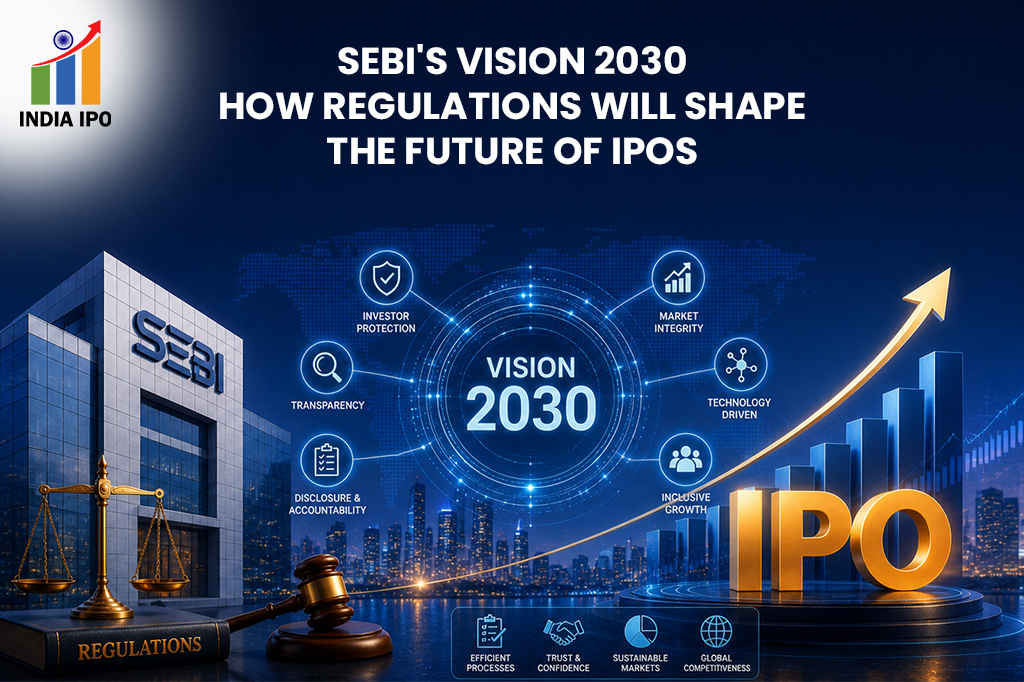
The focus of this article is clear: the SEBI new IPO reforms introduced across the 2024–26 window are not incremental tweaks. They represent capital market re-engineering. As per SEBI's Vision 2030 regulatory framework, it will lay out the rules for who lists, how they list, and what protections investors get, and also determine whether India becomes one of the most sophisticated, trusted capital markets on earth by 2030. The future of the IPO market in India will not experience a serendipitous revival; it will be engineered back to life through one regulation after another.
To figure out where SEBI is headed, we need to understand its past actions better. The story behind the evolution of SEBI IPO norms, spanning four phases, indeed speaks of a maturing regulator.
The features of the early capital market in India after reforms include a paper-based filing system, high barriers to entry, and a conservative regulatory approach owing to market manipulations that prevailed during the early 1990s. The retail investor's involvement was insignificant; state-owned companies and certain industry segments were largely responsible for the listing.
The new SEBI that emerged in India in the decade after the global financial crisis emerged as a transformed entity that recognised corporate governance as an imperative in the marketplace. It enforced stricter disclosure standards, imposed stricter capital requirements for promoters, standardised IPO lock-in periods, and implemented stricter scrutiny of Related Party Transactions. The LODR Regulations introduced by SEBI in 2015 were the most exhaustive governance guidelines ever issued in India.
But the COVID-19 pandemic brought out a new cohort of first-time investors. SEBI reacted by facilitating reforms: UPI-based IPO applications exploded via ASBA, IPO listing period was reduced from T+6 to T+3, and the framework was tweaked to allow new-age tech startups that may not be profitable for 3 years. At this time, shares of listed companies owned by domestic institutions increased from 13% to 20%.
This period is fundamentally distinct from the others. It marks the dawn of the SEBI IPO reform era of 2025, an epoch of forward-thinking structuring instead of retroactive adjustment, using risk-based regulation, technology-based regulation and strategic restructuring of existing systems. At the landmark 211th meeting of the SEBI Board in September 2025, major reforms were proposed regarding the IPO structure, rules governing anchor investors, the duration of public holding, AIF investment norms, and ESG guidelines. These reforms are neither remedial nor incremental; rather, they completely replace the old system.
The SEBI regulatory changes for IPOs affecting startup and founder-led companies are among the most consequential of this reform cycle. The old framework, designed for asset-heavy industrial companies with predictable earnings, was structurally hostile to India's startup economy. The new framework corrects this architecturally.
Liberalised ESOP treatment under the revised ICDR framework allows founders and early employees to retain stock options under a more flexible post-IPO lock-in regime, directly addressing the talent retention crisis that plagued the first generation of tech IPOs. Differential Voting Rights (DVR) frameworks have been progressively clarified, giving founders the ability to maintain strategic control even after public listing, a provision critical for founder-led conglomerates considering an offer for sale (OFS) as part of their listing structure.
For SME IPOs, SEBI tightened OFS rules through the March 2025 ICDR amendment framework by capping OFS at 20% of issue size and restricting each selling shareholder from offloading more than 50% of pre-issue shareholding on a fully diluted basis. This reform prevents the perverse scenario in which promoters use public markets solely as a personal exit vehicle. SEBI’s ICDR Amendment Regulations, 2026 further streamlined the public issue framework by requiring a draft abridged prospectus to be filed along with the draft offer document and rationalising the format of investor-facing disclosures, thereby improving early-stage access to key issue information.
The success of the founder-friendly changes at SEBI is evident in the IPO pipeline. By April 2026, there were 128 unicorns in India, with a collective valuation of more than $391 billion and total funding of $118 billion. The 2026 IPO pipeline has been one of the strongest in history, with 21 startups already filing their DRHPs with SEBI, and 25 more startups at various stages planning their IPOs this year. Zepto, the quick-commerce unicorn, received SEBI approval for an IPO of ₹11,000 crore in April 2026, with a listing in July–September 2026. Unicorns like Flipkart, Zepto, OYO, InMobi, Fractal, and Zetwerk could raise over ₹50,000 crore in their public offerings. India's IPO pipeline for 2026 includes nearly 200 companies with plans to raise over ₹2.6 lakh crore, of which 103 companies are awaiting regulatory approvals to raise ₹1.39 lakh crore.
In a speech delivered in February 2026, the Chairman of SEBI, Mr. Tuhin Kanta Pandey, stated India’s capital markets should be “transparent, well-governed, and investable for long-term institutional capital”. This is why SEBI has used the SWAGAT-FI framework. This single-window access mechanism simplifies registration and compliance for trusted foreign investors, alongside a consolidated India Market Access portal that centralises foreign investor engagement.
Simplified FPI registration, reduced disclosure friction and faster vetting timelines are designed to attract long-duration capital from global pension funds and sovereign wealth funds. The SEBI IPO regulations update on foreign investor participation directly acknowledges that domestic institutional ownership, while rising, remains insufficient to provide counter-cyclical market stability during global risk-off events. Anchoring foreign capital through regulatory clarity is SEBI's answer to that structural vulnerability.
The SME IPO segment has been one of India’s most vibrant but also most scrutinised capital market stories and the SEBI new IPO reforms reflect that dual reality. NSE revised the eligibility criteria for migration from the NSE SME Platform to the Main Board through its circular dated April 24, 2025, effective May 1, 2025. The revised framework includes, among other conditions, revenue from operations above ₹100 crore in the previous financial year, net worth of at least ₹75 crore, listing on the SME platform for at least three years, minimum paid-up equity capital of ₹10 crore, average market capitalisation of at least ₹100 crore, and positive operating profit from operations for at least two out of the preceding three financial years.
This is not tinkering with the rules; it is a quality filter. Under the 2025 SME framework tightening, where there is a change in promoters involving more than 51% change, the DRHP may be filed only after the lapse of one year from such a change. On the PSU side, SEBI’s June 2025 board process approved a special framework for voluntary delisting of eligible public sector undertakings, marking a parallel effort to recalibrate capital-market access and exit routes within a more structured regulatory architecture.
There has always been a reputation gap when comparing India with international listing centres on one feature – regulatory speed. The SEBI IPO reforms 2025 have directly addressed it. The mandatory listing cycle T+3, in effect since December 2023, means that the period from closing an IPO to its availability for trading is shortened to only three workdays, the same as in the most effective markets. Moreover, the introduction of additional ICDR reforms in March 2026 standardises the DRHP process and eliminates potential ambiguity, thereby reducing the need for lengthy inquiries from regulators.
The trend is obvious: India seeks to compete with Singapore, London, and New York in terms of listing efficiency as well. Defined DRHP review timelines, reduced ambiguity in regulatory queries and standardised documentation requirements are the infrastructure of this competition.
One of the most important changes introduced by SEBI regulations in 2025 concerns the timeframe for attaining Minimum Public Shareholding. This three-year timeframe was very tough on major corporate houses and family businesses in India, which have refused to list due to the urgency and challenges of attaining Minimum Public Shareholding.
Under Section 80 of the Securities Contracts (Regulation) Rules, as amended in September 2025, there is a phased implementation period, depending on the market capitalisation after IPO:
This is a clear structural compromise made for India's corporate giants. The expected consequence: several large private firms and family-led conglomerates previously reluctant to list will find the IPO route genuinely viable for the first time.
There has been a complete overhaul of the anchor investor framework under the amendment passed by the ICDR in November 2025. The earlier guidelines provided for 15 anchor investors for an allocation of ₹250 crore, and then another 10 for every additional ₹250 crore. The revised anchor investor framework expands this to 15 additional investors per ₹250-crore block for allocations above ₹250 crore.
More significantly, 40% of the anchor investor portion is now formally reserved, with one-third earmarked for domestic mutual funds and two-thirds specifically reserved for life insurance companies and pension funds. This is an insertion of long-term capital within the structure of the listing process. Insurance companies and pension funds inherently have no reason to run from volatility. It is because these firms have been made to act as the anchor investors that SEBI can ensure price stability. Anchor investors are no longer just validators of the offer price; they are becoming the primary volatility dampeners of India's IPO market.
The 35% quota for retail investors remains unchanged, and this should not be overlooked; it is a signal. The participation of retail investors is the core of the Indian story of democratising the capital market. Cutting down on retail quotas at the expense of institutions' convenience would weaken the social/political consensus that shapes India’s IPO market. With rising domestic institutional shareholding and greater retail participation driven by mutual fund investments through SIPs, India’s capital markets are gaining organic strength that cannot be replicated even by the largest number of foreign investors. Retail investors submitted over 7.3 crore applications across mainboard IPOs in 2024 alone; a participation base that no institutional reconfiguration can afford to alienate.
The current lock-in framework in Indian IPOs must be read separately for mainboard and SME issues, because the two segments now follow distinct rules in important respects.
The amendment to the SEBI IPO regulations, as of the December 17, 2025, Board Meeting, included a highly important step regarding the non-transferability of pledged shares held by non-promoters of the company going for an IPO. In this case, the depository itself would classify such pledged shares as non-transferable. While the lock-in period durations themselves did not change in December 2025, the enforcement mechanism was fundamentally upgraded.
The OFS regulations have traditionally been a pressure point, enabling initial shareholders, including promoters and private equity investors, to exit their investments at the expense of new public investors entering the deal. These concerns have been addressed in the new IPO regulations by SEBI through dual level discipline in the OFS:
These rules ensure that IPOs are not just a means to an end for promoters, making it difficult for them to raise capital while simultaneously exiting. While the main board IPOs offer more flexibility regarding OFS structures, the trend is increasingly towards mandating significant primary offerings with secondary offerings.
SEBI IPO guidelines for investor protection are no longer mere compliance measures; they are now built to be proactive and technology-driven. The board approved, at its December 2025 meeting, a standardised offer document summary, available from the DRHP filing stage, that outlines the critical risks, financials, and use of funds in simple terms. Pledged shares are now automatically locked in by depositories, eliminating a significant channel of promoter abuse.
Enhanced risk disclosures in the DRHP, tightened lock-in norms, monitoring of IPO proceeds usage with mandatory utilisation certifications and strengthened Related Party Transaction scrutiny are the immediate deliverables of the SEBI IPO regulations update 2025 cycle.
Looking toward 2030, the frontier of investor protection will be technology-driven. Prospectus screening using AI will detect inconsistencies in disclosure and financial irregularities. Public red-flag analysis dashboards will enable retail investors to receive algorithmic signals on IPO quality before bidding. The real-time compliance monitoring, now being implemented by SEBI, NSE, BSE, and the Ministry of Corporate Affairs, will help shift the compliance approach from periodic to real-time for listed companies.
One of the most discussed and until recently, entirely unregulated dimensions of India's IPO ecosystem is the Grey Market Premium (GMP).
The GMP, therefore, is the unregulated indicative price at which IPO shares are traded before their listing. Although the GMP lacks regulatory backing, it is used by retail buyers as an indication of the listing-day expectation, thereby creating a shadow price discovery mechanism.
Tuhin Kanta Pandey, chairman of SEBI, gave a clear signal in August, 2025 that SEBI would be examining a "narrowly scoped regulatory framework specifically for the 'to-be-listed' market," but not the entire unlisted securities market.
SEBI is exploring a regulated pre-listing trading platform informally called the "when-listed" market that would allow investors to trade allotted IPO shares in a transparent, exchange-supervised environment during the T+3 window between allotment and listing. This would replace unregulated grey-market activity with monitored price discovery, reduce listing-day volatility driven by GMP speculation, and boost tax compliance on pre-listing gains.
In relation to 2030, the regulation of the pre-listing market will constitute an important structural change, as it will turn GMP from hearsay on the streets into a legitimate price indicator available to everyone without discrimination.
The nature of capital itself has changed; it is no longer impartial. The BRSR framework, which applies to the 1,000 largest companies listed on stock exchanges, requires reporting on carbon dioxide emissions, water consumption, women’s participation, pay parity, and occupational health and safety, all verified independently against the BRSR Core metrics. As per SEBI’s March 2025 revisions to the BRSR regime, two additional leadership parameters for green credits have been included, extending voluntary ESG value-chain reporting to the top 250 listed companies from FY2025-26 onward.
A far more audacious attempt would be that of SSE itself, which has been expanded with widened eligibility criteria, as approved by SEBI in June 2025. With this step, social enterprises would gain access to capital through impact investors in a dedicated exchange marketplace. In the decade ahead till 2030, climate scenario disclosure is becoming mandatory under the DRHP, ESG score incorporation into institutional allocations, and an ESG premium in the IPO valuation of sustainable companies, enabling lower capital costs and stronger institutional subscription.
India has already built an IPO infrastructure stack among the most technologically advanced in the world. The implementation of the UPI-ASBA regime has made retail applications for participation in an IPO a 30-second process using mobile devices. The T+3 listing cycle commenced operations in December 2023. The fully dematerialised allotment process, integrated across NSDL and CDSL and the forthcoming integration between SEBI, RBI and MCA regulatory databases are creating a unified regulatory intelligence layer with no parallel in most emerging markets.
The 2030 vision for the regulatory tech stack:
The ecosystem around the IPO process, the pre-IPO fund-raising chain, participation discipline and institutional behaviour post-IPO listing is attracting as much regulatory oversight as the IPO process itself. The June 2025 SEBI Board approved a new Co-Investment Scheme Framework for Category I & II AIFs, and a revamped regulatory framework for angel funds. This brings into sharper focus the pre-IPO fund-raising activity under a better regulatory regime.
The Expanded Demat Mandate for Pre-IPO Stakeholders, announced by SEBI in June 2025, ensures that all stakeholders of pre-IPO companies can be traced and their ownership digitalised before any IPO application process is even considered. The mandatory lock-in arrangement for all pledged shares in depositories further seals a gap that had undermined the enforcement of IPO lock-in norms in previous cycles. Sponsors' rules for "skin in the game" require promoters to remain economically invested even after an IPO listing. Moving towards 2030, the ultimate aim would be a comprehensive IPO-readiness certificate system in which governance, financial, and ESG benchmark compliance are mandated before DRHP filing.
The IPO distribution framework in India has been characterised by misaligned incentives in the past. The revision of SEBI IPO regulations at the board meeting in December 2025 has included the revised stockbroker regulation framework and regulations for the distribution of mutual funds, with limitations on exit loads and disclosure norms for distributors. The rationalisation of the shortened prospectus, as an outcome of SEBI's IPO reforms, aims to increase retail investors' access to information.
By 2030, the IPO distribution process is expected to incorporate algorithms that assign IPO subscriptions to different categories of investors based on demand signals and conflict-free distribution, with robo-advisor tools providing impartial scoring of IPOs without the distribution bias associated with intermediaries' commissions.
Each regulatory system that looks forward must acknowledge its core contradiction. For SEBI, this would be a trade-off between capital flexibility, required to attract quality businesses and international investors, and market stability, necessary to maintain retail confidence in markets that can be tumultuous.
The instruments used by SEBI include: price band systems to control listing-day volatility; promoter participation to protect stakeholder interests; revamped lock-in period norms to prevent promoters from exiting immediately after listing; and exchange-level controls on volatility. Higher EBITDA thresholds and more rigorous migration criteria for the SME segment illustrate SEBI's view that quality and dynamics are complementary, not contradictory.
The increased timeline of minimum public holding for large-cap stocks represents a measured form of liberalisation. SEBI recognises that requiring forced equity dilution of ₹5 lakh crore businesses within three years does not serve either the corporation or public markets. Here, SEBI Vision 2030 is not about deregulation but regulated freedom.
Imagine Q3 2030. A D2C consumer brand headquartered in Jaipur, founded by a 32-year-old entrepreneur, backed by a Category II AIF from Pune and a Singapore-based growth fund, is preparing its IPO. The DRHP has been drafted with an AI-assisted disclosure engine that automatically flags related-party transactions, benchmarks risk factor language against a regulatory library of 800 previous DRHPs and generates a standardised summary in Hindi and English simultaneously.
SEBI's review, powered by a machine learning compliance layer, generates a preliminary query list within 72 hours. There is an anchor investor framework with 28 institutional anchors comprising of NPS pension funds and two life insurers regulated by IRDAI, all available under the 2025 anchor investor reforms. The OFS regulations stipulate that no more than 50% of an investor’s prior holding may be sold in an OFS, while also ensuring a meaningful primary issuance of growth capital.
Retail investors use the IPO scoring tool in the investment application, which combines ESG disclosures, the financial quality score, the extent of anchor investors’ involvement, and grey-market sentiment. The allotment process takes one day post-trade. Refunds are immediate.
In the meantime, a precision engineering SME company in the state of Madhya Pradesh, which has earned revenues worth ₹120 crore, moves out of the NSE Emerge into the Mainboard, facilitated by the updated entry rules, and joins an expanding Mainboard from about 5,000 companies in 2024 to over 8,000 companies by 2030. Retail investors can invest through fractional IPOs with as little as ₹100. Simultaneous global listings, enabled by convergence between SEBI and SEC/FCA frameworks, allow Indian conglomerates to access domestic and international capital in a single offering.
Every element described above is the logical extension of SEBI IPO reforms already in force or formally proposed.
No honest vision document ignores risks.
India's IPO market has reached a rare inflexion point, where the regulatory architecture itself becomes a source of competitive advantage. The SEBI IPO reforms 2025 are not a response to market failure; they anticipate the market India wants to build by 2030. Every structural change, the tiered minimum public shareholding framework, the expanded anchor investor framework, the ESG disclosure architecture, the disciplined offer for sale (OFS) rules, the redesigned IPO lock-in norms and the T+3 listing cycle, is a deliberate investment in the credibility of India's capital markets as a global institution.
It is trust, compounded over time, which elevates a big market to the status of a great market. The lesson for founders is transparency. For international investors, it is consistency. For retail investors, their investments need to be safeguarded, strengthened, and enhanced.
India's position in the international IPO table justifies such a bold objective. As of 2025, India's main board witnessed 103 IPOs amounting to ₹1,75,901 crore, while the overall money raised through IPOs on both the main board and the SME board was ₹1.95 lakh crore. By the number of IPOs and the money raised from them, India ranks fourth in the global IPO league table. The gap to the top three US, China and one rotating contender, is now a matter of regulatory confidence, not capital depth. SEBI's Vision 2030 closes that gap.
The future of the IPO market in India will not be accidental. It will be the product of every regulatory decision being made today, under every SEBI regulatory change of this decade.
India's IPO market in 2030 will not simply be larger; it will be engineered, intelligent and globally respected
The INDIA IPO Publication is managed by an editorial team that includes highly experienced finance journalists, market researchers and professionals from the capital markets industry who strive to create high-quality content based on credible sources. Our editors write about IPOs, capital markets, corporate news, capital-raising strategies, regulations and other business matters to ensure our audience stays updated with the latest information. We conduct detailed research and fact-check all information before publishing any content to ensure credibility.
Next Reading
Strategic IPO Planning
Join hundreds of founders who scaled their vision with India's most trusted public listing advisory network.
Verify EligibilityQuick IPO Resources
Trending News