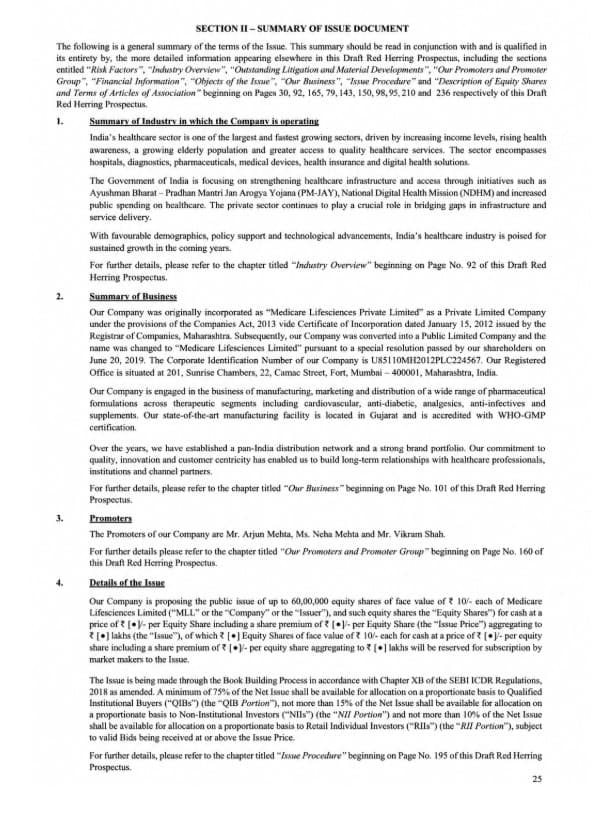
DRHP Introduction
A Draft Red Herring Prospectus (DRHP) is a preliminary offer document prepared before an IPO that contains detailed disclosures about the issuer and the proposed offer. Certain final offer details, including the final offer price and other issue–related particulars, may be determined and disclosed at a subsequent stage.
For an SME IPO, the issuer must satisfy the eligibility criteria prescribed under the applicable SEBI ICDR framework and the specific requirements of the SME stock exchange on which it proposes to list. These requirements may differ between NSE Emerge and BSE SME.
For SME IPO–DRHP filing, the criteria set require companies to meet prescribed financial, governance, disclosure and compliance standards, ensuring they are operationally sound, transparent and suitable for listing on SME stock exchanges.
| Eligibility Criteria | NSE Emerge | BSE SME |
|---|---|---|
| Company Type | Incorporated in India under the Companies Act, 1956/2013 in India. | Incorporated in India under the Companies Act, 1956/2013 in India. |
| Post-Issue Paid-up Capital | The company’s post-issue paid-up capital (face value) shall not exceed ₹25 crore. | The post-issue paid-up capital of the company (face value) shall not be more than ₹25 crore. |
| Track Record | Track record of at least three years of either (i) the applicant seeking listing; (ii) the promoters/promoting company, incorporated in or outside India; or (iii) a proprietary/partnership firm subsequently converted into a company. | Track record of at least three years. If the company does not have a three-year track record, the project should be appraised and funded by NABARD, SIDBI, a scheduled bank other than a co-operative bank, or a financial institution, and the company should have at least one full financial year of operations, supported by audited financial statements for that year |
| Net Worth | Net worth should be positive. | Net worth of at least Rs. 1 crore for the preceding two full financial years |
| Minimum Operating Profit (EBITDA) | Operating profit of at least Rs. 1 crore from operations for any two out of the previous three financial years, and positive free cash flow to equity to the company in at least two of the preceding three financial years. | Minimum operating profit (EBITDA) of ₹1 crore from operations in at least 2 of the last 3 financial years. BSE SME does not separately require positive FCFE. |
| Net Tangible Assets | Positive net tangible assets | ₹3 crores in the last preceding (full) financial year |
| OFS Cap | OFS by selling shareholders in an SME IPO shall not exceed 20% of the total issue size, and selling shareholders cannot sell more than 50% of their holding | Same as NSE Emerge |
| Minimum Allottees | Minimum 200 allottees required (increased from 50). | Same as NSE Emerge |
| Minimum Application Size | Minimum application is 2 lots (minimum investment of ₹2 lakh). Previous norm was 1 lot / ₹1 lakh. | Same as NSE Emerge |
| Post-Conversion Waiting Period | Entities that have converted from a proprietorship, partnership firm or LLP must have completed at least 1 full financial year as a company before filing the DRHP. | Same as NSE Emerge |
| Promoter Change Cooling-Off | Where there has been a complete change of promoters, or where incoming promoters have acquired more than 50% of the company’s shares, the issuer must observe a 1-year cooling-off period before filing the DRHP. | Same as NSE Emerge |
| Outstanding Convertible Securities | Issuers with outstanding convertible securities or any subsisting rights to acquire equity shares are ineligible to file for an SME IPO, except where such rights arise solely from ESOPs granted to employees. | Same as NSE Emerge |
| Promoters’ Experience | Promoters should have at least three years’ experience in the same line of business and should hold at least 20% of the post-issue equity share capital, individually or severally | Same as NSE Emerge |
| Dematerialised Shares | Mandatory | Mandatory |
| Merchant Banker | SEBI-registered Merchant Banker mandatory | SEBI-registered Merchant Banker mandatory |
| Registrar to the Issue (RTI) | Mandatory | Mandatory |
| Underwriting | 100% underwriting mandatory | 100% underwriting mandatory |
| Market Maker | Mandatory (minimum 3 years) | Mandatory (minimum 3 years) |
| Corporate Governance | Compliance with Companies Act, SEBI ICDR Regulations and NSE Emerge requirements | Compliance with Companies Act, SEBI ICDR Regulations and BSE SME requirements |
| Financial Statements | Audited financial statements as per applicable accounting standards | Audited financial statements as per applicable accounting standards |
| Legal & Regulatory Compliance | No material regulatory defaults affecting listing | No material regulatory defaults affecting listing |
| Minimum Public Shareholding | As prescribed under SEBI regulations | As prescribed under SEBI regulations |
A company planning an SME IPO must comply with the applicable eligibility, disclosure, governance and listing requirements. The draft offer document plays a critical role by providing prospective investors and other stakeholders with material information about the issuer, the proposed offer and the associated risks in a balanced and non-promotional manner.
Cover Page of DRHP — Format
The cover page of the DRHP is the formal gateway to the offer document and SEBI prescribes its content closely.
The cover page of a DRHP is the introductory page that provides key information about the proposed IPO, including the issuer’s name, issue type, face value, lead managers, stock exchanges, and important disclaimers. It serves as the first reference point, helping investors quickly identify the offering and its regulatory status.
A properly formatted DRHP cover page typically includes the following:
- Company name, registered office address and corporate identity number (CIN)
- Nature and type of the issue (fresh issue, offer for sale, or a combination)
- Names of the Lead Manager(s), Registrar to the Issue and other key intermediaries
- The designated stock exchange(s) — for SME IPOs, this is NSE Emerge and/or BSE SME
- A general risk disclosure statement directing investors to the "Risk Factors" section
- Details of any promoter or director who has faced SEBI disciplinary action, been declared a wilful defaulter, or been named a fraudulent borrower in the preceding period — this disclosure is required prominently on the cover page of the offer document
- The cover page should contain the disclosures prescribed under the applicable SEBI ICDR requirements and Schedule VI, together with the relevant issue and intermediary details available at the draft offer document stage
Public Availability of SME DRHP: For SME IPOs, the DRHP filed with the stock exchange must be made available to the public for a minimum period of 21 days from the date of the public announcement. The issuer is required to publish a newspaper notice within 2 working days of filing the DRHP, and this notice must include a QR code providing direct investor access to the document. This public comment window is a mandatory checkpoint in the SME IPO filing timeline and did not exist under the pre-2025 framework.
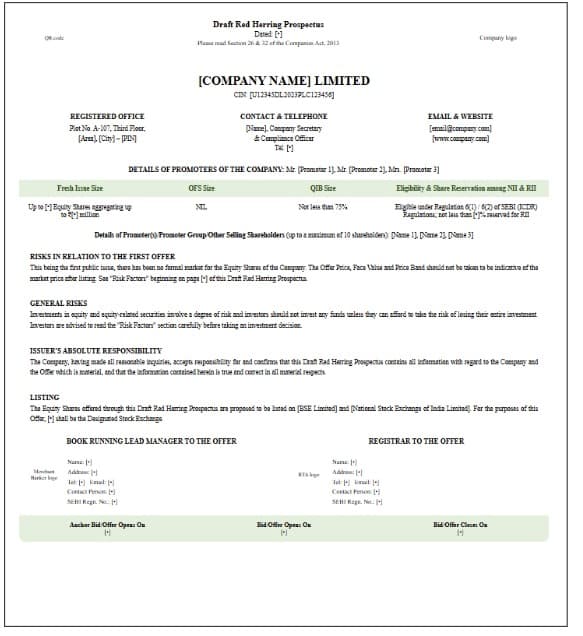
The cover page should follow the prescribed disclosure format and applicable regulatory and stock exchange requirements to facilitate an efficient review of the draft offer document.
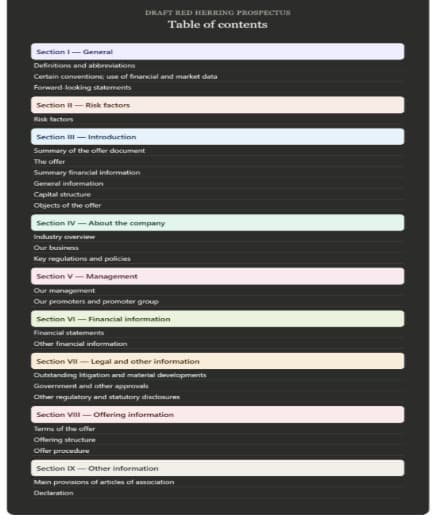
Table of Contents
In a DRHP, the table of contents serves as an important navigational guide and should reflect the structure and sequencing of disclosures prescribed under the applicable SEBI ICDR requirements.
If you go to any table of contents, you will typically open with definitions and abbreviations, move into a summary of the offer document, then cover risk factors, followed by sections on the business, industry, management, financial statements, legal proceedings and finally issue–related information and material contracts available for inspection.
A clear and logically sequenced Table of Contents helps readers and the reviewing authorities navigate the offer document and locate the required disclosures efficiently.
General Information — IPO Format for DRHP Filing
The "General Information" section in DRHP functions as an administrative anchor for the entire document. It typically discloses the company's incorporation details and Corporate Identification Number (CIN); the addresses of its registered and corporate offices; details of statutory auditors and legal counsel; the names and SEBI registration numbers of all intermediaries (Lead Manager, Registrar and Bankers to the Issue); the designated stock exchange for the SME platform and the credit rating (where applicable, though SME issuers of equity shares are not always required to obtain one).
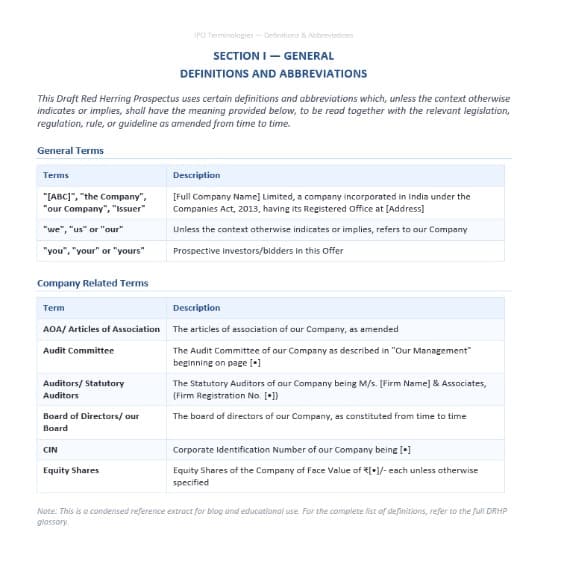
This section may also provide relevant information regarding the issuer's eligibility for the proposed SME listing. The applicable eligibility requirements should be assessed under the prevailing SEBI ICDR framework together with the specific criteria prescribed by the relevant SME stock exchange.
Summary of DRHP
The Summary section organises the entire DRHP into a concise overview and provides answers to such questions as what the company does, why it is raising capital, how much is being raised (in ranges, since exact figures follow later), the key strengths the company is presenting and a snapshot of financial performance over the restated period.
It exists because most retail investors will never read all 500+ pages of a DRHP, but it is designed to be the first and sometimes only section many readers engage with in depth, as it provides the answers to all the questions which can come into the mind of a reader, which is exactly why SEBI requires it to be accurate and non-misleading rather than promotional in tone.