Summary of Offer Document
The "Summary of the Offer Document" is a mandatory disclosure chapter under SEBI (ICDR) Regulations, 2018, appearing early in the DRHP to give prospective investors a concise, structured snapshot of the offer before they navigate the full prospectus. It consolidates the most decision-critical facts from across the document into a single, easily referenced section.
Key components covered under this section:1. Nature and Structure of the Offer
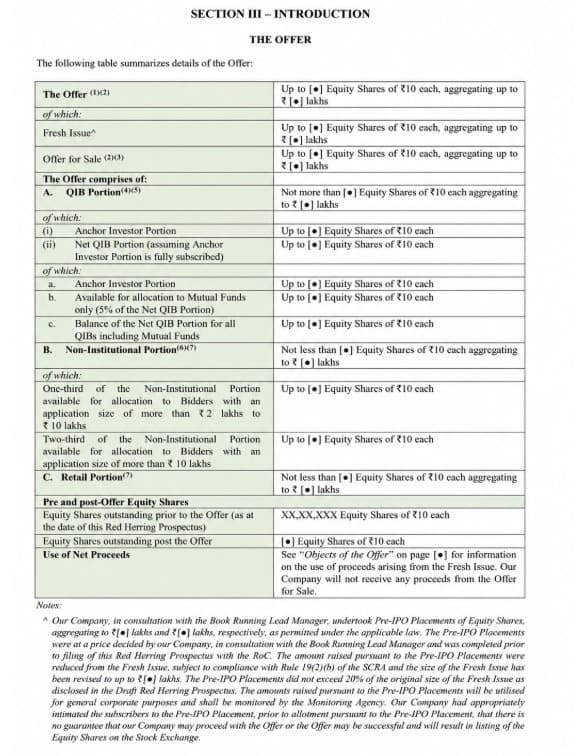
It specifies whether the issue is a Fresh Issue (new capital raised by the company), an Offer for Sale (OFS) (existing shareholders divesting stake, with no fresh funds to the company), or a combination of both, along with the respective proportions and objects for which fresh issue proceeds will be utilised.
2. Face Value and Price Details
States the face value per equity share and other relevant details of the proposed offer. Where the price band or final offer price has not been determined at the draft stage, such information is disclosed at the applicable subsequent stage of the IPO process.
3. Eligibility Route for Listing
Discloses the eligibility criteria applicable to the issuer under the SEBI ICDR Regulations and the requirements of the relevant SME stock exchange. These may include requirements relating to track record, financial performance, net worth and other conditions prescribed by the applicable SME platform.
4. Pre- and Post-Issue Shareholding Pattern
Presents a comparative snapshot of promoter, promoter group and public shareholding before and after the offer, allowing investors to assess dilution impact and post-listing ownership structure.
5. Investor Categories and Participants
Identifies the classes of investors participating in the issue:- Qualified Institutional Buyers (QIBs) — mutual funds, banks, FIIs, insurance companies, etc.
- Anchor Investors (if applicable) — QIBs allotted shares a day before the offer opening under SEBI's anchor investor framework
- Non-Institutional Investors (NIIs) — HNIs and corporate bodies
- Retail Individual Investors (RIIs) — individual investors applying up to the retail investment limit
6. Reservation and Allocation Ratios
Specifies the percentage of the issue size statutorily reserved for each investor category (RII, NII, QIB), as prescribed for SME issues under Chapter IX of the SEBI ICDR Regulations. From March 2025, the allocation methodology for Non-Institutional Investors (NIIs) has changed: allotment is no longer on a proportionate basis but by draw of lots, split into two sub-categories — one-third of the NII portion is reserved for applications above the minimum (2 lots) and up to ₹10 lakh in value, and two-thirds for applications above ₹10 lakh. This change applies to book-built SME IPOs.
Objects of the Issue
In draft papers, the object of the issue plays a crucial role, as from this section any reader (investors, market regulators, or the general public) can understand what the actual goals of the issuing company are from the listing proceeds.
In this section, we'll get the answer to: For what strategic purposes does the issuing company use the proceeds? And what are the core sectors of the company that need funding to grow?
But it is not so easy to mention every single requirement of the company on the papers; SEBI ICDR requires that every specified use of IPO proceeds be specific and quantified — a generic phrase like "working capital requirements" without an attached number is not acceptable disclosure.
Typically, the points that every issuing company mentions in proceeds allocation across categories include funding working capital needs, repayment or prepayment of borrowings, capital expenditure for expansion and general corporate purposes.
Here are some points that are important for every issuing company or company planning for an IPO:
- General corporate purposes are subject to a prescribed cap under the current SEBI ICDR framework. Under the March 2025 SEBI ICDR amendments, the GCP allocation is capped at the lower of 15% of the total issue size or ₹10 crore (reduced from the earlier cap of 25%). In addition, the combined allocation across GCP and any unidentified acquisition or investment targets cannot exceed 25% of the total issue size. These limits are intended to prevent companies from raising funds without a clearly justified use.
- IPO proceeds cannot be used to repay loans availed from promoters, promoter group members or related parties. This prohibition was introduced by the March 2025 SEBI ICDR amendments and applies to all SME IPOs filed on or after the amendment date.
- Where loan repayment to third-party lenders forms an object of the issue, the amount must be certified. The March 2025 ICDR amendments clarified that for loans availed by subsidiaries, or for loans availed during periods not yet covered by audited financials, certification may be provided by any ICAI-registered Chartered Accountant rather than exclusively the statutory auditor. For the issuer's own loans for audited periods, certification from the statutory auditor remains the requirement.
Fund Utilisation Monitoring (Amended March 2025): The threshold for mandatory appointment of an independent monitoring agency (credit rating agency) has been lowered from ₹100 crore to ₹50 crore of IPO proceeds. For SME IPOs where fresh issue proceeds are below ₹50 crore, the statutory auditor must certify utilisation of funds in each set of quarterly financial results. Where working capital exceeding ₹5 crore is included as an object of the issue, the statutory auditor must separately certify its utilisation every quarter.
Capital Structure of the Company
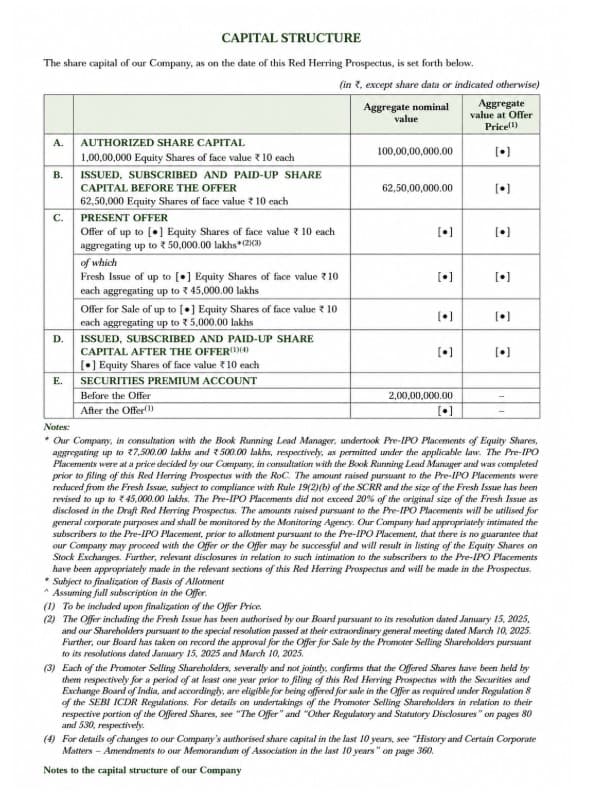
The Capital Structure of the Company section is a mandatory section in the Draft Red Herring Prospectus (DRHP), as it presents a comprehensive overview of the company's share capital before and after the proposed IPO.
Prepared by the company in collaboration with the Book Running Lead Manager (BRLM), legal advisors, auditors and the Company Secretary, this section is disclosed in accordance with the SEBI (Issue of Capital and Disclosure Requirements) Regulations, 2018.
It outlines details such as the authorised share capital, issued, subscribed and paid-up capital, proposed fresh issue, offer for sale, securities premium and the post-issue capital structure.
The primary purpose of including this section is to provide transparency regarding the company's ownership structure and the impact of the IPO on shareholders.
It enables investors, analysts, regulators and other stakeholders to assess shareholding dilution, promoter ownership, changes in capital composition and the overall size and structure of the public issue, thereby supporting informed investment decisions and ensuring compliance with SEBI's disclosure requirements.
Basis for Offer Price
Basis for Offer Price is a mandatory section in the Draft Red Herring Prospectus (DRHP) that explains how the company has determined the proposed IPO price or price band.
This section is prepared by the issuer company in consultation with the Book Running Lead Manager (BRLM)/merchant banker, as it is disclosed under the SEBI (Issue of Capital and Disclosure Requirements) Regulations, 2018, to ensure transparency in the pricing process.
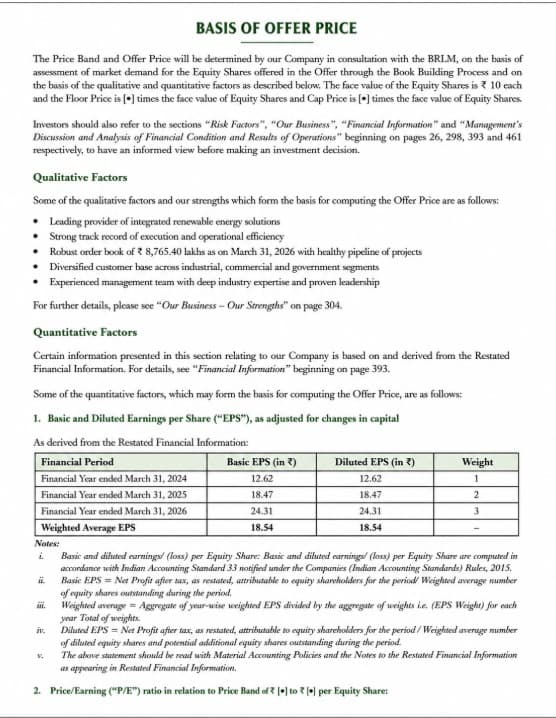
Since 2022, SEBI ICDR has required companies to justify their issue price using both qualitative and quantitative factors, including three years of historical Key Performance Indicators (KPIs), certified by the statutory auditor and a peer comparison against listed companies operating in a similar business. This section typically presents:
- Earnings per share (basic and diluted) for the restated periods
- Price-to-earnings ratio compared against industry peers
- Return on net worth
- Net asset value per share, pre- and post-issue
- A qualitative narrative explaining why the company believes its price reflects fair value, referencing its competitive positioning, growth trajectory and financial performance
These disclosures help investors understand whether the proposed valuation is supported by the company's financial performance and market position. The section also explains the relationship between the face value, issue price and price band, enabling investors to assess whether the IPO is reasonably priced compared with listed peers. Its primary purpose is to promote informed investment decisions by providing a clear and transparent basis for the company's IPO pricing.
This is one of the most heavily scrutinised sections of the DRHP because it is where promotional optimism most often collides with regulatory demand for substantiated, auditor-certified figures.
Price Band Advertisement — Amended March 2025: The floor price or price band must be announced through newspaper advertisements at least 2 working days before the issue opens. Under the March 2025 amendments, the pre-issue advertisement and the price band advertisement have been merged into a single combined publication, which must be published in the same newspapers in which the DRHP filing notice was published. This combined advertisement is released after the Red Herring Prospectus is filed with the stock exchange.
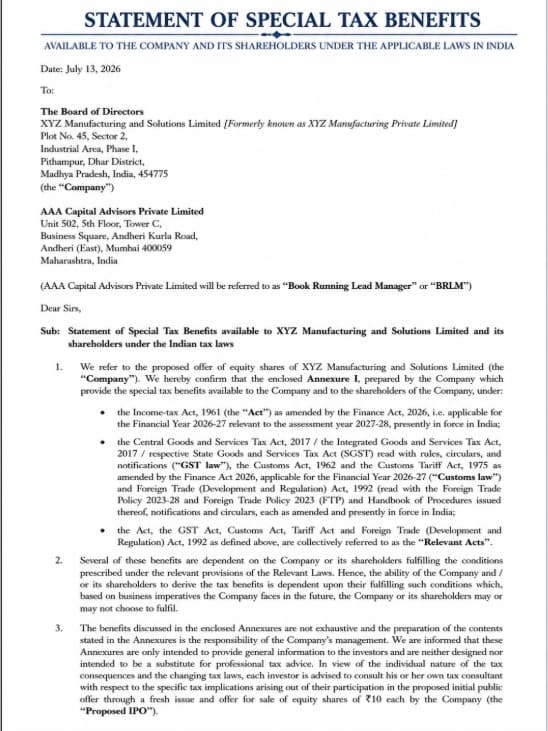
Statement of Tax Benefits
A Statement of Tax Benefits is a mandatory disclosure in the DRHP that outlines the key tax benefits available to the issuer company and its shareholders under the applicable tax laws of India, prepared by the company's tax advisors or chartered accountants and reviewed by the Book Running Lead Manager (BRLM) before being included in the DRHP.
Purpose of the Statement of Tax Benefits
- Explains applicable tax benefits available to the company and its shareholders under Indian tax laws.
- Promotes transparency by disclosing tax-related incentives, exemptions and deductions relevant to the IPO.
- Helps investors understand the potential tax implications of investing in the company's equity shares.
- Clarifies eligibility conditions that must be fulfilled to avail the disclosed tax benefits.
- Highlights regulatory compliance by demonstrating adherence to applicable tax laws and disclosure requirements.
- Provides an independent professional opinion from tax advisors on the tax benefits available at the time of filing.
- Alerts investors to legislative changes, as future amendments to tax laws may affect the availability of these benefits.
- Supports informed investment decisions by enabling investors to evaluate the company's tax position alongside its financial and business performance.
It typically explains the tax incentives, exemptions, deductions, concessions and other benefits available under the Income Tax Act, 1961, along with other relevant tax laws such as the Goods and Services Tax (GST) and customs regulations, where applicable. The section also specifies that the availability of these benefits depends on the fulfilment of prescribed legal conditions and that future amendments to tax laws may affect their applicability.
By presenting an independent professional opinion on applicable tax benefits, this section enables investors to evaluate potential tax advantages while making informed investment decisions.
Risk Factors
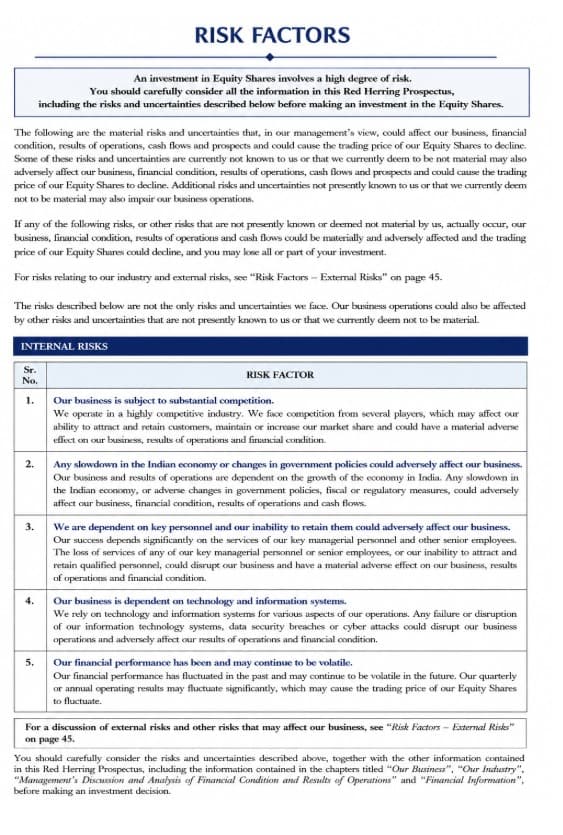
Risk Factor is one of the most important sections of the DRHP, providing a detailed disclosure of the material risks that may affect the company's business, financial condition, operations, profitability and future growth, as well as the value of its equity shares.
Key personnel, including the Book Running Lead Manager (BRLM), legal advisors, auditors and senior management, prepare the risk factor section of the DRHP. The SEBI (Issue of Capital and Disclosure Requirements) Regulations, 2018, are followed in the disclosure of this section.
Risk factors are broadly grouped into three categories: risks relating to the business and industry (competition, input cost volatility, regulatory dependence), risks relating to the issue itself (dilution, lack of a prior public market for the shares, restrictions on OFS or lock-in) and external risks (macroeconomic conditions, currency fluctuation, geopolitical disruption). The section also explains how these risks could adversely impact the company's performance or the market price of its shares after listing.
As it provides a balanced view of potential uncertainties, the Risk Factors section ensures that investors are fully informed before making an investment decision.
The primary objective of Risk Factors is to promote transparency, prevent misleading disclosures and enable investors to assess the potential challenges associated with the company and the IPO, thereby facilitating informed investment decisions while ensuring compliance with SEBI's disclosure requirements.
Introduction to the Business and the IPO
The DRHP's "Introduction to the Business and the IPO" section gives investors a concise overview of the issuer company and the planned IPO. This section is disclosed in compliance with the SEBI (Issue of Capital and Disclosure Requirements) Regulations, 2018. It was drafted by the issuer company in cooperation with the Lead Manager, legal advisors, auditors and the Company Secretary.
It highlights the company's business activities, industry, products or services, competitive strengths, operational footprint, growth strategy and key financial highlights. The section also provides a summary of the IPO, including the type of issue (Fresh Issue and/or Offer for Sale), the objectives of the issue, proposed stock exchange listing and the intended utilisation of the proceeds.
This section serves as a high-level overview; it enables investors to quickly understand the company's business and the purpose of the public issue before exploring the detailed disclosures contained in the DRHP. Some points that come under this section are the following:
- The Issue
- Summary of Financial Statement
- General Information
- Capital Structure
- Objects of the Issue (IPO Objectives)
- Basis for Issue Price (Key Performance Indicators)
- Statement of Special Tax Benefit
This section naturally leads into the "About the Company" section, which provides a more comprehensive understanding of the company's history, business operations, organisational structure and overall corporate profile.
About the Company
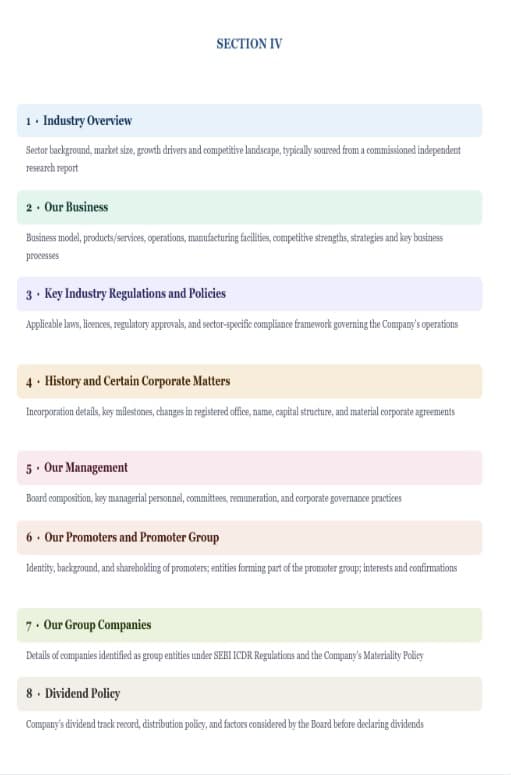
The About the Company section in the DRHP provides a comprehensive overview of the issuer company. It covers key information such as the company's incorporation details, registered and corporate office, business activities, products and services, industry presence, operational footprint, subsidiaries (if any), manufacturing facilities, key milestones, competitive strengths, business strategy and organisational structure.
This section covers: industry outlook, business model, products and services, revenue profile, competitive strengths, business strategies, infrastructure, intellectual property, human resources and insurance.
Additionally, it includes the company's history, corporate structure, promoters, directors, key managerial personnel, subsidiaries, shareholder information, dividend policy, corporate governance framework, material agreements and the key laws and regulations governing its business.
This section is prepared by some key personnel, including the Lead Manager, legal advisors and the company secretary and disclosed in accordance with the SEBI (Issue of Capital and Disclosure Requirements) Regulations, 2018.
By presenting a holistic picture of the business, this section helps investors understand how the company operates, where it stands within its industry and the factors driving its long-term growth before they analyse the financial, legal and risk-related disclosures in the subsequent chapters of the DRHP.