Why Is Stock Market Falling Today? Key Factors Behind Sensex...
19 Mar 2026



that Indian equity investors should apply dabbawala's principle of unshakeable commitment to a system that works, executed with discipline regardless of that particular day's conditions.
The report draws an analogy from Mumbai’s iconic dabbawalas—known for their near-perfect delivery system.
Sunainaa Chadha NEW DELHI
Listen to This Article
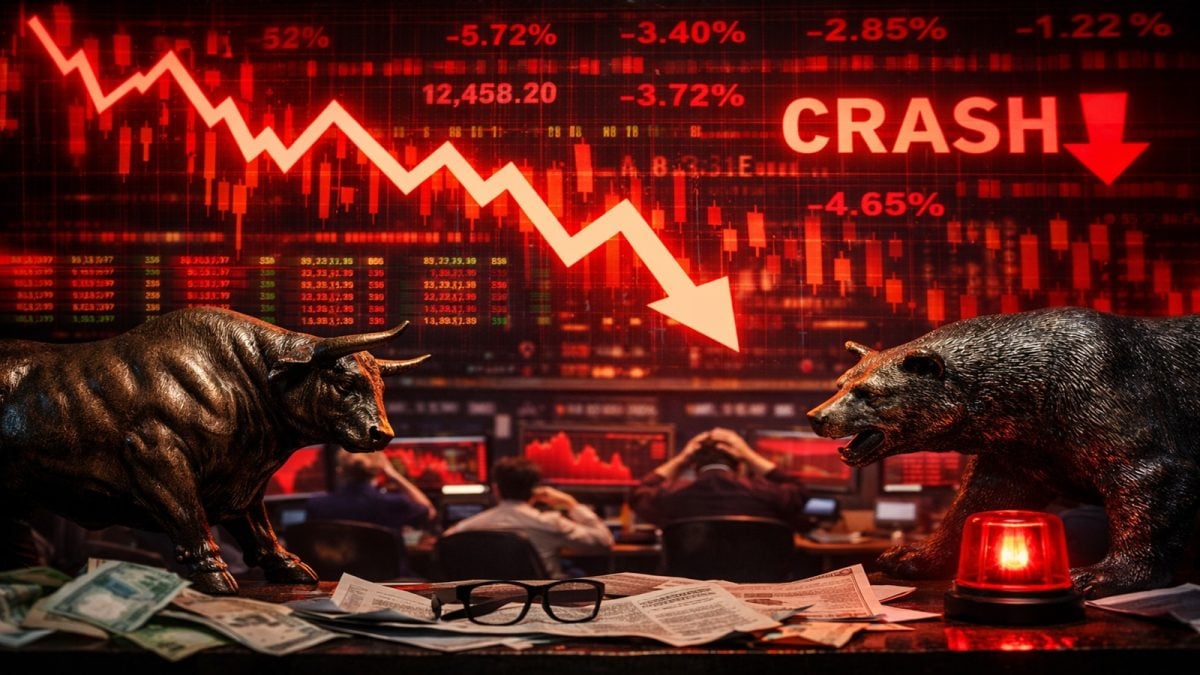
At a time when markets are volatile and headlines are dominated by global uncertainty, investors are once again being tested—not by market fundamentals, but by their own behaviour.As of mid-March 2026, the Sensex is down over 10% year-to-date, while the Nifty IT index has fallen more than 23%, entering bear market territory. Foreign investors have pulled out billions, crude oil prices have surged amid geopolitical tensions, and inflation has ticked up to 3.2% in February.
On the surface, this looks like a time to pause, reassess, or even exit. But according to a recent note by WhiteOak Capital Asset Management, this is precisely the moment when investors should do the opposite—stay disciplined and stick to their investment strategy.
“Dabbawala principle” of investing
The report draws an analogy from Mumbai’s iconic dabbawalas—known for their near-perfect delivery system.
Every day, thousands of dabbawalas deliver over 2 lakh meals across the city with almost zero error, not because of complex systems but because of discipline and consistency.
The lesson for investors is simple:
Follow a system that works, regardless of market conditions.
In investing, that system is often a systematic investment plan (SIP)—a disciplined approach that continues through market ups and downs.
Why market falls feel worse than they are
One of the biggest challenges investors face is psychological.
Behavioural economists have shown that losses feel twice as painful as gains feel rewarding, a concept known as loss aversion. When portfolios fall, investors instinctively want to “do something”—usually sell or stop investing.
But market corrections are not unusual—they are part of the journey.
Data shows that from 1980 to 2025, the Indian market experienced intra-year declines of 10% or more in most years, yet 36 out of 45 years still ended with positive returns. The average intra-year decline was around 20%, while long-term annual returns were about 17%.
In other words, volatility is not the opposite of returns—it is the price of earning them.
The real mistake investors make
The bigger risk is not market decline—it is investor behaviour.
Consider two investors: both start a ₹25,000 monthly SIP. When markets fall, one stops investing, while the other continues.
The one who continues benefits from rupee cost averaging, buying more units when prices are low. The one who stops misses this advantage.
Studies show this behaviour gap—buying high and avoiding markets during dips—has cost Indian investors about 5.3% annually between 2003 and 2022. Over time, this can lead to a massive difference in wealth creation.
Whike Oak cites the following example: Imagine Priya and Rahul, who both started a monthly SIP of ₹25,000 in a Nifty 50 index fund five years ago. When the market dropped 10% last quarter, Rahul panicked and paused his SIP, waiting for things to settle down. Priya kept investing. She did not enjoy watching her statement shrink. But she kept going. What Rahul doesn’t realise is that by pausing during a downturn, he has done the precise opposite of what his SIP was designed to do. The entire genius of systematic investing is that it buys more units when prices are low and fewer when they are high. Rupee cost averaging only works if you keep averaging. The moment you stop investing during a dip, you convert an automatic wealth-building mechanism into an emotional one.
Studies of Indian mutual fund flows consistently show that retail investors pour money in after rallies and pull back after corrections, buying high and sitting out the lows. This behaviour gap, the difference between what the average equity fund returns and what the actual investor earns, cost an average investor 5.3% annually from 2003-2022. The difference in wealth for two investors who put ₹10 Lakh each in 2003 in the above two scenarios comes out to be approximately ₹1.97 crore at the end of 2022.
Markets are volatile, but fundamentals remain intact
While global risks are real, India’s structural story remains strong.
SIP inflows continue to stay above ₹29,000 crore per month, close to record levels
GDP growth is projected at 7.5% for 2026
Inflation remains within manageable levels
Domestic investors have shown resilience, continuing to invest even as foreign investors sell.
This marks a shift from earlier cycles, where corrections often triggered panic exits.
Investing is a test match, not a T20
The report uses a cricket analogy to explain investor behaviour
Short-term investors often treat markets like a T20 match, reacting to every move. But long-term investing is more like a Test match—it requires patience, discipline and the ability to withstand difficult phases.
A 10% correction is like a tough spell of bowling—it feels intense, but it does not decide the outcome of the game.
Investors who panic and exit are essentially playing short-term games with long-term money.
History shows markets recover
If there is one consistent pattern in equity markets, it is this: they recover over time.
In 2008, markets fell over 60% but eventually recovered and delivered strong returns
In 2020, markets crashed nearly 40% during the pandemic but rebounded within months
Investors who exited locked in losses. Those who stayed invested—or continued SIPs—benefited from the recovery.
You do not need to know whether the market bottoms tomorrow or three months from now. You need to know that buying equities at lower prices improves your long-term returns, and that time in the market matters more than timing the market.
"If you had started a modest monthly SIP in the Nifty 50 two decades ago - a period that includes the 2008 global financial crises, the 2011 European debt panic, demonetisation, the pandemic crash, Russian invasion of Ukraine, and every single correction in between - your wealth today would still be a multiple of what you put in the beginning," noted the report.
Don't miss the most important news and views of the day. Get them on our Telegram channel
First Published: Mar 19 2026 | 8:40 AM IST