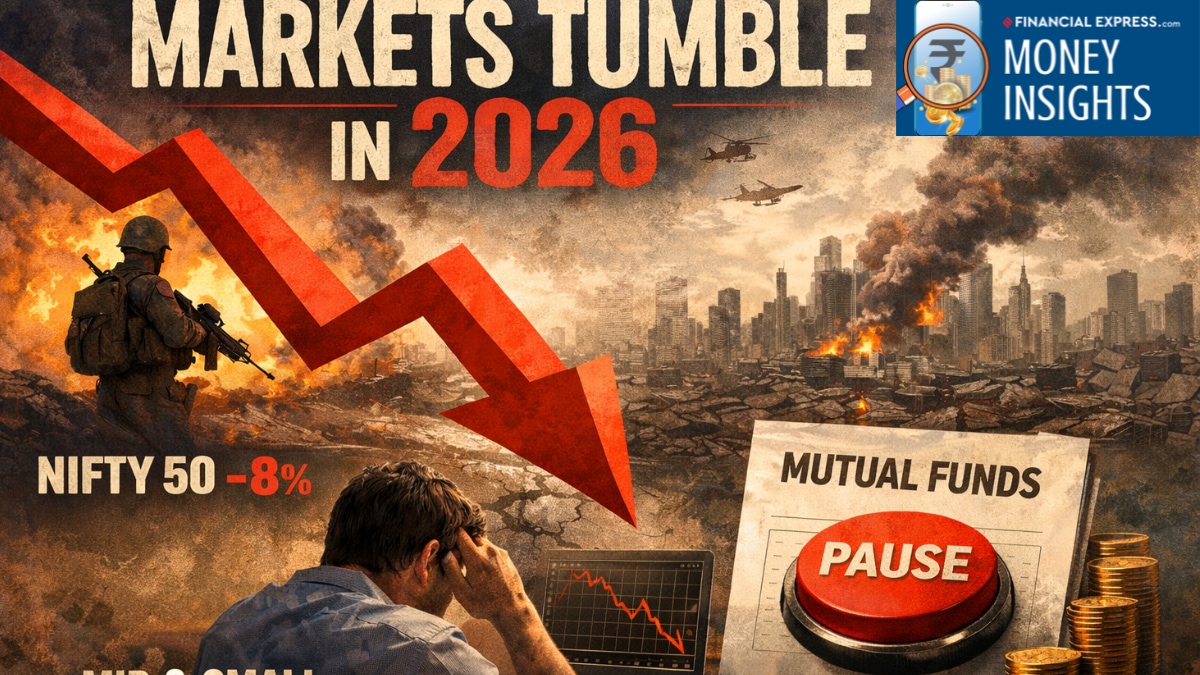
Radhika Gupta urged new investors to stay calm during market swings, saying volatility is a natural feature of equity investing. Citing past geopolitical events, she noted markets typically fall during crises but recover over time, advising investors to avoid panic decisions and continue SIPs for long-term wealth creation.
Market volatility is a feature of equity markets, not a bug: Radhika Gupta urges new investors to stay calm
Synopsis
Radhika Gupta urged new investors to stay calm during market swings, saying volatility is a natural feature of equity investing. Citing past geopolitical events, she noted markets typically fall during crises but recover over time, advising investors to avoid panic decisions and continue SIPs for long-term wealth creation.
Sharp ups and downs in the stock market often make new investors nervous. When indices fall suddenly or when portfolios do not grow for months, many begin to worry about their investments. However, Radhika Gupta, MD and CEO of Edelweiss Mutual Fund, says such volatility is a normal part of equity investing.
According to her, market volatility is a feature of equity markets, not a bug, and investors, especially beginners, should stay calm instead of reacting to short-term movements.
She posted a video message on social media platform X and addressed it as a small note for new investors in particular....
Best MF to invest
Looking for the best mutual funds to invest? Here are our recommendations.
View Details »
Gupta said the current market environment, which includes geopolitical tensions and daily swings in stock indices, making them volatile, has created many questions in the minds of investors. It is common to see markets fall by around 1% in a single day, which can make investors anxious. But she explained that such phases are not new and markets have gone through similar periods many times before.
Live Events
Also Read | Domestic vs global investors: How silver ETF bets played out differently in 400% rally
To explain this, Gupta pointed to past global events. One example was the September 11, 2001, attacks. After the attacks in 2001, markets fell by about 6–7% in a month. However, the fall did not last long, and markets bounced back quickly, rising around 14% over the next six months.
Another example was the Iraq War in 2003. During that period, markets again declined by around 7–8% in a month. But over the following year, markets recovered strongly and rose by more than 60%. Gupta said the reasons behind global events may be different, but markets usually follow a similar pattern—short-term panic followed by recovery.
“What is common to all geopolitical events? Well, the events may be different, markets fall, but eventually they do recover,” Gupta said in her video message.
Gupta also addressed another common concern among investors. Many investors feel disappointed when their portfolio value does not grow for a long time. Some investors say their investments have been flat for the last 18 months and wonder whether they made a mistake.
However, Gupta said history shows that such phases are quite normal. “The second question many of you have is, my portfolio has been flat for the last 18 months, I haven't made money.
I would only urge you to go back and look at some history.”
Also Read | Large, mid and small cap mutual funds see rising inflows in February. Is the shift back to equities underway?
When markets remain flat for a period, the next phase can often be rewarding. In several cases in the past, when markets stayed flat for around 18 months, the next 18 to 36 months delivered strong returns. During those periods, average returns ranged between 12% and 30%.
When it comes to what investors should do during volatile markets, Gupta said the best approach is often to stay patient. Investors do not need to make sudden decisions just because markets are falling or because headlines look negative.
She also advised investors not to cancel their SIPs or stop investing during uncertain times. Panic decisions taken during market volatility can harm long-term wealth creation and also stated that let this period ride out.
Instead of panicking and making wrong decisions, Gupta suggested that investors should stay focused on their financial goals and speak to their financial advisor if they feel unsure about what to do.
She added that while nobody can predict when geopolitical tensions will end or when markets will stabilise, long-term data gives a clear picture. Over time, Indian equity markets across large-cap, mid-cap, and small-cap segments have delivered returns of around 12–15% annually.
Earlier this month, Gupta posted about how markets bounced back in the instances when the Nifty delivered flat or weak returns over roughly 18 months, which is often referred to as a “dead period” by investors.
Also Read | Worried about 18 months of flat returns? Radhika Gupta shares a reality check
She wrote, “The market hasn't made money for 18 months! Since I am hearing this quite a bit, a perspective on what historically followed the 'dead 18-month period.”
Citing data sourced from Edelweiss Mutual Fund, she highlighted that the data shows that while 18-month returns during these phases were modest or even negative, the following 12 months or the 36 months told a very different story. In several historical instances, the next 12 months delivered strong double-digit returns.
Even more importantly, the next 36 months after such stagnant periods often delivered solid gains.
(Disclaimer: Recommendations, suggestions, views and opinions given by the experts are their own. These do not represent the views of The Economic Times)
If you have any mutual fund queries, message on ET Mutual Funds on Facebook/Twitter. We will get it answered by our panel of experts. Do share your questions on ETMFqueries@timesinternet.in alongwith your age, risk profile, and Twitter handle.
(Catch all the Mutual Fund News, Breaking News, Budget 2024 Events and Latest News Updates on The Economic Times.)
Subscribe to The Economic Times Prime and read the ET ePaper online.
...moreless
(Catch all the Mutual Fund News, Breaking News, Budget 2024 Events and Latest News Updates on The Economic Times.)
Subscribe to The Economic Times Prime and read the ET ePaper online.
...moreless
Inside Akasa’s big plans: CEO Dube on profits, fleet orders and why 2032 isn’t the end
Tax certainty will attract larger investors, patient capital to GIFT City: IFSCA chairman
From small-town India to the robotics frontier: Two founders and a deep-tech dream
Out, then in again: How AI put consulting back on IT’s hotlist
Value stocks rally shows why profit matters, not just narrative
These large- and mid-cap stocks with ‘Strong Buy’ & ‘Buy’ recos can rally over 23%, according to analysts
1
2
3