Indian markets offer strong 'alpha' opportunities in FY27 de...
01 Apr 2026


Synopsis
The Indian Premier League is reinventing its approach to sponsorship. Brands are moving beyond mere visibility, shifting their focus to storytelling and sustaining brand equity over time. High-value assets like front-of-jersey sponsorships are seeing increased demand as established players and innovative sectors such as AI dive in.
The Indian Premier League (IPL) is undergoing a decisive shift. What was once a high-decibel sponsorship marketplace is evolving into a strategic brand-building platform, where partnerships are designed not just for visibility, but also for narrative, engagement and long-term equity.
This recalibration is being driven by two forces. First, the premiumisation of high-value assets such as front-of-jersey sponsorships. Second, the return of stable, brand-safe capital from sectors that prioritise credibility over short-term visibility.
Also Read: Pitch perfect for private equity as the IPL investment playbook draws global investors
The timing makes this shift even more striking. The August 2025 regulatory ban on real-money gaming, once among the biggest spending categories in the IPL, wiped out a significant pool of advertisers almost overnight. At one point, Dream11 alone occupied the front-of-jersey slot for five franchises.
Conventional wisdom would have suggested a pricing correction. Instead, the opposite has happened.
Live Events
Premiums Hold, Demand Deepens
Franchises such as Gujarat Titans, Punjab Kings, Lucknow Super Giants, Kolkata Knight Riders and Sunrisers Hyderabad have not only replaced these sponsors but have done so at a 15–20% premium. The most valuable real estate in IPL sponsorship continues to command rising valuations.
The exit of real-money gaming has had a far greater impact on sports broadcasters than on IPL franchises, given the significantly larger ticketsizes involved in the former. Frontof-jersey deals, typically priced at ₹20-30 crore, remain relatively manageable for brands.
This is not replacement spending, but an upgrade in brand capital, with the new roster of sponsors reflecting that shift. Gujarat Titans have partnered with Birla Estates. Kolkata Knight Riders have onboarded electric mobility brand Hero Vida. Lucknow Super Giants signed JK Super Cement, while Punjab Kings brought in CP Plus and Sunrisers Hyderabad partnered with Shree Cement.
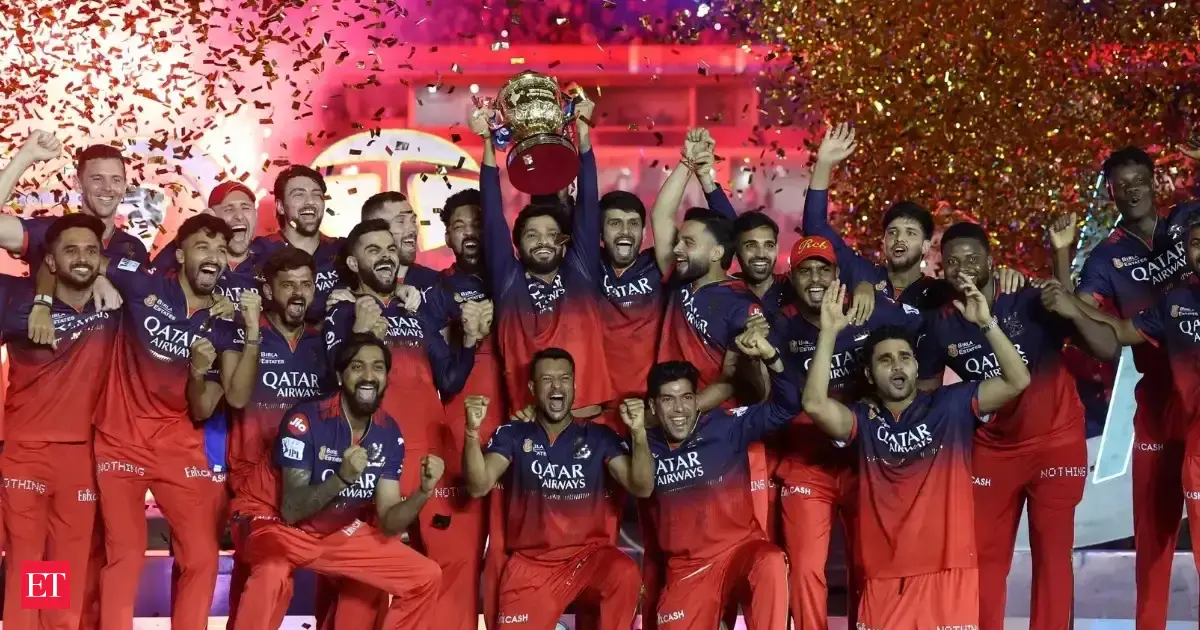
Elsewhere, Royal Challengers Bengaluru closed a record three-year ₹100- crore deal with smartphone brand Nothing, replacing Qatar Airways, while Rajasthan Royals secured Waaree Energies. The largest frontof-jersey deal remains with Mumbai Indians, which signed a ₹120-crore, three-year agreement with Lauritz Knudsen.
Also Read: Reliance's JioStar terminates Bangladesh IPL cricket broadcast deal, letter shows
India Inc Steps In
Sectors such as cement, mobile handsets, tyres and renewable energy are leading the charge. These categories are closely tied to India’s economic growth story, where scale, trust and mass visibility matter. At the same time, new-age segments such as artificial intelligence are making a strong entry, with ChatGPT partnering with five teams and Google Gemini with three.
Together, this sponsor mix signals that IPL team sponsorships are delivering both scale and depth, combining mass visibility with the ability to build sustained consumer engagement through storytelling across platforms, say experts.
According to WPP Media’s Sporting Nation report, India’s sports economy crossed $2 billion ( ₹18,000 crore) for the first time in 2025, with IPL team revenues surpassing ₹1,000 crore. That figure is expected to grow further in 2026, driven not by an expansion of inventory but by better monetisation of existing assets.
The Revenue Pyramid
Sponsorship revenues across IPL franchises can be broadly categorised into three bands. In the top band, teams such as Mumbai Indians, Royal Challengers Bengaluru and Chennai Super Kings generate between ₹130– 190 crore. The mid-band, comprising teams like Kolkata Knight Riders, Delhi Capitals and Lucknow Super Giants, falls in the ₹90–105 crore range, while the remaining teams are clustered in the ₹80–90 crore range.
Experts note that this divergence ref lects differences in brand strength, the market size of a franchise’s home city, and monetisation capability, rather than on-field performance alone.
IPL franchises have two primary revenue streams: central revenue from media and league rights, and local revenue from team sponsorships, ticketing, licensing and merchandising. The central pool remains stable, with each franchise receiving around ₹450 crore annually.
In effect, the league is extracting more value per association rather than simply adding more sponsors. At the same time, the number of partnerships continues to rise, with teams now averaging 20–30 sponsors across tiers.
“IPL teams are spoilt for choice. Advertisers see inherent value in partnering with IPL franchises, regardless of the players, their track record, catchment area or social media following,” says Vinit Karnik, managing director – content, sports and entertainment at WPP Media South Asia, adding that revenue growth now depends on how effectively teams can service and deliver value to a growing pool of partners.
The Narrative Shift
This shift is also visible in how brands are approaching sponsorship.
A Mumbai Indians official says thatearlier, brand managers focused on efficiency, measuring how much value each rupee delivered through tightly defined metrics. “Now the thinking has shifted. Brands are looking to build narratives. Even with something like a jersey, the real value comes from how that story is amplified across digital and other platforms,” the official adds.
Executives say the IPL is increasingly attracting more corporate and established brands, even as it draws newer categories such as artificial intelligence.
“IPL team sponsorships in 2026 continue to grow, but the market is clearly maturing. Spend is shifting towards more corporate, brand-safe sectors, premium jersey assets are commanding higher valuations, and with limited inventory, teams are expanding their roster of partners to maximise revenues,” says Rajesh Menon, CEO, Royal Challengers Bengaluru.
“IPL team sponsorship revenues are still growing, with significant headroom ahead. What we are seeing is not just scale, but also premiumisation and deeper partnerships,” says Binda Dey, CMO, Kolkata Knight Riders. “Brands today are investing in co-branded activations, experiences, digital integrations and co-created IPs, not just logo visibility.”
The broader ecosystem, she adds, continues to expand without signs of a plateau.
Diverse Sponsor Base
Sunil Gupta, CEO, Delhi Capitals, echoes the sentiment, pointing to a structural shift in the sponsorship mix. “Top franchises continue t o see momentum, but there is a clear move towards more strategic, long-term partnerships rather than simply adding volume,” says Gupta.
He adds that the exit of real-money gaming brands has opened the door for a more diverse set of advertisers. “This year, we have seen strong interest from BFSI, consumer tech, global airline brands and renewable energy. These are categories that align well with scale and credibility.”
For teams, the shift is not just about revenue growth, but also about the diversity and quality of brands entering the ecosystem.
Saurabh Arora, chief commercial officer, Punjab Kings, says the change is evident in the expanding category mix. Along with traditional sectors, the franchise has seen strong interest from security and surveillance, energy drinks, paints, renewable energy, and new-age categories such as EV mobility and wearable tech.
“That shift tells you that the IPL is no longer just an advertising platform. It has become a serious brand-building platform. The focus now is not just on selling space, buton creating properties and IP that brands can build around through the year.”
Sponsors, too, are seeing tangible value in team partnerships.
BKT, which has partnered with eight IPL franchises, says its wide presence ensures strong visibility across the tournament. “With our presence across eight teams, including on-ground and digital, we achieve visibility across nearly 70% of the games,” says Rajiv Poddar, managing director, BKT Tyres.
Broadcast to Beyond
The execution model is also evolving, with broadcast emerging as a key lever alongside on-ground visibility. For BKT, the IPL plays a central role in its transition to a consumer-facing brand, as it targets ₹23,000 crore in revenue by 2030.
“The IPL has become a powerful platform for brand building because it combines unmatched scale with sustained engagement over a defined period,” says Rajat Abbi, VP, marketing, Schneider Electric. “It is not a one-off moment. It plays out daily across screens and becomes part of how audiences consume content and conversation.”
From a returns perspective, the distinction is becoming clearer. League-level sponsorships deliver broad reach and immediate visibility. Team partnerships, on the other hand, offer sharper advantages in building deeper brand associations. They allow brands to align with a specific identity, tap into loyal fan bases, and create contextual, repeat engagement over time.
“For us, the strength of team partnerships lies in their ability to build continuity, relevance and stronger emotional connections with audiences,” says Abbi.
(You can now subscribe to our Economic Times WhatsApp channel)
Trade was just the first casualty; RBI rate cuts may be next in the Iran War fallout
From conflict to cockpits: Iranian pilots turn to India as airlines race to hire
Jyoti Structures bankruptcy shows how revival can drag for nearly a decade
Prashant Jain’s contrarian masterstroke: From IT exit to SBI super bet
Stock Radar: GE Vernova T&D India stock sees profit booking after hitting record highs in March 2026; buy the dip or book profits?
Weekly Top Picks: These stocks scored 10 on 10 on Stock Reports Plus
1
2
3