CIIL emphasises the importance of multilingualism and mother tongue education for equity and cultural identity on International Mother Language Day.
Languages must coexist rather than compete: RIE Principal
The Central Institute of Indian Languages (CIIL), Mysuru, on Friday celebrated International Mother Language Day with academic deliberations, book releases, and reflections on multilingual education.
In his welcome address, CIIL Deputy Director P.R. Dharmesh Fernandez highlighted the historical significance of International Mother Language Day and traced the origins of the observance to the Language Movement.
Pradyumna Kumar Sethy, Principal, Regional Institute of Education (NCERT), Mysuru, who was the guest of honour, emphasised the critical role of the mother tongue in education and nation-building.
Highlighting India’s rich linguistic diversity, he observed that the country recognises 22 Scheduled Languages along with hundreds of other languages spoken across regions.
Referring to the National Education Policy (NEP) 2020, he underlined the importance of imparting early education in the mother tongue to strengthen cognitive development and cultural identity.
Recalling various language movements, he said that the day commemorates the sacrifice of language martyrs and reinforces the need to promote multilingualism.
Drawing from academic experiences, he illustrated how language barriers can disadvantage talented students and stressed that access to examinations and knowledge in one’s mother tongue ensures equity and inclusion.
Prof. Sethy argued that languages must coexist rather than compete, cautioning against linguistic hierarchies and imposition and calling for mutual respect among linguistic communities and greater production of knowledge in Indian languages, as demonstrated in countries such as Japan, Korea, and China.
“Mother tongue is not merely a medium of communication but the voice of our culture and ancestors,” he remarked, urging citizens to preserve their linguistic heritage while embracing global opportunities.
Shailendra Mohan, Director, CIIL, who presided, highlighted the transformative potential of Artificial Intelligence in promoting Indian languages.
Referring to developments in AI-driven translation across multiple Indian languages, he described technology as a powerful instrument for emotional and national integration. He encouraged youth participation in developing digital resources and knowledge bases in Indian languages.
In collaboration with the NCERT, CIIL has published primers in 121 languages and developed SWAYAM courses in 16 Indian languages to expand access to language learning, said Pankaj Dwivedi, AD, CIIL.
He spoke about the ongoing translation of the Constitution of India into Indian languages and the development of technological tools to enhance linguistic accessibility in governance and public services. Language services have also been provided for recruitment agencies and Public Sector Banks across the nation, he said.
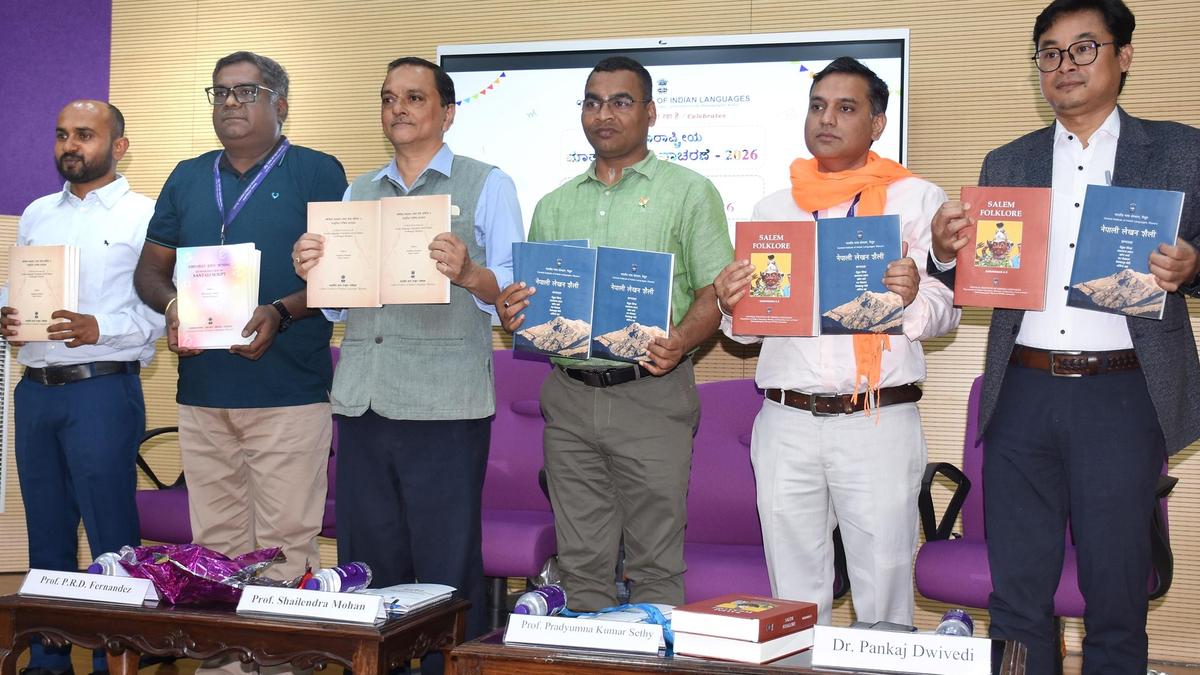
During the celebration, four books published by the Institute were released.