Equity Mutual Fund Inflows Jump To 8-Month High Of ₹40,450 C...
10 Apr 2026


Synopsis
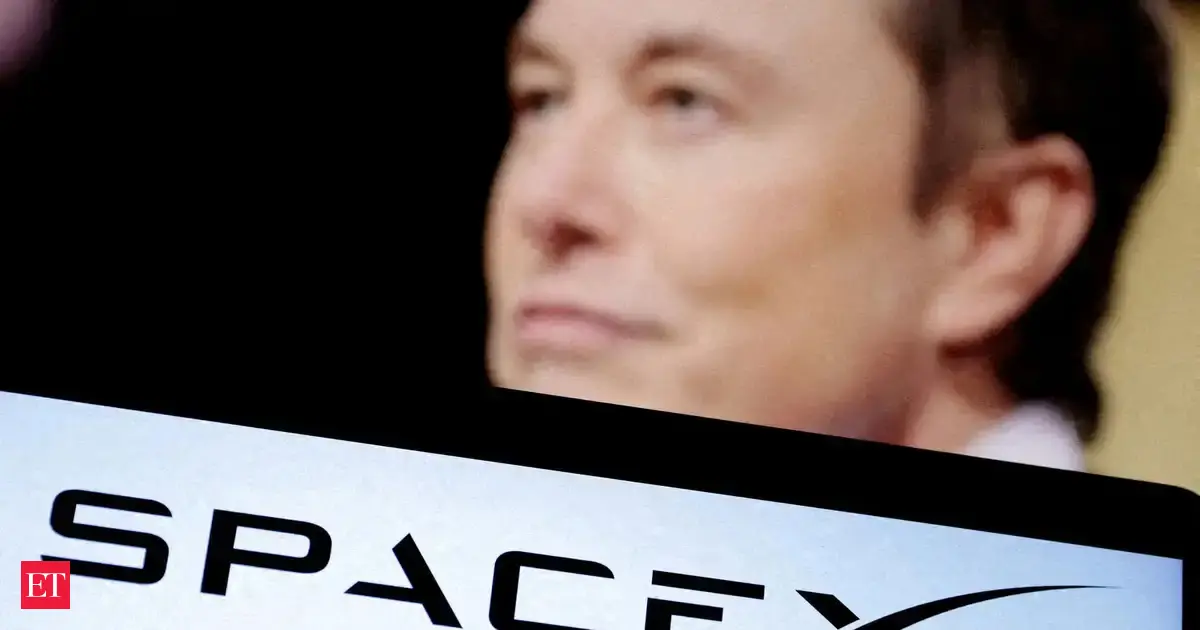
SpaceX is targeting a $1.75 trillion valuation for its upcoming IPO, aiming to raise over $75 billion. This valuation is driven by its profitable Starlink satellite network and a leading launch business, with investors also factoring in future potential from ventures like Starship and xAI. Despite stretched valuation multiples, strong demand and a unique market position fuel investor confidence.
Elon Musk's SpaceX is seeking a $1.75 trillion valuation in its forthcoming initial public offering. How far into the stratosphere is that?
Going by common Wall Street metrics, the answer is, way out there. SpaceX would immediately become the sixth most-valuable publicly listed U.S. firm, worth more than the likes of Meta Platforms, which has been publicly listed for more than a decade, and Berkshire Hathaway, a company older than SpaceX founder Elon Musk. And yet, there is no sign that investors will think twice about hitting the buy button once it goes public in an IPO that could raise $75 billion or more, which would be a record. The frenzy has grown so intense that some are pouring money into opaque secondary markets, accepting complex arrangements and murky ownership just for a shot at owning the shares.
"It has almost no comparable listed peer to benchmark a valuation off of and would likely come at a significant premium to anything else that is listed in the space tech sector, given its size and market leadership," said Samuel Kerr, global head of equity capital markets at Mergermarket.
SpaceX's valuation is grounded in its profitable, fast-growing Starlink satellite network, which has over 10 million subscribers, and a launch business that analysts and investors say has transformed access to orbit. The Falcon 9, which in December 2015 became the first large rocket to make a controlled recovery after delivering a payload into orbit, completed 165 launches in 2025, a new annual record.
But analysts and portfolio managers are also pricing in considerably more. Musk's track record of building successful, industry-disrupting companies gives analysts and portfolio managers confidence that the unproven bets - Starship, xAI, and an ambitious push into data-center satellites - will eventually pay off too.
Live Events
"This is a set of proven juggernaut, mega-cap businesses," said Daniel Hanson, portfolio manager at Neuberger's Quality Equity Fund, an existing SpaceX investor with close to 10% of its $2.6 billion in assets allocated to the company. "The launch business and the Starlink business are proven, here and now. xAI is about optionality," he said, referring to businesses that could add value over time as they benefit from long-term shifts toward AI, data and global connectivity.
Here's a quick look at the pros and cons ahead of the IPO.
LEADING THE SPACE RACE
SpaceX has a commanding lead in deploying the low-Earth orbit satellites that deliver internet and communications for its Starlink service from space. Starlink is profitable and accounts for roughly 50% to 80% of SpaceX's revenue.
Many of the parent company's other ambitions are yet to be realized. These include the delayed Starship rocket program for Moon and Mars missions and plans to launch up to one million data-center satellites linked to its money-losing AI unit.
To justify the valuation, "investors will need to keep strict tabs on the timing of Starship coming to market and on the ramp-up of Starlink service direct to cellphones," PitchBook analyst Franco Granda said in a note last month.
Even so, SpaceX launches a rocket nearly every two days, faster than any space program or firm in history, giving it key capacity in a market where launch access has become a bottleneck for rivals like Amazon, which is building its own satellite networks.
"It's a one-of-a-kind for a start," said Mark Boggett, CEO of venture capital fund Seraphim Space.
MULTIPLES ARE STRETCHED
SpaceX posted about $8 billion in profit and revenue of $15 billion to $16 billion in 2025, Reuters exclusively reported in January. The profit figure is based on EBITDA, or earnings before interest, taxes, depreciation and amortization, a standard measure of operating performance. Revenue growth has ranged in recent years from 51% in 2024 to 100% in 2021.
Unlike listed companies covered by analysts, no consensus projections exist for SpaceX's growth. Reuters made several assumptions in order to compare SpaceX's potential valuation with listed firms.
Reuters assumed cash flow and revenue would double in 2026 from reported levels in 2025, an aggressive rate aimed at making the valuation multiples err on the low side.
Using those assumptions, at a market capitalization of $1.75 trillion, SpaceX would carry a price-to-revenue multiple of 56 and a price-to-EBITDA multiple of 109 - eye-popping valuations for even the fastest-growing companies.
Tesla, which Musk also leads, is valued at 12 times expected revenue and 79 times EBITDA, making it one of Wall Street's priciest stocks. Palantir is at 43 and 75 for those metrics, respectively, after its shares soared 500% in the past two years on optimism about its fast-expanding AI business.
Generally speaking, the higher the multiple, the harder it is for a company's performance to meet expectations to keep its stock appreciating.
"Starlink is the only reason this valuation is defensible," said Shay Boloor, chief market strategist at Futurum Equities. Its subscriber base "is just growing at crazy levels."
THE FOG OF PRIVATE COMPANY VALUATIONS
In its merger with Musk's artificial intelligence startup xAI in February, SpaceX was valued at $1 trillion and the Grok chatbot developer at $250 billion. That transaction gives analysts at least one recent anchor for the combined entity's value, and some investors argue it is too conservative. It is currently valued at $1.54 trillion on secondary trading venue Nasdaq Private Market.
"SpaceX is consistently one of the most actively traded names on our platform because there's nothing else like it in the private markets today," said Greg Martin, co-founder at Rainmaker Securities, a trading platform for private pre-IPO shares. "Demand has also almost always outpaced supply, and that's been true even during periods where broader secondary market activity has been more muted."
(You can now subscribe to our Economic Times WhatsApp channel)
Explore More Stories
Canadian commander in Latvia removed after military charge linked to benefits probe; Interim leadership installed as case proceeds
Quote of the day by Aristotle: ‘The aim of art is to represent not the outward appearance of things, but their…’
Lady Gaga cancels Montreal show over worsening respiratory illness, refunds issued for ticketholders
Word of the day - Dissembling
Three-vehicle collision in Dartmouth, Nova Scotia leaves drivers injured; police probe underway
Canada Air Travel in Turmoil: Over 400 flights delayed, several cancelled as severe winter weather hits major airports and airlines across key cities; check details
Quote of the Day by Bing Crosby: ‘Once or twice I’ve been described as a light comedian. I consider this the most…'
Canadian authorities warn of surge in fake ‘milk settlement’ text scam exploiting class-action credibility
Quote of the Day by Chris Hadfield: ‘Early success is a terrible teacher; you're essentially being rewarded for a lack of…’ Canadian astronaut’s guide to success later in life and an important lesson on preparation
Burdett ‘Burd’ Sisler, oldest living Canadian and WWII veteran with 14 great-great-grandchildren, dies weeks before celebrating his 111th birthday
Tuberculosis rates spike in northern Saskatchewan, NDP alleges government withheld case information
Canada grocery prices climb 5.7 percent in February, led by sharp meat and poultry spikes as costs outpace inflation
Montreal counterfeit money scheme: Police arrest 4 men, seize large amounts of fake currency in multiple investigations
1
2
3