Zinema Media and Entertainment Limited Concludes EGM with Al...
28 Mar 2026


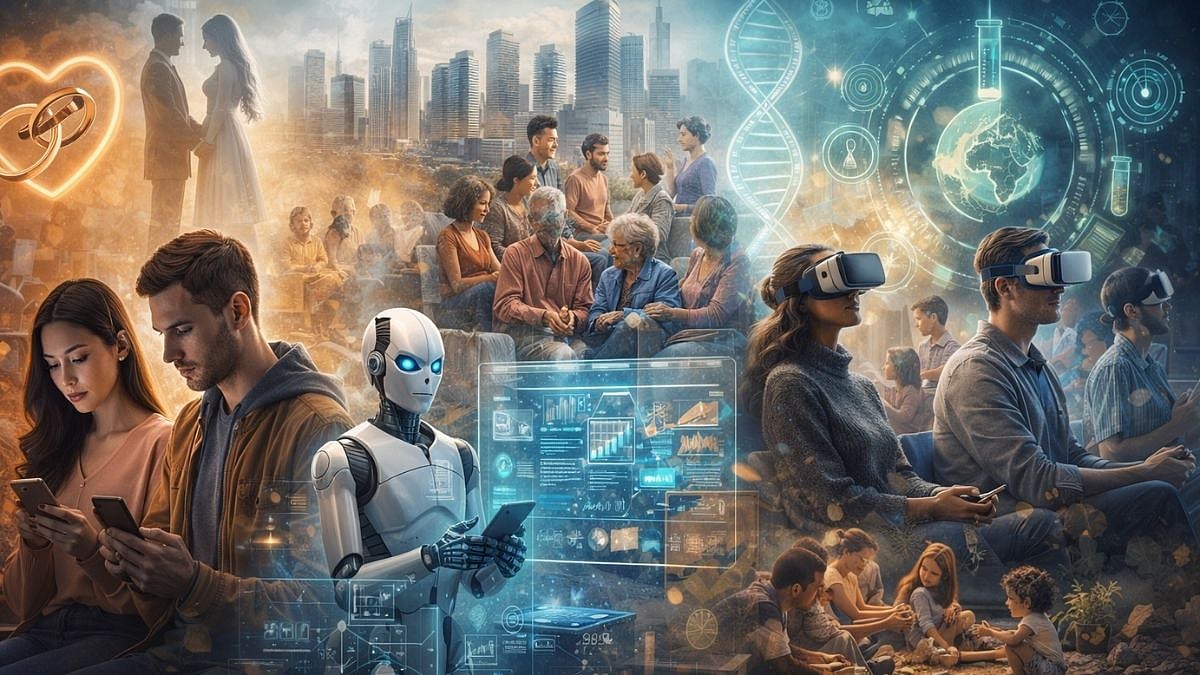
We stand at the cusp of a quiet civilisational pivot—not marked by upheaval, but by a steady withdrawal from long-held norms. There are no revolutions or manifestos—only individual decisions to delay, reconsider, or opt out. Across the world, and increasingly in India, individuals are choosing self-authorship over social prescription. The traditional arc of education, marriage, children, and stability is no longer a default pathway but one option among many.
Technology and longevity reshaping life choices
This shift is driven less by ideology than by capability. Hyper-personalised learning, immersive experiences, and artificial intelligence are expanding the boundaries of fulfilment. Rising longevity—where 60 increasingly resembles 40 in vitality—further dilutes the urgency that once defined life’s milestones. Marriage, long seen as an economic and social necessity, must now justify itself against a broader range of choices.
Changing role of marriage in modern society
Historically, marriage pooled risk, labour, and social capital. It provided stability in uncertain environments and ensured continuity through children. Today, platforms mitigate risk, AI augments labour, and identity is increasingly self-constructed. Marriage does not disappear, but it must compete. Some partnerships will deepen and become more intentional, while others may struggle under rising expectations. The shift from obligation to choice is transformative.
Demographic trends and evolving family structures
This transition is closely tied to demographic change. Declining fertility is not merely about economics but reflects lived realities—gender dynamics, expectations of fairness within households, and the perceived costs of parenthood. When these concerns intersect with a world offering abundant alternatives, the calculus changes. Raising children, while meaningful, is time-intensive and identity-shaping, whereas modern life increasingly offers flexibility and reinvention.
Hesitation replaces certainty. The sentiment shifts from “yes, now” to “perhaps later,” and often to never. The consequences are already visible: smaller households, delayed marriages, declining birth rates, and the rise of “chosen families”—networks of care that exist outside traditional kinship structures. This is not a rejection of family, but a redefinition of what a meaningful life can look like.
Emerging models of community and caregiving
Even as the nuclear family weakens, a paradoxical trend emerges: the potential return of community. Not one rooted in compulsion or scarcity, but one built on choice. Child-rearing may gradually move towards more collective models—learning ashrams that blend mentorship with AI-driven personalisation, co-parenting cooperatives that share time and resources, and civic systems that treat childhood development as shared infrastructure. In such models, the child is supported by an intentional ecosystem rather than two individuals alone.
Ethical challenges in biotechnology and AI
Yet these transformations bring complex ethical challenges, particularly in biotechnology. Advances in genetics are moving from disease prevention towards enhancement. Traits such as cognition, resilience, and temperament could increasingly become subject to design. This raises difficult questions about equity, consent, and the definition of what it means to be human. Without safeguards, there is a risk of creating a society divided not just by wealth, but by engineered capability.
At the same time, artificial intelligence is evolving from assistance to agency. AI systems are beginning to function as tutors, caregivers, financial planners, and companions, enabling individuals to live independently without necessarily being isolated. This marks a shift from tools that support human activity to systems that increasingly shape it.
Governance, policy and India’s role
However, this evolution complicates legal and moral frameworks. If AI systems can make decisions, create value, or cause harm, how should they be classified? Questions of liability, accountability, and transparency will become central to governance, particularly in societies rapidly integrating digital infrastructure into everyday life.
India holds a unique advantage in navigating this transition. Its experience in building large-scale digital public systems offers a foundation to balance innovation with inclusion. A national personalised learning ecosystem could democratise access while ensuring equity. Community-based child-rearing models could be piloted in urban and semi-urban settings. Early regulation of genetic enhancement could prevent misuse, while clear frameworks for human-AI interaction could establish norms of accountability.
Reimagining institutions and addressing loneliness
At the same time, marriage itself must be reimagined—not preserved out of inertia, but strengthened through fairness, dignity, and genuine mutual value. In a world of expanding choice, institutions endure not by default but by relevance.
Equally important is the recognition of loneliness as a public health concern. As individuals gain greater autonomy, the need for belonging does not diminish; if anything, it intensifies. A society built on self-authorship must also invest in creating meaningful bonds and shared spaces of connection.
A civilisational transition ahead
Ultimately, the transformation underway is not merely social but civilisational. Longer lifespans will redefine adulthood, allowing for multiple phases of learning, work, and reinvention. Parenthood will increasingly become a deliberate choice rather than a default expectation, and identity will shift from fixed roles to evolving narratives.
This future holds immense promise in terms of freedom and human potential, but it also carries risks of fragmentation and inequality. The challenge, therefore, is not to resist these changes but to shape them with intention and foresight. As demographic trends evolve and technology accelerates, societies must move beyond reactive policymaking towards conscious design.
The question is not whether this future will arrive, but whether it will be guided by ethics and inclusion or left to unfold unevenly. If navigated wisely, it could lead to a more humane and resilient civilisation. If neglected, it risks becoming efficient yet deeply unequal—a future no society can afford to inherit.
About the author
Shailesh Haribhakti is a Chartered Accountant, Independent Director, and author of Sustainable Abundance and History of the Future.