Tech Mahindra Allots 1,12,907 Equity Shares Through Employee...
01 May 2026


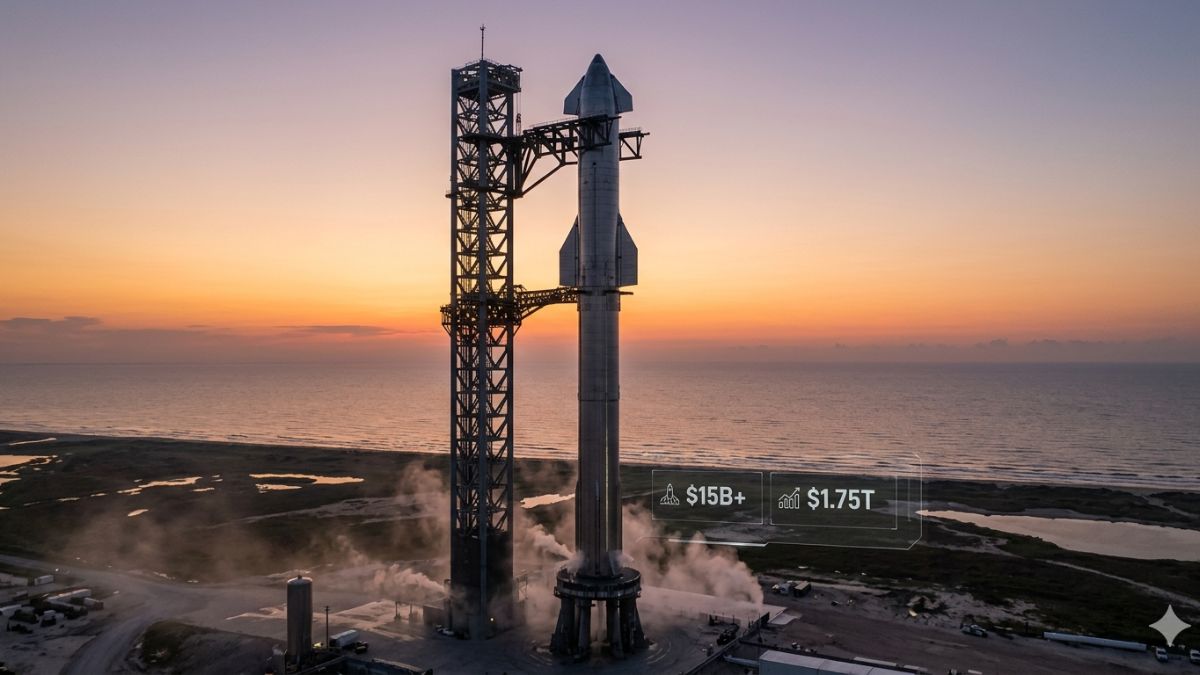
As the company sprints toward a public market debut at a staggering $1.75 trillion valuation, Starship has emerged as a key link between SpaceX’s current satellite dominance and its future as a multi-planetary logistics giant.
Cost comparison: The evolution of a giant
The sheer scale of Starship’s development costs highlights a fundamental shift in how SpaceX operates. The $15 billion figure reported by Reuters has massively eclipsed the roughly $400 million SpaceX spent developing Falcon 9, which is arguably the world’s most frequently flown rocket.
Falcon 9 has reportedly underpinned SpaceX’s commercial dominance, enabling rapid Starlink deployments and giving the company a wide lead over launch rivals.
“We have continued to invest significantly in further increasing our lead by pursuing full and rapid reusability at scale, including investing over $15 billion in our next-generation rocket, Starship,” SpaceX said in its confidential IPO registration accessed by Reuters.
The surge highlights how fundamentally different Starship is from Falcon and from any rocket that has come before it. As per reports published by Reuters and other agencies, this is how features and costs of Musk’s Falcon 9 and starship compare.
The Starlink Connection: Why the $15B Matters
As per a Reuters report, the future of SpaceX’s most lucrative businesses rests on this towering two-stage system. Musk’s space X reportedly intends to launch its “V3” Starlink satellites in the second half of 2026.
These upgraded satellites are too large for the workhorse Falcon 9; they require the massive payload bay of Starship to be economically viable. Beyond the internet, Starship is also the vehicle intended to deploy thousands of AI computing satellites, a space-based alternative to power-hungry terrestrial data centers.
Analysts present fuel and water based hurdles
Despite eye-catching milestones of Musk’s space tech giant including the recent mid-air “catch” of the Super Heavy booster with mechanical arms, the path to Musk’s goal of thousands of launches per year is paved with a long queue of logistical hurdles.
According to a Federal Aviation Administration analysis, a single Starship launch requires about one million gallons of water for acoustic vibration suppression and the equivalent of 244 tanker trucks of natural gas to complete the launch.
“There is not enough water in the water system to support the launch of Starship” at the scale Musk envisions, Chris Quilty, president of Quilty Space, told Reuters.
Apart from the resource constraints, Musk’s vision of ‘In-Orbit’ represents Space X’s next most formidable challenge. The maneuver involves a risky and unproven process in which Starships dock with tanker versions of the vehicle to transfer fuel.
The challenge is compounded by the propellant itself. Liquid oxygen must be kept at extremely low temperatures and tightly sealed to prevent it from seeping out into space.
“That’s probably the last big challenge,” Hans Koenigsmann, former SpaceX VP, told Reuters.
Space X response to mentioned challenges
“In-orbit refueling is complex, and we have not yet demonstrated or attempted it,” SpaceX said in its filing as per Reuters. “We may not be able to develop, commercialize, scale, or successfully implement these or other strategic initiatives on the timelines we currently anticipate, or at all,” it added.
Visualising the future: “Version 3” and beyond
SpaceX is currently preparing for its first test flight since October, which will debut the Starship V3 prototype “Version 3 is basically a clean-sheet design of the ship,” Charlie Cox, Director of Starship Engineering, said in a video SpaceX posted on X on Friday.
This version is critical for NASA’s Artemis moon program, which has funneled at least $3 billion into SpaceX. As per a Reuters report, NASA’s Human Landing System (HLS) depends entirely on the success of this “Version 3” architecture.
“That Version 3 is what HLS is going to be based on,” Kent Chojnacki, Deputy Manager of NASA’s Human Landing System program told Reuters. A lot’s gonna be dependent on this first flight,” he concluded emphasizing the importance of the upcoming launch.