

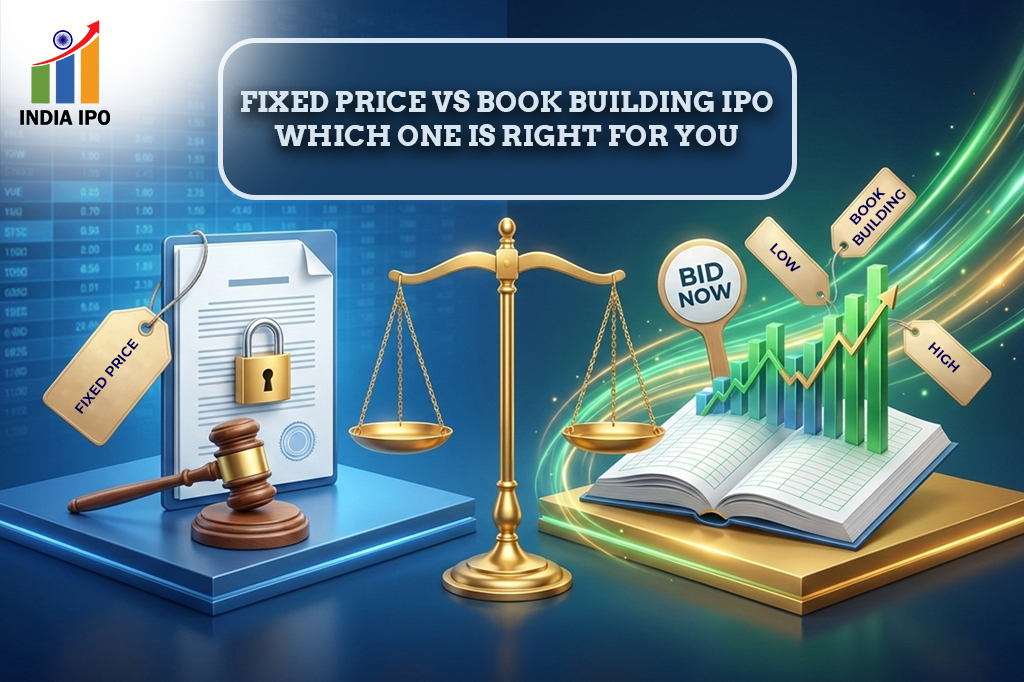
When a company plans an IPO, selecting the appropriate IPO pricing model is a critical strategic decision for its leadership and merchant bankers. Understanding the basics of fixed price vs book building allows founders to align their capital requirements with current market conditions and investors’ appetite. In a fixed price IPO, a firm sets a price, whereas in a bookbuilding IPO, investors determine the price through bidding.
For the SME IPOs, the strategy must be very mindful to ensure the issue is neither underpriced nor ignored by institutional buyers. Choosing the right IPO pricing model confirms that the company does not leave money on the table while still offering enough to satisfy investors. Without a deep dive into the mechanics of fixed price vs book building, an SME IPO strategy might fail to capture the true value of the business.
This is where IndiaIPO expert tips become invaluable for modern entrepreneurs. We emphasise that the IPO pricing model should be chosen based on the company's specific financial health and the broader economic climate. By following IndiaIPO expert tips, businesses can weigh the pros and cons of fixed price vs book building to find their "Goldilocks" price point. Let’s understand the IPO pricing model and how to choose the right model for your business.
An IPO pricing model is the systematic framework used by a company and its underwriters to determine the value of shares offered to the public. Choosing the right IPO pricing model is a cornerstone of market entry, as it directly influences investor demand and the company’s capital-raising efficiency. Whether you go for a fixed price or a book building, the model acts as the first handshake between the issuer and the investor, setting the tone for post-listing performance.
Now, if the pricing model is seen as the crucial step in market entry, then pricing can easily impact a brand's "subscription heat" and long-term credibility. For the smaller firms, an SME IPO strategy often relies on pricing that balances attractiveness with fair valuation.
For any business, while going public, selecting the best pricing model that will match their business and make them succeed has become most important and for that, having an expert is a must and here, India IPO provides the right guidance and ensures that regulatory compliance is the first step toward a successful IPO pricing model. By following IndiaIPO expert tips, an IPO consultant in India helps businesses avoid the common pitfalls of fixed price vs book building. Let’s understand both pricing models and their differences to have a clearer, more transparent picture.
In India, IPO pricing is governed by the Securities and Exchange Board of India (SEBI). While book building is mandatory for most mainboard IPOs listed on the NSE and BSE, SME IPOs can opt for either a fixed price or book building, depending on strategy and target investors
A Fixed Price IPO is a method where the company, in consultation with its lead manager, sets a specific, non-negotiable price for its shares before the issue opens to the public. In this IPO pricing model, the exact price per share is pre-determined and publicly announced in the offer document, meaning investors apply for shares at that single, known cost.
For Small and Medium Enterprises (SME) IPOs, this model is preferred because it offers simplicity and clarity to retail participants, and it is well-suited for companies with a steady, predictable valuation and a target loyal base of retail investors.
But what if any company doesn’t find a fixed price model a fit for them? So, to avoid that issue, it’s important to understand the benefits and cons of a Fixed Price Model (pricing model). By understanding this difference, any company will be sufficiently knowledgeable to determine whether it’s good for them.
|
Aspect |
Advantages (Pros) |
Disadvantages (Cons) |
|
Certainty |
Provides total price certainty for both the issuer and investors, simplifying the SME IPO strategy. |
Lack of "price discovery" means the IPO pricing model may not reflect true market appetite. |
|
Costs |
Involves lower administrative and marketing costs compared to the fixed price vs book building alternative. |
Fixed issues are more prone to "underpricing," potentially leaving capital on the table. |
|
Investor Base |
Clearer and simpler for retail investors to understand and participate. |
IndiaIPO expert tips indicate these may struggle to attract large-scale institutional interest. |
|
Market Risk |
Avoids the volatility of price discovery in a fluctuating fixed price vs book building environment. |
If the price is set too high, an IPO consultant India warns the issue may face under-subscription. |
For having a successful IPO with the right pricing model, businesses need to hire an expert who will help them with their expertise, such as an IndiaIPO expert. An IPO consultant expert will consider factors and suggest that a fixed price provides a sense of certainty that the more combative fixed price vs book building discovery process cannot always guarantee.
Consulting with an IPO consultant in India ensures your SME IPO strategy isn't compromised by choosing the wrong path between fixed-price and book-building. By leveraging IndiaIPO expert tips, you can determine if a fixed IPO pricing model aligns with your funding goals.
A Book Building IPO is a dynamic process in which the company does not set a specific price but instead offers a price band within which investors can bid for shares. In this IPO pricing model, the final price is determined by the total demand from various investor categories.
This method is the pillar of modern price discovery, allowing the market to "decide" where the company stands. When companies allow the market to determine the value, this often attracts more institutional interest.
As an IPO consultant in India, this complex bidding mechanism is used to ensure the issuer achieves the highest possible valuation that the market is willing to support. Also, if a company wants to attract Qualified Institutional Buyers (QIBs), book building IPO is preferred as these investors value the transparent, demand-based bidding process.
But, before choosing this for your company, businesses need to understand the pros & cons of this pricing model. After understanding this, companies become clearer about the book-building IPO pricing model and make an effective decision about public listing.
|
Aspect |
Advantages (Pros) |
Disadvantages (Cons) |
|
Valuation |
Enables efficient price discovery, ensuring the IPO pricing model reflects real-time demand. |
IndiaIPO expert tips warn that the process is more expensive and time-consuming. |
|
Investor Quality |
Attracts Qualified Institutional Buyers (QIBs), which is a key SME IPO strategy for credibility. |
The fixed price vs book building shift means higher marketing and roadshow costs. |
|
Flexibility |
Allows the issuer to adjust to market sentiment within the fixed price vs book building spectrum. |
Can be confusing for retail investors compared to a simple fixed price vs book building model. |
|
Market Success |
Often leads to better long-term liquidity as per an IPO consultant India. |
If bidding is weak, the IPO pricing model could result in a lower-than-expected floor price. |
The contrast between fixed price and book building is most noticeable during the bidding phase. Investors place bids at various price points within the range and the "cut-off" price is finalised after the book closes. So, choosing an expert for this is a must; consulting an IPO consultant in India helps you navigate this process and ends the war between fixed price and book building.
While it is worth noting that a fixed price vs. book building choice depends on the issue size, an IPO consultant in India will typically recommend book building for companies with strong institutional appeal.
Now, here are experts who gave tips and cleared the confusion, such as IndiaIPO expert tips: an SME IPO strategy should incorporate book building when the business has a unique, high-growth narrative, and the IPO pricing model attracts high-quality institutional buyers who provide the necessary "anchor" for the issue.
We have seen both pricing models and their pros & cons, but now the question is: which one is best for your business? When evaluating the fixed price vs book building landscape, understanding the structural differences is vital for any issuer.
In a fixed IPO pricing model, the price is set in stone before the issue opens, whereas in a book-building model, it is determined through a flexible bidding process. As an IPO consultant in India, the differences between the two pricing models significantly impact how investors perceive a brand’s value.
A well-executed SME IPO strategy must choose between these paths based on whether it prioritises price certainty or market-driven valuation. Let’s see their difference to understand them better.
|
Feature |
Fixed Price IPO |
Book Building IPO |
|
Price Discovery |
Pre-determined by the issuer and the IPO consultant India. |
Discovered through investor bidding and demand. |
|
Transparency |
High upfront clarity on the IPO pricing model. |
Real-time transparency in demand via the "book." |
|
Investor Response |
Usually attracts more retail and HNI interest. |
Strongly driven by institutional and QIB response. |
|
SME IPO Strategy |
Best for smaller issues with lower marketing budgets. |
Best for high-growth firms seeking global reach. |
|
Regulatory Process |
Simpler filings as per IndiaIPO expert tips. |
More rigorous, requiring a Red Herring Prospectus. |
The choice between fixed price and book building directly affects subscription levels and listing performance. While an SME IPO strategy using a fixed price may see massive over-subscription if the price is rooted. Every IPO consultant in India knows that fundraising outcomes depend on this balance.
But these businesses need experts to help them choose the right model and provide guidance. As an IPO consultant in India, book building often leads to better post-listing liquidity because the IPO pricing model has already been "tested" by institutional demand.
By following IndiaIPO expert tips, companies can navigate the fixed price vs book building divide to ensure their IPO pricing model maximises capital. Ultimately, an IPO consultant in India ensures your SME IPO strategy aligns with your long-term financial goals.
Choosing between a fixed price and book building IPO is not about which model is “better”; it is about which model aligns with your company’s size, investor strategy, valuation expectations, and long-term capital plans.
The right IPO pricing model depends on how you want the market to value your business and who you want as shareholders after listing.
Let’s break it down clearly.
A fixed price model may be more suitable if:
In the case of many SME IPOs, a fixed price works well when you want a steady flow of capital instead of aggressive valuation maximization.
Book building may be the better option if:
Book building could be the preferable option in case:
However, for growth-focused companies, particularly those planning future fundraises or strategic expansion, book building often delivers a more firmly established long-term market position.
Before finalising your IPO pricing model, several critical factors must be evaluated to ensure market success. Company size and financial strength are the primary drivers; while larger corporations often lean toward the discovery process, a robust SME IPO strategy may favour the fixed price model to maintain cost efficiency.
Furthermore, market conditions and investor sentiment play a decisive role. In a volatile market, an IPO consultant India might suggest a fixed IPO pricing model to provide stability, whereas a bullish market (when prices go high by 20%) is grown for the competitive bidding inherent in book building.
As a leading IPO consultant in India, we underline that the target investor segment, whether courting high-net-worth institutional (HNI) buyers or focusing on a loyal retail base, will fundamentally dictate the fixed price vs book building path you choose.
To assist in this growth, here are some IndiaIPO expert tips for alignment:
By integrating these IndiaIPO expert tips, any IPO consultant in India can help clarify an SME IPO strategy that optimises the choice between fixed price and book building to maximise fundraising impact.
An IPO consultant in India is required to select the pricing model for the public listing; their decision serves as the final decision. They serve as strategic architects, conducting exhaustive market research and demand assessments to determine which IPO pricing model will yield the highest success rate.
By analysing peer benchmarks and current liquidity, an IPO consultant India ensures that the mini war between fixed price vs book building is backed by data rather than guesswork. For SMEs, an expert-designed IPO strategy provides a protective layer, ensuring the business is valued fairly while remaining attractive to the public.
While selecting an expert for the IPO pricing model, consider these points to make sure that the IPO consultant India will make the right decisions:
Ultimately, an IPO consultant in India transforms the terrible fixed price vs book building puzzle into a streamlined tactical advantage. Whether you are refining an SME IPO strategy or launching a massive mainboard IPO, the IPO pricing model you select with an expert IPO consultant, such as IndiaIPO expert tips, will define your financial future.
There is no universally “better” IPO pricing model; only the one that aligns with your capital goals, investor targeting, and market timing.
If certainty and cost-efficiency matter most, a fixed price IPO may be more suitable, particularly for SMEs seeking structured and predictable capital raising.
If valuation optimisation, institutional participation, and stronger post-listing liquidity are priorities, a book building IPO often delivers better long-term results.
Ultimately, the right choice depends on your growth ambitions, risk appetite, and shareholder strategy, not just your issue size. A well-thought-out pricing decision ensures that your IPO is not only successfully subscribed to but strategically positioned for sustainable performance in the public markets.
Read more :