
Startup India Registration: Complete Legal Framework & Compliance Guide (2026)
Starting a business in India is an exciting journey, but turning an idea into something that is legally recognised and scalable isn’t just about passion and funding. Founders really need to choose a suitable business structure, understand which laws apply, complete the right registrations and then keep compliance on track as the company scales.
The Startup India initiative helps eligible businesses gain a more formal identity, access government support and also build stronger credibility with investors, customers and even business partners. With Startup India registration along with DPIIT recognition, the qualifying entities might then tap into IP support, public procurement benefits, additional funding opportunities, some compliance relaxations and a few selected tax incentives.
As of 31 March 2026, more than 2.23 lakh start-ups had earned DPIIT recognition, creating more than 23.36 lakh direct jobs (self-reported by startups). Over 1.07 lakh of the recognized start-ups had at least one woman director or partner. Though impressive, these numbers will also make compliance with the DPIIT registrations and the startup ecosystem more important.
Understanding Startup India
What is Startup India?
Startup India was launched on 16 January 2016 by the Government of India to foster the growth of innovation and startup ecosystems and create a better climate for attracting investments and creating jobs. This initiative provides a platform to support startups with recognition, intellectual property, favorable public procurement opportunities and various funding programs.
In everyday language, the term ‘Startup India registration’ is used to describe the process of DPIIT startup registration and receiving the Certificate of Recognition. Although Startup India does not substitute for the process of company incorporation, GST registration, tax registration, or the procurement of licenses for specific sectors.
A founder would, therefore, need to identify the following distinctions:
- Incorporation or registration of a legal entity.
- PAN, TAN and account opening procedures.
- GST, shops and establishments, Labour and other applicable approvals.
- Startup India Registration through the DPIIT Recognition Process.
What is DPIIT recognition?
DPIIT stands for the Department for Promotion of Industry and Internal Trade, which can be described as a division of the Ministry of Commerce and Industry. It was established in 1995 and reconfigured by the year 2000. DPIIT was previously named DIPP, which stands for the Department of Industrial Policy and Promotion (or DIPP). The name was changed to DPIIT in the year 2019 to emphasize its larger job in promoting industry as well as internal trade.
DPIIT recognition officially classifies an eligible Indian entity as a startup under Gazette Notification G.S.R. 108(E) dated 4 February 2026 (Ministry of Commerce & Industry), which replaced the 2019 notification and introduced wider provisions, including the DeepTech category. Applicants must create an NSWS account and select the “Registration as a Startup” form.
Benefits of Registration
Startup India registration enables the following benefits for an enterprise:
- Right to self-certify compliance with specified labour laws and a single Environmental Impact Assessment (EIA) / Consent (with online Environmental Clearance) through a web-based portal.
- Expedited examination of patent applications and services of the government for facilitating IP.
- Benefit of procurement by the Government of India and select tenders, which have been made with relaxation of norms for Startup India enterprises.
- Eligibility for the Section 80-IAC tax benefit is subject to additional criteria.
- Focused funding, credit guarantee and incubation programs.
- Enhanced trust of investors, financiers, customers and strategic partners.
- Recognition in government start-up portals and programs.
Recognition is not a guarantee of funding, a tax concession or regulatory clearance. It is a prerequisite for each of these benefits. Each benefit requires its own application and its own criteria.
Startup India Eligibility 2026
The Startup India Scheme eligibility includes various resources to ease the process of recognition and registration of new businesses. Here are the details of the resources with respect to the DPIIT notification, 2026.
Business structures
DPIIT registration is applicable to an incorporated/registered business in India that is any of the following:
- A private limited company registered under the Companies Act, 2013.
- A registered partnership firm under the Indian Partnership Act, 1932.
- A limited liability partnership under the LLP Act, 2008.
- A multi-state cooperative society registered with the Central Registrar of Cooperative Societies.
- A cooperative society registered under a state or union territory cooperative law.
However, a cooperative society must still satisfy all other startup conditions (innovation, scalability, age and turnover limits) to qualify for DPIIT recognition.
An unregistered partnership, sole proprietorship, or informal business does not qualify for DPIIT recognition in this framework. A proprietor may contemplate incorporation or registration of a business entity, depending on the business model and mercantile requirements.
Age Limitation for a Startup
A non-DeepTech startup is eligible for a maximum of 10 years from the date of its incorporation or registration.
A recognised DeepTech startup is eligible for a maximum of 20 years. The age is reckoned from the date of original incorporation or registration. The age will not be reset even if the business rebrands, raises capital, or adds a new product.
Turnover limit for Startup
An ordinary startup must not have a turnover exceeding ₹200 crore in any financial year since its incorporation or registration.
A recognised DeepTech startup must not have a turnover exceeding ₹300 crore in any financial year. If the applicable turnover limit is exceeded, the notification would not apply to the entity.
The turnover limit for Startup India scheme eligibility is distinct from the lower, separate turnover limit for the Section 8‑IAC tax deduction. Founders must understand the differences between the two thresholds. They should not consider either of the two limits as a substitute for the other.
Innovation and scalability
Innovation in a startup means creating or improving a product, service, process, or technology to solve a specific market problem in a new or better way.
Scalability means the startup can expand its customers, revenue and operations rapidly without a proportional increase in costs.
The entity must be developing:
- Products, processes, or services through innovation or improvement.
- A scalable business model that has the capacity to generate employment or wealth.
- The application must include a description of the problem, the technology or process used, the market, scalability, competitive advantage and expected economics.
- A trading or resale business (even if it uses a mobile application) will not qualify unless the business model demonstrates genuine innovation and scalability rather than just broad marketing language.
- A new business created by breaking up or restructuring an existing business is ineligible.
DeepTech startup criteria
A DeepTech startup is an entity recognised under the DPIIT notification for developing innovative, research-driven, or technologically advanced products, processes or services.
It can qualify as a startup for up to 20 years from incorporation or registration, compared with 10 years for other startups.
Its turnover must not exceed ₹300 crore in any financial year and it must demonstrate innovation, scalability, employment generation or wealth-creation potential.
The 2026 notification defines a DeepTech startup as an eligible startup (i.e., it already meets the standard entity, age, turnover, innovation and scalability conditions) that also satisfies all of the following:
- Builds a solution based on a new discovery or advancement in science or engineering (still under development or yet to be developed).
- Incurs a high percentage of expenditure on research and development relative to its revenue or funding.
- Owns or is actively creating significant novel intellectual property and is taking concrete steps toward commercialisation.
- Faces extended development timelines, long gestation periods, high capital and infrastructure needs and material technical or scientific uncertainty.
Applicants seeking DeepTech startup status must submit their R&D records, technical papers, details of the prototype, patent applications, lab records, product development, funding and their plans to commercialize their invention.
How to Register a Startup In India: Step-by-Step Process
Step 1: Incorporate the business
The most appropriate structure should be selected before applying for DPIIT startup registration.
When equity investment and other related aspects are anticipated, the preferred option is to set up a private limited company. An LLP may be considered by professional and consulting businesses where flexibility at the operational level is required. A partnership firm will also meet the stipulation for recognition; however, it may not appeal to investors.
Once all the relevant incorporation or registration processes are complete, obtain:
- Certificate of Incorporation or registration
- Permanent Account Number
- Tax Deduction and Collection Account Number, if required
- Memorandum and Articles of Association for a company
- LLP Agreement for an LLP
- Partnership Deed and Registration for a Partnership
- Digital Signature Certificate for the authorized signatories
- Bank and accounting records
Incorporation is a legal formation step. It is not the same as Startup India registration.
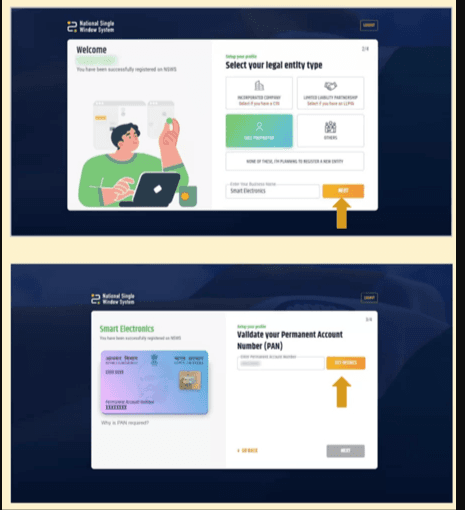
Step 2: Create an NSWS Account
As of now, the startup registration process online route is through NSWS.
The applicant is required to:
- Reach the NSWS website
- Create an account with the entity and authorized signatory information
- Reach the dashboard
- Select “Add Approvals” or the equivalent approval search option
- Find “Registration as a Startup”
- Add the DPIIT recognition form to the dashboard
The portal may seek information related to identity, entity, PAN, address and authorized signatory. Ensure that information aligns with the MCA records and incorporation certificate.

Step 3: Apply for DPIIT recognition
Fill the form carefully. Your application will need your legal name, date of incorporation, entity type, registered address, directors or partners, business activity, industry and contact details, as well as a website.
You should describe your business like this:
- The problem of your customer.
- The product or service you offer.
- The underlying innovation or technology.
- The stage of your business.
- Evidence of users or deployment and revenue.
- The potential for new jobs and wealth creation.
- The intellectual property you filed, own, or are developing.
- Your business is going beyond local and conventional businesses.
For a DeepTech application, supply the additional technical and R&D evidence requested by the portal.
Step 4: Upload documents
As per the DPIIT process, the minimum documents required are the incorporation/registration certificate and a brief description of the business, innovation and scalability. In practice, the portal or review process may also request the following documents:
- The PAN of the entity.
- The Memorandum and Articles of Association.
- The LLP agreement or partnership deed.
- Details of the directors or partners.
- Board resolution or authorisation letter, as applicable.
- The Digital Signature Certificate of the applicant.
- A link to the website, product demo, proof of concept, or product demo pitch deck.
- Details of patents, trademarks, or designs, if available.
- Evidence of financial, revenue, user, or employment growth.
- Deep tech evidence for R&D, technology and IP.
Documents must be valid, readable and concise. Exaggeration and unsupported innovation statements should not be included.
Step 5: Review and certificate
DPIIT can accept the application, request additional information, or reject the application with an explanation. Once an application is approved, a Certificate of Recognition is issued digitally and can be downloaded from the NSWS/DPIIT portal.
Recognition is valid subject to continued compliance with age, turnover and other conditions. DPIIT may revoke recognition if it was obtained through misleading or incorrect information, or if the entity ceases to meet the eligibility criteria (e.g., breaches the age or turnover thresholds).
Legal Framework for Startups
The legal requirements for startups in India are fragmented and dispersed across multiple statutes. DPIIT recognition does not exempt a company from the requirements of the Companies Act, taxes, labour laws or sectoral regulations.
Companies Act, 2013
A private limited company must comply with the following:
- Requirements related to board meetings and minute-keeping.
- Requirements for appointment and disclosure of directors.
- Maintenance of statutory registers.
- Record keeping for share transfers and allotments.
- Requisite formalities related to transactions amongst related parties.
- Requirements regarding the maintenance of financial records and the audit thereof.
- Requirements related to the holding of annual general meetings.
- Requirements for annual filings with the Registrar of Companies.
The more common forms are AOC-4 for financial statements and MGT-7 or MGT-7A, if required, for annual returns. The applicable form can differ based on the company type and the relevant MCA rules. MCA states that MGT-7 is the annual return form for companies with share capital.
LLP Act, 2008
An LLP must retain its agreement, monthly records of partners, account books and records of designated partners.
The two major yearly filings are:
- Form 11: Annual Return of LLP.
- Form 8: Statement of Account and Solvency.
According to MCA, Form 11 is usually filed within 60 days of the end of a financial year and Form 8 is filed within 30 days of the end of 6 months of that financial year.
Income Tax Act
From 1 April 2026, the Income Tax Act, 2025 came into force (applicable from Tax Year 2026-27). Startups must meet the regular income tax requirements and could also be eligible for certain tax advantages. They include Section 80-IAC for qualified profit-linked deductions. Section 54EE as well as 54GB for certain capital gain reliefs and Section 79 to carry forward losses, subject to conditions.
The DPIIT startup registration does not automatically allow the tax deduction. The qualifying startup has to satisfy the provisions of the tax law and obtain the required certificate.
GST
The startup company has to get GST registration when the relevant threshold for turnover or other requirements is satisfied. After that, the business should keep following the GST tax return requirements, make electronic invoices where applicable and do the reconciliation of input tax credits properly, as expected.
The threshold limits cannot be applied mechanically. CBIC states that the threshold of ₹20 lakhs (or ₹10 lakhs in some specified states) is presumed to be the normal threshold.
FEMA and Sector Regulations
Foreign investments, overseas payments, foreign shareholders, external commercial borrowings and share issues or transfers may require notification to the RBI under the Foreign Exchange Management Act (FEMA).
The startup must verify:
- Sectoral limits on foreign investment.
- Automatic route and government approval requirements.
- Regulations regarding pricing and valuation.
- Prohibited sectors.
- Reporting forms and deadlines.
- Rules on downstream investments.
- Beneficial ownership and know your customer regulations.
Sector regulators may also apply. For instance, securities and financial services (RBI), insurance (IRDAI), health products (CDSCO) and education services (UGC) may impose regulatory requirements for some activities, as may regulators for e-commerce and services to protect consumers.
Benefits of DPIIT Recognition
Tax benefits and Section 80-IAC
Eligible startups can claim a 100% deduction of profits from eligible business for three consecutive financial years out of the first ten years from incorporation, subject to conditions. Key limitations:
- Generally available to Private Limited Companies and LLPs (not partnership firms or cooperatives).
- DPIIT recognition is necessary but not sufficient; a separate Inter-Ministerial Board (IMB) certificate is required.
- The turnover limit for 80-IAC is ₹100 crore in the financial year for which the deduction is claimed (distinct from the ₹200/₹300 crore DPIIT recognition thresholds).
- Under the Income Tax Act, 2025 (effective 1 April 2026), the incorporation window is extended to entities incorporated before 1 April 2030, subject to other conditions.
This is why founders should treat Startup India (DPIIT) registration and the 80-IAC tax holiday as two separate but interconnected applications.
Intellectual Property Benefits
- Recognised startups can avail themselves of government facilitator services and expedited patent examinations, but statutory fees are still payable.
- As per Startup India, recognised startups are eligible for an 80% discount on patent filing fees as compared to other companies, within the limits and fees applicable.
- Wherever possible, patent applications need to be filed before public disclosure.
- Use of confidentiality agreements, invention assignments and founder-to-company IP transfer documents is advisable.
Government Tender Benefits
Some startup businesses eligible to register on GeM are granted participation in government procurement. Specific manufacturing startups may become exempt from requirements related to prior experience and turnover, as may be the case, based on technical capability and quality. Registered startups may also be exempt from the earnest money deposit in relevant tenders.
By March 2026, more than 38,600 startups had been onboarded on GeM, with cumulative startup orders valued at more than ₹19,190 crore (largely driven by FY 2025-26).
Funding and Financing Schemes/Services
The recognition may provide additional access to services and schemes, including, among others:
- The Startup India Seed Fund Scheme
- The Fund of Funds for Startups
- The Credit Guarantee Scheme for Startups
- State-led Incentive programs
- Government challenges
- Innovation grants
By the close of fiscal 2025-26, the government reported that under the initial Fund of Funds, more than ₹7,000 crore was released to AIFs that invested over ₹26,900 crore in startups. The Fund of Funds 2.0 was published with a proposed corpus of ₹10,000 crore. The Credit Guarantee Scheme was modified to permit an increase in the guarantee cover for each beneficiary from ₹10 crore to ₹20 crore.
These Startup India scheme eligibility criteria do not indicate approval. Assessments of applicants’ files and lenders’ assessments and sector conditions continue to stay in force and may impact approvals.
Self-Certification Benefits
Certain startups may self-verify compliance with six specified labour laws and three environmental laws.
Under Startup India, self-certification of certain labour laws can reduce inspections for five years, unless there is a legitimate and verified complaint. ‘White’ category startups under the environmental framework can also self-certify with random checks.
Self-certification should not be misconstrued as a complete waiver for obligations related to employment, safety, wages, pollution and the workplace.
Compliance Requirements for Startup Registration
Registrar of Companies (ROC) and MCA compliance
Create a compliance calendar for the following:
- Board meetings as well as shareholder meetings
- Annual financial statements and annual returns
- Director KYC and event-based filings
- Share allotments, ESOPs and transfers
- Changes in the registered office
- Deposits, loans and related-party transactions
- Beneficial Ownership declarations
- Appointment, rotation and changes in the Auditor
Income Tax compliance
Keep records for the following:
- Annual Income Tax Return
- Tax Audit
- TDS payments and returns
- Advance Tax
- Books of accounts and invoices
- Documentation of capitalised expenditure on software and equipment
- Transfer pricing
- Investor records
- Valuation of Share Premium
Recognition does not exempt the filing of returns when the company has no income or records a loss.
GST compliance
For the startup registration process online, keep the following:
- GST tax invoices
- GSTR-1, GSTR-3B, Input Tax Credit
- E-Invoicing and E-way Bill
- GST registration changes
- Annual return and reconciliation statement
- Records for exports, zero-rated supplies, refunds
- Compliance for startups
Labour and Employment Compliance
Based on location and workforce, consider the following:
- Shops and Establishments Act
- Provident Fund and ESI
- Professional Tax
- Minimum Wages and Wage Registers
- Payment of Gratuity
- Maternity Benefits
- Contract Labour
- Workplace Safety
- Compliance with POSH, which includes establishing a Statutory Internal Committee (wherever applicable)
- All employment contracts, leave records and appointment letters
All Statutory Records and Annual Filings
Keep a central place for:
- Certificates and Licenses
- Board resolutions and minutes
- All statutory registers
- Accounting records and bank statements
- Invoices and Tax Returns
- Payroll Records
- All Investor agreements
- IP contracts, assignments and renewals
All records of data processing and contracts with data processing vendors.
A founder should build this system as one of the first things a founder does when handling how to register a startup in India, rather than waiting for an audit or funding.
Sector-Specific and Emerging Compliance
Data Privacy and Cybersecurity
The Digital Personal Data Protection Act, 2023 and Digital Personal Data Protection Rules, 2025 establish a new, phased compliance framework for businesses that process digital personal data, with full operational compliance required by 13 May 2027 (18 months from notification) and intermediate milestones such as Consent Manager registration opening around November 2026.
Some of the features of a practical privacy program include:
- Privacy notices and a mechanism for consent or lawful use
- A data retention policy and data inventory
- Security and safeguards
- Contracts with processors and vendors
- Access controls
- Mechanisms for user grievance
- A breach-response plan
- Restrictions on cross-border data flows
- Protections for child data, if applicable
- Additionally, FEMA and foreign investment
Before foreign capital is received, confirm the provisions of the instrument, the category of the investor, the sectoral cap, the valuation, the corresponding approval and the reporting timeline. Preserve all share certificates, valuation reports, board approvals and subscription agreements along with bank records.
FinTech, HealthTech, EdTech and e-commerce
A FinTech company may require RBI authorisation and may need to comply with payment, lending, account aggregator and KYC, outsourcing and data security norms.
A HealthTech company may need to comply with medical device, clinical, pharmacy, advertising, patient data and telemedicine norms.
An EdTech company may need to comply with the norms relating to consumer protection, advertising, child safety, data and education.
An e-commerce company may need to comply with all the applicable norms relating to consumer protection, marketplaces, seller disclosure, refunds and grievances as well as foreign investment.
IP Protection
Prior to selecting a brand, do a trademark search. Execute invention and copyright assignments from founders, employees, consultants and vendors. Protect the source code and product designs and databases, as well as trade secrets and domain names, through contracts and technical means.
Common Startup India Registration Mistakes
Even the most well-intentioned startup founders are running into issues when going through the startup registration process online. Here are some common, recurring mistakes in DPIIT applications:
- Misconstruing incorporation as DPIIT recognition—Forming a private limited company or an LLP through the MCA is not the same as getting DPIIT recognition and vice versa. Both have to be done and they are done separately.
- Thinking there is a tax exemption automatically provided—DPIIT recognition does not mean a company is entitled to section 80-IAC automatically. A lot of startups wrongly think that recognition is enough to claim the exemption.
- Filling in forms incorrectly or incompletely—not having matching information, names, addresses, or dates on the incorporation form or the recognition form is one of the most common, completely avoidable reasons for forms to be rejected.
- Believing there is no post-registration compliance—A lot of people think acknowledging DPIIT recognition is done and completed. They do not understand that recognition status is tied to investment limits, revenue limits and how frequently you file.
- Using the old registration criteria—A lot of startup founders think that they have to follow the old definition of a ₹100 crore revenue limit, even though the ₹200 crore limit has been defined, along with allowing deep tech and cooperative societies to fall under G.S.R. 108(E).
Startup India Compliance Checklist 2026
Reference this for the recognition process and the compliance obligations with the legal requirements for startups in India that follow:
Registration Documents
- Certificate of Incorporation/Registration
- Entity's PAN and TAN
- Authorized signatory KYC and Aadhaar
- Innovation write-up and supporting evidence (pitch deck, product demo, website)
Tax Filing
- Income Tax Return for the year
- Advance tax installments (if applicable)
- Separate IMB Application for Section 80-IAC in case opting for the tax holiday
- TDS Returns including deferred tax payment under Section 192(1C) and ESOPs (where applicable)
GST
- GST Registration upon crossing the GST turnover threshold
- Regular GST filing and book turnover reconciliation
MCA/ROC Filing
- Financial Statements and Annual Return (MGT-7 / AOC-4 for companies; Forms 11 and 8 for LLPs)
- Board Meeting Minutes and Statutory Registers
Labour Compliance
- Self-certification for applicable labour laws through the Shram Suvidha Portal
- Genuine compliance with EPF, ESI and minimum wage requirements
IP and Data Protection
- Filing of trademarks and patents with DPIIT-facilitated rebates
- IP-assignment agreements with founders and employees
- Practices/consent for data privacy based on sector-specific needs.
Frequently Asked Questions (FAQs)
Q1. Is Startup India Registration Mandatory?
No. Startup India registration and DPIIT recognition are typically voluntary. If a startup wishes to avail itself of government benefits, procurement access, tax certifications, or government grants, DPIIT recognition is deemed beneficial.
Q2. Who is eligible for the Startup India registration?
A business that is incorporated or registered in India as a private limited company, partnership firm, LLP, multi-state cooperative society, or eligible state/UT cooperative society can be considered eligible, as long as the innovation, age, turnover, or scalability for the Startup India scheme eligibility criteria are met.
Q3. What is the turnover limit for startups in 2026?
For DeepTech startups, the DPIIT recognition turnover limit is ₹300 crore in any financial year since incorporation or registration. This is different from the ₹100 crore beneficiary limit under the separate provisions of charity-based tax incentives. For other DPIIT-recognized startups, the turnover limit is ₹200 crore.
Q4. For what period is DPIIT recognition valid?
A DeepTech startup can be recognized for 20 years from the date of incorporation or registration and is subject to the validation criteria as stated in the notification. The validity for other startups is 10 years. The recognition stands withdrawn for any violation of notifications and/or misrepresentation of facts.
Q5. What are the documents required?
As per the 2026 notification, the minimum documents required are the incorporation/registration certificate and a business description. While filling out the online form, the applicant may be required to submit PAN, the constitution documents, authorization, the names of the directors/partners, proof of concept, IP information and Deep Tech.
Q6. Does DPIIT Recognition Provide Automatic Tax Exemption?
No. Registration of a startup with DPIIT does not provide the profit-linked tax deduction. Eligible private limited companies and LLPs have to satisfy the other provisions of the tax acts and obtain the required certification.
Q7. What annual compliance requirements do you generally see?
Income tax returns, tax deducted at source, GST returns, resumption of accounting records, audit, labour and other required filings, renewal and protection of IP, data-protection controls and sector-specific reports.
Q8. What are the annual compliance requirements of an LLP?
LLPs must file:
- Form 11 (Annual Return) within 60 days of the end of the financial year and
- Form 8 (Statement of Account & Solvency) within 30 days of six months after the end of the financial year.
They must also maintain books of account, partner records, designated partner details and comply with applicable tax, GST & labour laws.
Conclusion & Next Steps
Startup India registration is not a single form-filling exercise; it is a legal and financial strategy that runs from incorporation through years of ongoing compliance. Getting it right means understanding the current eligibility criteria accurately, following the process step by step through the NSWS portal and treating the resulting certificate as a starting point rather than a finish line for tax, IP and funding benefits. Just as important is respecting the broader legal requirements for startups in India: company law, tax law, GST, FEMA, labour law and sector-specific regulations, which apply regardless of DPIIT status.
The 2026 framework is significant because the threshold for recognition has been raised to the amount of ₹200 crore. DeepTech startups are granted the benefit of a 20-year timeframe with a limit of ₹300 crore and the legal structures that are eligible specifically include certain cooperative societies. In addition, the new Income Tax Act of 2025 as well as the phased data protection frameworks require the founders to revise their guidelines for compliance.
Every startup in India has legal requirements that should be reviewed before beginning incorporation, prior to starting fundraising, before entering a sector that is regulated and prior to foreign investment and before applying for any incentive from the government. Being up-to-date on DPIIT announcements, NSWS requirements, MCA forms, tax laws and regulator guidance is crucial for meeting the legal requirements for startups in India and for protecting the company’s reputation, funding prospects and long-term growth.