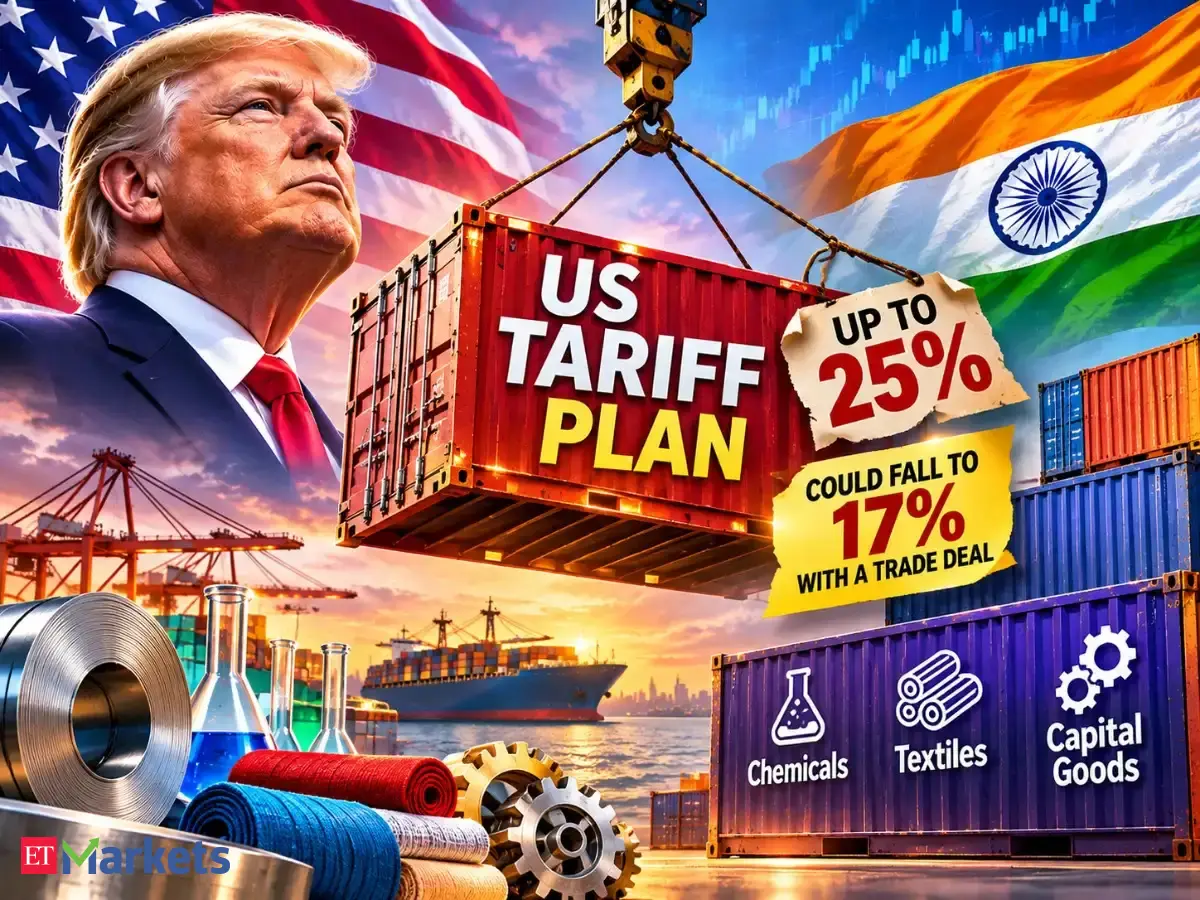
A proposed US tariff of up to 25% on Indian goods has put export-linked stocks back in focus, with chemicals, textiles and capital goods among the sectors facing potential exposure. A trade deal could lower the proposed rate to 17%, but until that is settled, companies selling into the US must account for a new source of uncertainty.
The proposal is not yet in force, and the near-term market impact may be limited. The effect on individual exporters, however, could depend on which products are covered and whether they can redirect shipments.
The US Trade Representative proposed new tariffs on 14 economies after an investigation under Section 301 into policies it says contribute to excess manufacturing capacity. India faces a proposed rate of up to 25%. The proposal allows the rate to fall to 17% if India and the US reach an Agreement on Reciprocal Trade. The rates remain proposals, with public comments scheduled through Jan. 5, 2027, and hearings due to begin on Jan. 25.
Jefferies identifies Navin Fluorine , PI Industries and SRF among chemical exporters that could face the proposed rate. Welspun Living is named among textile companies with exposure. In capital goods, Cummins India , Thermax and KEI are among the companies that could be affected. The research does not quantify the potential impact on each company’s revenue or earnings, so the exposure will depend on the products they export and the final tariff terms.
The hit may be uneven across India’s export base. Pharmaceuticals, energy products and some electronics and auto-component categories, which are about 45% of India’s exports to the US, are outside the current tariff framework or remain subject to separate sector-specific rules, according to Jefferies. Electronics and pharmaceuticals alone account for about 43% of India’s exports to the US. Emkay says textiles, gems and jewellery, and marine products could see slower growth. These categories do not all face the same treatment, making product-level coverage important to assessing the impact on individual exporters.
The scale of the trade link explains why the tariff proposal matters to markets. India exported $103.8 billion of goods to the US in 2025, while imports from the US were $45.4 billion, according to Jefferies. Electrical machinery and equipment accounted for $30.1 billion of exports, and pharmaceutical products for $15.1 billion. Machinery and mechanical appliances contributed $7.3 billion, while precious metals and stones accounted for $6.4 billion. The report says electronics and pharmaceuticals together made up about 43% of exports to the US.
"This is more a tactic to apply pressure on India to reach a deal. India is unlikely to relent much. This tariff threat is unlikely to have any impact on the market in the near-term," Geojit's Dr VK Vijayakumar said.
The proposed rate would leave India at a relative disadvantage to many Asian peers. Bangladesh, Indonesia, Malaysia and Thailand face proposed rates of 18%, while Japan, South Korea and Taiwan face 15%. Vietnam’s proposed rate is higher, at 35%. Emkay says India’s position has deteriorated from the earlier tariff round, when it had a lower rate than several competing Asian exporters. A 17% rate under a deal could give India a 1–3 percentage-point advantage over some emerging-market peers, according to Jefferies.
The USTR’s investigation also points to the policy issues that could shape the negotiations. It flags programmes such as Make in India, Production Linked Incentives and Atmanirbhar Bharat, arguing that they contribute to excess capacity. It also cites labour protections, preferential financing to priority sectors, market-access barriers and India’s links to industrial imports and investment from non-market economies. JM Financial says some of the comparisons in the investigation, especially those with the US, are not appropriate and argues that India’s position on measures including Chinese value-add, labour and manufacturing share of GDP gives it scope to negotiate.
The proposed tariffs could also affect the timing of exports. India’s shipments to the US averaged $8.4 billion a month in the first part of FY27, with growth in recent months above 30%, Emkay says. The brokerage expects frontloading ahead of implementation to support exports in the near term.
India’s US exports averaged $8.6 billion a month from February to July 2025, compared with $6.5 billion in the previous six months, as exporters moved shipments ahead. Exports then fell sharply after the tariff rate was raised to 50% in late August 2025. India also diversified destinations during that episode: US exports declined 10% from September 2025 to March 2026, while exports to the rest of the world rose 3%, according to Emkay.
That history suggests a near-term export lift would not necessarily mean the risk has passed. Frontloading can shift shipments forward, while the eventual tariff rate and exporters’ ability to find other markets will shape what follows. Emkay expects India’s goods exports to grow more than 15% in FY27, with frontloading of US shipments contributing to that outlook.
India’s broader economic data have remained resilient through tariffs and geopolitical disruption, Emkay says. GDP grew 7.8% in FY26, and the brokerage estimates 7.9% growth in the first half of FY27. Goods exports rose 22% in the first seven months of FY27, while the current account deficit is projected at less than 1.5% of GDP for the full year.