
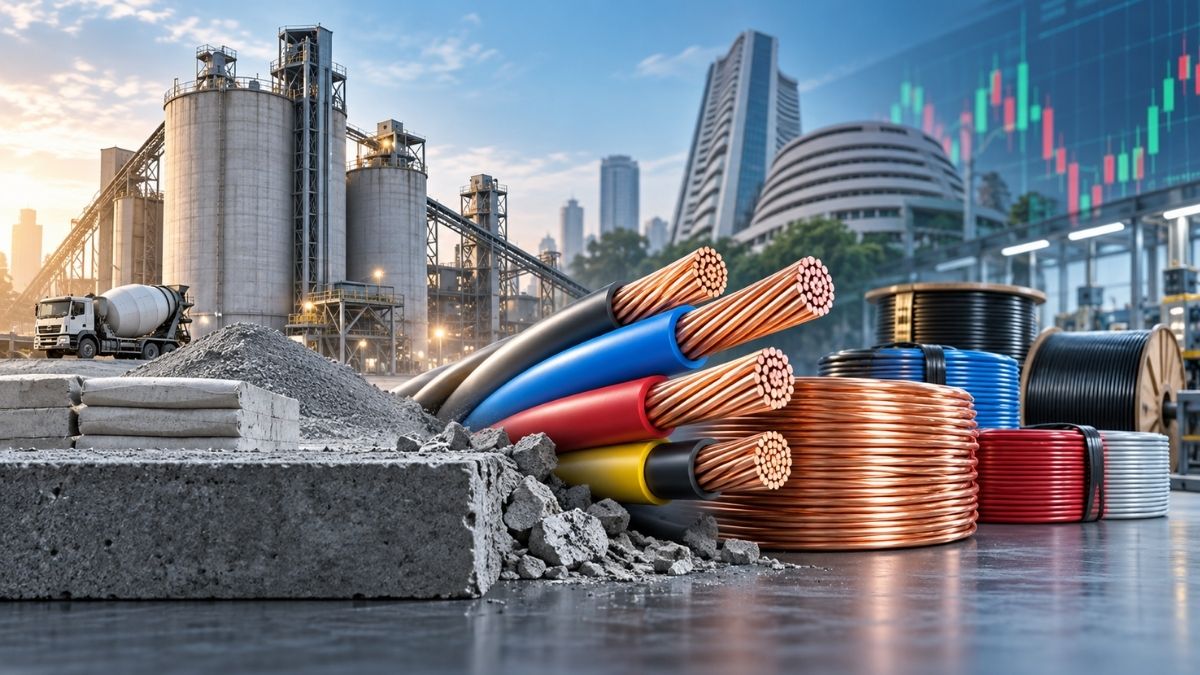
A cement company makes a foray into the wires and cables business. What would it mean for investors tracking existing cable market leaders like Polycab, KEI Industries and RR Kabel? The question is simple – Will a deep-pocketed new entrant take market share from the established players or will the industry’s rapid growth leave enough room for everyone.
UltraTech Cement, India’s biggest cement maker, has poured Rs 1,800 crore into a new venture called Ultravolt, and the plant in Jhagadia, Gujarat has already started production.
Market experts and analysts believe the immediate threat is not a sharp loss of volumes. The bigger concern could be pricing pressure and dealer incentives, especially in the wires segment. FinancialExpress.com spoke to a host of industry experts to understand the impact. Here’s what they had to say –
Sunny Agrawal, Head of Fundamental Research at SBI Securities, believes UltraTech’s entry has come earlier than expected, but he does not see the initial investment large enough to materially shake up the industry.
Agrawal said, “UltraTech’s entry into wires & cables through Ultravolt has come earlier than expected, although the risk was partially reflected in sector valuations after the February 2025 announcement. While UltraTech brings the advantages of a strong balance sheet, established brand and extensive distribution network, we do not believe the initial Rs 1,800 crore investment is large enough to materially disrupt the industry.”
The reason is simple, the sector is growing at a fast pace. “Unlike the paint industry, the wires & cables industry is growing at 13-15% annually on a market size of roughly Rs 1 trillion, creating an incremental opportunity of around Rs 13,000-15,000 crore every year. This should allow both incumbents and new entrants to grow simultaneously,” added Agrawal.
That growth could absorb a large part of Ultravolt’s capacity. Agrawal estimated that with the announced capex and around five times revenue asset turns, Ultravolt could eventually generate close to Rs 9,000 crore of revenue at peak utilisation.
But there is another issue. He said, “The key risk from UltraTech’s entry is likely to be margin pressure rather than market-share loss.”
This is because an aggressive push for shelf space could force existing companies to increase dealer incentives or adjust pricing.
He noted, “If Ultravolt adopts an aggressive market-share acquisition strategy by offering higher dealer margins and incentives, incumbents may be forced to respond, resulting in pressure on industry profitability and margin trajectories.”
Akshay Shetty, Research Analyst at Mirae Asset Sharekhan, sees an even clearer distinction between wires and cables. He pointed out that, “Market share will build gradually. Ultravolt started production at Jhagadia, Gujarat on 1 September 2026, with capacity of about 10.98 lakh km and industry demand continues to grow steadily, so this capacity gets absorbed.”
For him, pricing is the bigger concern. “Pricing power is the real pressure point. Capex is just Rs.1,800 crore, It is a small bet for UltraTech and a large threat for incumbents,” he said.
He also believes the threat will initially be greater for wire-heavy businesses.
Shetty elaborated, “The pressure is on wires first, not cables. Ultravolt is launching in house wires and light-duty cables. Cables need vendor approvals, technical references and years of track record.”
That could provide some protection to companies with stronger institutional, high-voltage and export exposure.
In the overall cable and wire segment, Agrawal continues to favour the incumbent leaders. He said, “We continue to prefer the incumbent leaders, particularly Polycab, which remains the industry’s strongest player with 30-31% market share, the widest distribution network, superior profitability and a meaningful export franchise.”
He also sees KEI Industries as a higher-growth opportunity, while RR Kabel remains worth watching after its recent rally.
He further added, “From a valuation perspective, we would prefer accumulating incumbents on corrections rather than chasing them after the recovery. Polycab remains our preferred pick, especially around 31-32x forward earnings, given its scale, brand strength and leadership position.”
But there is a key monitorable. Agrawal said, “The key monitorable is margins. A moderate decline would be manageable, but a sustained fall below 10% could impact earnings growth.”
Shetty also picks Polycab. “Within wires and cables, Polycab would be our preferred pick. Scale, brand and distribution reach give it the strongest defence against a new entrant,” he noted.
For investors looking at higher growth, KEI remains another name on the radar.
Despite its entry into cables, analysts do not expect Ultravolt to become a major earnings contributor immediately.
Shetty said, “As for UltraTech, we continue to view it primarily as a cement story, with Ultravolt providing long-term optionality rather than becoming a meaningful earnings contributor in the near term.”
Raghav Maheshwari, Assistant Vice-President at Equirus Securities, also sees the cement business as the stronger near-term story.
Maheshwari said, “UltraTech remains best placed among incumbent leaders.”
He points to UltraTech’s roughly 12% volume CAGR between FY21-26, ahead of several large peers. The company also plans to expand cement capacity from 196.8 million tonnes in FY26 to around 242.5 million tonnes by FY28.
His preferred large-cap cement exposure remains clear.
“Top stocks to watch: UltraTech Cement remains our preferred large-cap cement exposure, supported by superior execution, high utilisation, and the strongest medium-term growth visibility.”
The cable entry could create some near-term pressure on UltraTech as investors assess whether the new business deserves capital.
Jigar S. Patel, Senior Manager of Equity Technical Research at Anand Rathi Share and Stock Brokers, says the stock is currently showing a weak short-term trend.
The stock is trading below its 55-day, 89-day, 100-day and 200-day exponential moving averages (EMAs). It has moved towards the Rs 11,250-Rs 11,300 zone, where buying interest could emerge.
Patel has placed support at Rs 11,250-Rs 11,200, followed by Rs 11,000. Resistance is seen at Rs 11,650-Rs 11,720, with Rs 12,000 above that.
SBI Securities’ Agrawal believes annual industry demand growth of 13-15% is large enough to accommodate a new player without immediately taking away large chunks of incumbent market share.
But the more important test could be profitability. The sector’s relatively modest net margins leave less room for prolonged price competition. At the same time, cables with lengthy certification and approval processes may remain more insulated than retail-focused house wires.
For now, analysts continue to prefer Polycab, while KEI Industries remains a higher-growth name to watch. RR Kabel is also in focus, but valuation could matter more after its recent gains.UltraTech’s entry, meanwhile, changes the competitive landscape. The real test begins when Ultravolt moves from commissioning capacity to fighting for customers, dealers and market share.