
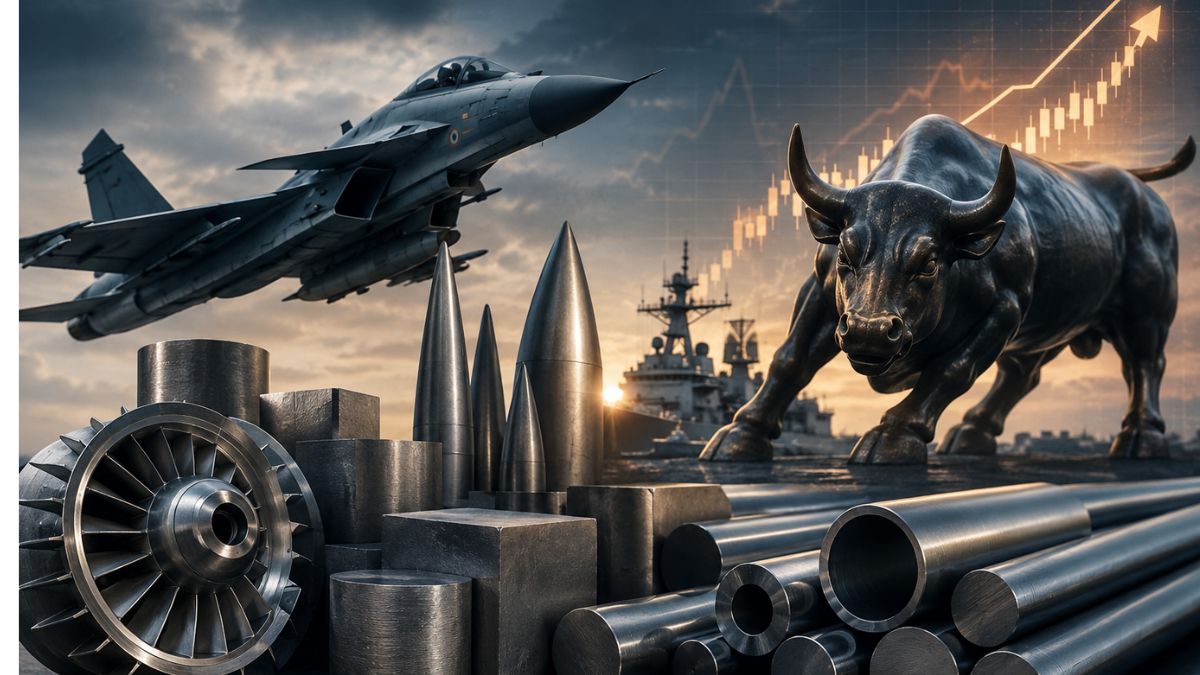
Mishra Dhatu Nigam, or MIDHANI, is entering a potentially larger defence procurement cycle with an order book of Rs 2,290 crore, more than Rs 660 crore of titanium orders and a Rs 1,000-crore capital expenditure programme planned over the next three years.
The timing is interesting, as it comes at a time when the government has given the Armed Forces greater financial authority to buy equipment and increase indigenous procurement. On June 4, Defence Minister Rajnath Singh released the Delegation of Financial Powers to Defence Services 2026, giving the Armed Forces financial powers to facilitate more than Rs 1.25 lakh crore of procurement through the revenue route under current-year budget allocations.
The Ministry of Defence also doubled the financial powers delegated for indigenisation and research and development, with the stated aim of reducing dependence on foreign equipment manufacturers.
MIDHANI, a Government of India enterprise under the Ministry of Defence, makes titanium alloys, superalloys and special steels used in aerospace, defence, space and other strategic applications. It finished FY26 with turnover of Rs 1,208.63 crore and profit after tax of Rs 130.79 crore. The company produced about 700 tonnes of titanium during the year, nearly twice the previous year’s output, and expects around Rs 1,500 crore of fresh orders in FY27.
The policy does not guarantee MIDHANI any orders. The company still faces imported raw-material requirements, energy constraints and lengthy aerospace qualification cycles. The management expects at least 15% revenue growth in FY27, with 20% as the target if supply conditions improve, while EBITDA margins are expected at 23% to 25%.
DFPDS-2026 or Delegation of Financial Powers to Defence Services 2026 gives the military services greater financial authority to make revenue-route purchases, including urgent operational procurement and joint-Service purchases. The Ministry said financial powers have increased by up to 100% in several areas, while some categories have received more than a two-fold increase. The ceiling for urgent operational requirements has also increased by 100%.
The government has introduced provisions for joint-service procurement by the Lead Service with higher delegated powers and added new Competent Financial Authorities to decentralise procurement of goods and services.
For MIDHANI, the most relevant provision is the doubling of financial powers for indigenisation and R&D within the military ecosystem. The company makes materials required for aircraft, aero-engines, missiles, naval systems and space applications, placing it near the beginning of several defence manufacturing chains.
MIDHANI’s order book stood at Rs 2,290 crore as of April 1, 2026. During the June 3 earnings call, Chairman and Managing Director Dr SVS. Narayana Murty referred to the open order book as about Rs 2,250 crore and said the company expects to add around Rs 1,500 crore of orders during FY27.
Defence accounts for roughly 79% of the backlog, while the order book was about 1.9 times FY26 revenue.
The company had struggled to convert production into sales during the first half of FY26, but execution improved sharply in the fourth quarter.
Murty told analysts that MIDHANI had achieved its highest-ever turnover and converted its production into sales.
“Whatever we have made, not only that we have had the highest turnover, we could convert everything into sales,” Murty said during the Q4FY26 con call announcements.
Q4FY26 revenue rose 34.6% year-on-year to Rs 552.7 crore from Rs 410.6 crore. EBITDA increased 24.3% to Rs 116 crore from Rs 93.3 crore, while PAT rose 38.6% to about Rs 77.9 crore from Rs 56.2 crore.
For FY26, turnover increased 12.52% to Rs 1,208.63 crore from Rs 1,074.1 crore. PAT increased 18.82% to Rs 130.79 crore from Rs 110.07 crore. EBITDA stood at Rs 237.6 crore, giving the company an EBITDA margin of 19.7%.
MIDHANI produced about 700 tonnes of titanium during FY26, almost twice its previous-year production. Management said the company has installed capacity to produce substantially more and already has titanium orders worth more than Rs 660 crore.
Asked about the production outlook, Murty said, “We are fully geared up for a good amount of Titanium production.”
The company also supplied more than 700 ring-rolled rings made from titanium and superalloys for aero-engine applications during FY26.
Titanium remains one of MIDHANI’s most important product areas because the company can take the material through multiple stages of processing rather than stopping at alloy production.
MIDHANI is moving from strategic metals into specialised aerospace products, where qualification requirements are higher, and production involves more processing.
During FY26, the company developed and qualified indigenous cast superalloy single-crystal blade material for aero-engine applications. It also secured NADCAP certification for heat treatment.
For aerospace customers, the certification allows OEMs to procure material directly from a certified manufacturer.
Murty explained, “OEMs can directly procure materials from the manufacturers.”
MIDHANI also received CEMILAC certification for critical aerospace-grade materials. The latest certification covers eight grades and forms of superalloys, two titanium grades and four special-steel grades for aero-engine applications.
The company has said more than 200 parts have been type-certified and supplied for aero-engine applications.
Several international engine manufacturers have been auditing MIDHANI’s facilities. Management expects commercial supply qualification with a major international engine OEM towards the end of FY27.
MIDHANI plans to spend about Rs 1,000 crore over three years on downstream manufacturing equipment, including machinery for forging, bar rolling and wire drawing.
Management said some existing equipment dates from around 1980 to 1985. The replacement programme will bring in more automated machinery and Industry 4.0 systems.
The objective is to increase output from the existing manufacturing base and improve the conversion of melted metal into saleable products.
Murty explained, “So it will improve the efficiency and yield of the product.”
The detailed project reports were at an advanced stage during the June 3 earnings call, with board approvals expected within one to two months.
Finance Director Madhubala Kalluri said the company plans to fund the programme through internal resources and term loans. Management does not expect the planned capex to create a major funding constraint.
MIDHANI’s immediate revenue ambition is around Rs 2,000 crore, compared with Rs 1,208.63 crore in FY26.
Management expects higher production, better yields, downstream capacity and a larger contribution from value-added products to drive the increase.
The FY27 target is at least 15% revenue growth, with 20% retained as the management target if raw-material and energy supplies improve. Management expects EBITDA margins of 23% to 25% in FY27, compared with 19.7% in FY26.
A 15% increase on FY26 revenue would put annual revenue at roughly Rs 1,390 crore, while 20% growth would take it to roughly Rs 1,450 crore. These are calculations based on the company’s FY26 revenue and are not additional management guidance.
During the earnings call, management pointed to roughly Rs 8,000 crore worth of titanium alloys, superalloys and special steels that India currently imports.
MIDHANI believes a portion of that imported business can move to domestic production as defence and aerospace programmes increasingly seek indigenous sources.
Management has discussed an eventual revenue ambition of Rs 5,000 crore over five to seven years.
“Reaching the higher revenue at a rate of 15% to 20% growth year-on-year is not far from reality.”
The Rs 5,000-crore figure is a long-term management aspiration rather than a formal financial forecast. The immediate target remains Rs 2,000 crore of revenue.
MIDHANI produces strategic materials that can replace imported finished defence products, but many of the raw materials needed to manufacture those alloys are imported.
Management identified nickel, cobalt, molybdenum, tungsten, vanadium and chromium as six critical materials for the proposed Metal Bank. Rhenium was also mentioned among the wider group of critical inputs.
MIDHANI imports more than 20 materials from different countries. Europe is a major source by value, while titanium sponge is also sourced from Kazakhstan.
Murty explained the problem, “India is not bestowed with the best of raw materials required for superalloy production.”
The company has dealt with sanctions that prevented procurement, sudden price increases and situations where material was available but could not be transported.
Murty said, “There are multiple ways in which the supply chains are getting disrupted.”
For a company working under fixed-price defence contracts, such disruptions can affect execution and margins.
MIDHANI has signed an MoU with stakeholders to establish a Metal Bank for critical imported materials.
Management expects the facility to become operational within roughly four months from the June 3 earnings call.
The proposed structure is intended to provide a continuing reserve rather than a one-time inventory purchase. Material would be available when normal supplies are disrupted and replenished when procurement conditions return to normal.
Murty described it as “a perpetual bank.”
The initiative is connected to the company’s FY27 growth guidance. Management has retained 20% as its target, but raw-material availability will determine how much of that target can be delivered.
“Our target will be 20%. But it all depends on the supply chain constraints of raw materials.”
Director Production and Marketing Padavittan Babu expects EBITDA margins to reach 23% to 25% as revenue and product mix improve.
MIDHANI is already developing materials for the Advanced Medium Combat Aircraft programme.
The company is working on both titanium and superalloys for AMCA requirements.
“MIDHANI is currently executing some of the AMCA alloys, both Superalloys as well as Titanium.”
Commercial orders will depend on the programme’s development and qualification cycle. The company is also working on materials for indigenous aero-engine programmes and other strategic applications.
During FY26, MIDHANI commissioned a Rs 40-crore aerospace fastener facility.
The plant produces superalloy, titanium-alloy and special-steel fasteners for aerospace and defence applications. Management expects annual revenue of roughly Rs 20 crore to Rs 30 crore from the facility, with around Rs 25 crore viewed as a stable annual level.
The company also manufactures its own specialty alloy wire, which is used as an input for the fasteners.
“we can make our own wire, ” during the company’s earnings call after the annoncement of the Q4FY26 earnings.
The company is pursuing similar opportunities in investment castings, titanium components, superalloy rings and other specialised aerospace products.
MIDHANI’s export business remains small compared with its domestic defence business.
Management said FY26 exports were around Rs 85 crore during the conference call and expects at least Rs 100 crore in FY27.
The larger opportunity lies in international aerospace qualifications. International engine manufacturers have been conducting repeated audits of MIDHANI’s facilities, with commercial qualification expected from a major international engine OEM towards the end of FY27.
MIDHANI shares closed trade at Rs 426 on August 11. The stock has gained 10.05%, over the past year. It has gained 24.65% so far this year while the six-month gain stands at 15.43%.
Over the past month, the stock has gained 3.31%.
The stock remains below the Rs 469 52-week high cited in the FY26 research reports, while the 52-week low was Rs 267.
MIDHANI now has a sizeable order book, a growing titanium business and a defined investment programme. Its Rs 2,290-crore order book gives it work to execute, while the expected Rs 1,500 crore of fresh orders in FY27 would provide another source of revenue beyond the existing backlog.
The more difficult part is converting the company’s technical capabilities into sustained commercial output. Raw materials still have to be imported, some machinery is decades old and aerospace customers can take several rounds of qualification before placing regular orders.
The government’s procurement changes improve the setting for domestic suppliers, but the company still has to deliver on its own numbers. Reaching at least 15% revenue growth, moving towards 23% to 25% EBITDA margins and progressing towards Rs 2,000 crore of revenue will depend on execution rather than policy announcements.
The longer-term opportunity for the company is tied to the Rs 8,000 crore of titanium alloys, superalloys and special steels India currently imports. MIDHANI already has the metallurgy capabilities, a Rs 660-crore-plus titanium order pipeline and work underway on AMCA and aero-engine materials.
If those qualifications translate into repeat orders while the new equipment lifts production and yields, MIDHANI can increase its role in India’s defence manufacturing supply chain without relying solely on a larger government procurement budget. That is the operating test behind the company’s much larger Rs 5,000-crore revenue ambition.
: Mishra Dhatu Nigam (MIDHANI) is scheduled to announce its Q1 FY27 financial results on August 12, 2026.
This disclaimer has been generated using AI to support user well-being and responsible content consumption.