
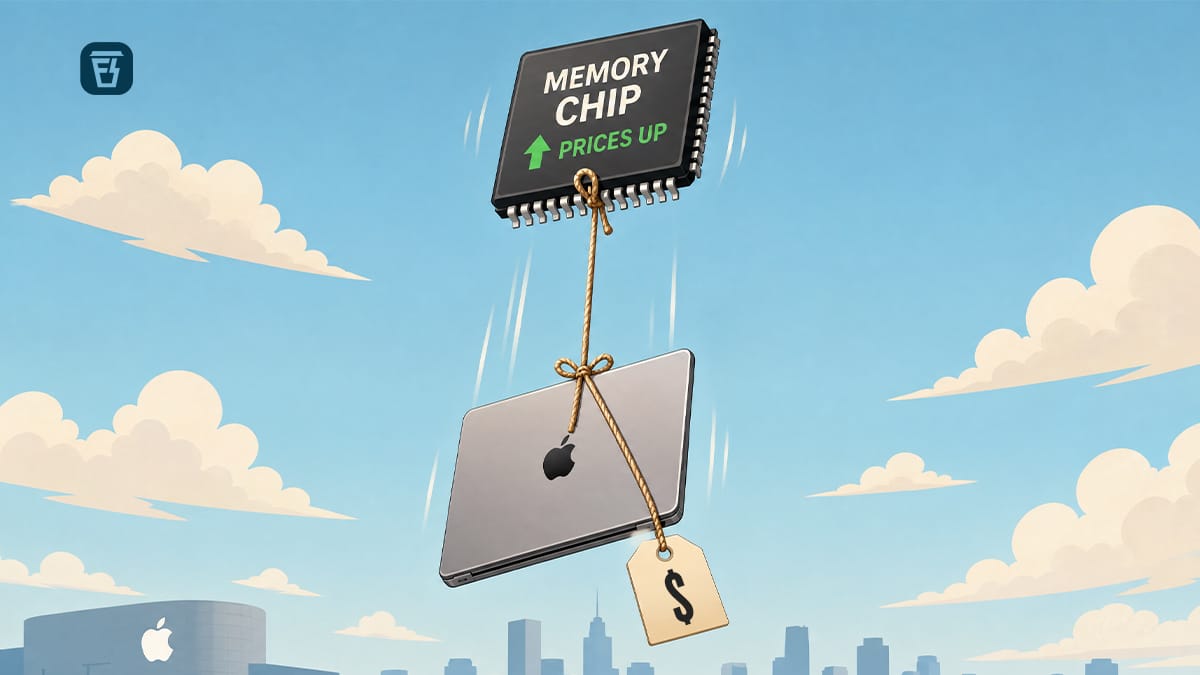
In today’s Finshots, we tell you why Apple is asking the US government for permission to buy Chinese chips.
But here’s a quick sidenote before we begin. If you’re someone who loves to keep tabs on what’s happening in the world of business and finance, then hit subscribe if you haven’t already. We strip stories off the jargon and deliver crisp financial insights straight to your inbox. Just one mail every morning. Promise!
If you’re already a subscriber or you’re reading this on the app, you can just go ahead and read the story.
The Story
Last week, a friend and I dropped by iPlanet to check out the MacBook Air. We liked what we saw, but decided to sleep on it for a couple of days before pulling the trigger.
And that, folks, turned out to be quite an expensive decision.
By the time we walked back in, Apple had increased the prices of its Macs, iPads and other devices.
As it turns out, the culprit wasn’t only inflation or tariffs. It was a global scramble for memory chips that has become so intense, Apple is now asking the US government for permission to buy them from a Chinese company.
If you’ve been watching the news lately, the problem sounds very familiar. AI companies are building data centres at a blistering pace. Those servers need enormous amounts of memory chips. So companies like Samsung, SK Hynix and Micron have increasingly moved production towards the customers willing to pay the most.
That has left fewer chips for laptops, tablets and phones. Apple can still buy them, but not at yesterday’s prices. And that’s beginning to show up on product price tags. We wrote about the whole memory price hike here back in December.
But rising prices aren’t the most interesting part of this story. It’s what happened next.
Apple approached the US government for permission to buy memory chips from a little-known Chinese chipmaker, ChangXin Memory Technologies (CXMT).
The catch? The Pentagon had already blacklisted the company over alleged military ties.
So why does Apple seem so desperate to source chips from a blacklisted Chinese firm, you ask?
To understand that, we’ll have to rewind a bit. If you’ve never heard of CXMT, don’t worry. You’re not alone.
Just a few years ago, it barely registered in the global memory chip industry. Today, it’s China’s biggest DRAM maker and the world’s fourth-largest with a 7.7% market share.
DRAM (Dynamic Random Access Memory) chips are the memory chips that temporarily store data while your phone or laptop is running. They’re different from NAND (Not AND, yes that’s what NAND stands for) chips, which permanently store your photos, apps and files.
Its rise, however, didn’t begin in China. Like many semiconductor stories, this one begins with a company that failed.
Back in 2009, Germany’s Qimonda, once Europe’s biggest memory chipmaker, collapsed during the global financial crisis. Its patents were licensed out, its engineers scattered across the world, and some eventually found their way to China.
Fast forward to 2016. A Chinese entrepreneur named Zhu Yiming wanted to build China’s own DRAM company.
It sounded almost impossible. Samsung, SK Hynix and Micron had spent decades perfecting DRAM technology. They built vast patent portfolios and manufacturing expertise that made it incredibly difficult for new players to enter the market. And catching up would require billions of dollars and years of losses before producing a single competitive chip.
Naturally, private investors weren’t convinced. So Zhu turned to the city of Hefei instead.
That might sound unusual. But if you’re an Indian reader, think of it like the Tamil Nadu government’s early investment in Titan through TIDCO (Tamil Nadu Industrial Development Corporation). Hefei followed a similar playbook, only on a much larger scale, using state capital to invest in tech companies. The playbook would later earn a name: the Hefei model.
In CXMT’s case, that meant funding the years of losses while the company built its manufacturing capabilities. Meanwhile, two things happened almost at the same time.
First, the AI boom sent demand for memory chips soaring. Tech companies raced to build AI data centres, and every new server needed vast amounts of DRAM. Prices climbed, and suddenly every memory chipmaker was in the driver’s seat.
Then came an unexpected helping hand.
As the US tightened restrictions on Chinese technology companies, many of China’s biggest tech firms had little choice but to source memory chips domestically. Companies like Alibaba, ByteDance and Xiaomi suddenly became natural customers for CXMT.
Almost overnight, the company went from fighting for survival to serving one of the world’s largest memory markets.
And by the first quarter of 2026, CXMT was posting quarterly revenues of roughly $7.3 billion (50.8 billion yuan).
And the momentum hasn’t stopped there. Just yesterday, Tencent reportedly signed a long-term memory supply agreement with CXMT worth nearly $3 billion. The company is also preparing a blockbuster IPO that could fund its next phase of expansion.
And that’s how a company that barely existed a decade ago ended up on Apple’s supplier wishlist.
Now I know what you’re probably thinking: Why can’t Apple just buy more from Samsung? Or SK Hynix or any other manufacturer?
Well, actually Apple already buys memory from Samsung, SK Hynix and Micron. The problem is that all three suppliers have little reason to lower prices.
CXMT, however, changes that equation by giving Apple another credible supplier.
And before you ask, no, Apple can’t simply knock on the door of another Chinese chipmaker either.
That’s because CXMT occupies a very specific niche. It makes DRAM. China does have another well-known memory company called YMTC (Yangtze Memory Technologies Company). But it specialises in NAND flash. Or in other words, they’re solving two completely different problems.
Apple’s current headache isn’t storage. It’s working memory. And that’s a market where there are very few serious players.
That’s why CXMT isn’t just another supplier. So, it’s practically the only new supplier Apple can realistically turn to.
Of course, there’s no guarantee Washington will approve Apple’s request.
If it doesn’t, Apple obviously won’t stop making MacBooks or iPads. It’ll simply keep buying memory from Samsung, SK Hynix and Micron.
That leaves Apple with two choices. It can absorb those higher costs and accept lower margins. Or it can pass at least some of them on to customers, which is exactly what we’ve started seeing. That’s what makes CXMT so important.
And there you have it folks. For years, the US has tried to reduce dependence on Chinese semiconductor companies. But the AI boom has made memory chips so valuable that even Apple is now asking for permission to buy from one.
So yeah, we probably should’ve bought that MacBook two days earlier. But at least now we all know why it got more expensive. And surprisingly, the answer had very little to do with Apple itself.
Until next time…
Liked this story? Share it with someone who's regretting the Apple price hike over WhatsApp, LinkedIn and X.
🚨 ATTENTION: FINSHOTS FAMILY
This weekend, we’re hosting a free 2-day Insurance Masterclass that helps you build real financial security by understanding health and life insurance the right way.
📅 Friday, 3rd July at 6:30 PM: Life Insurance: How to protect your family, choose the right cover amount, and understand what truly matters during a claim.
📅 Saturday, 4th July at 10:00 AM: Health Insurance: How hospitals process claims, common deductions, the mistakes buyers usually make, and how to choose a policy that won’t disappoint you when you need it most.