
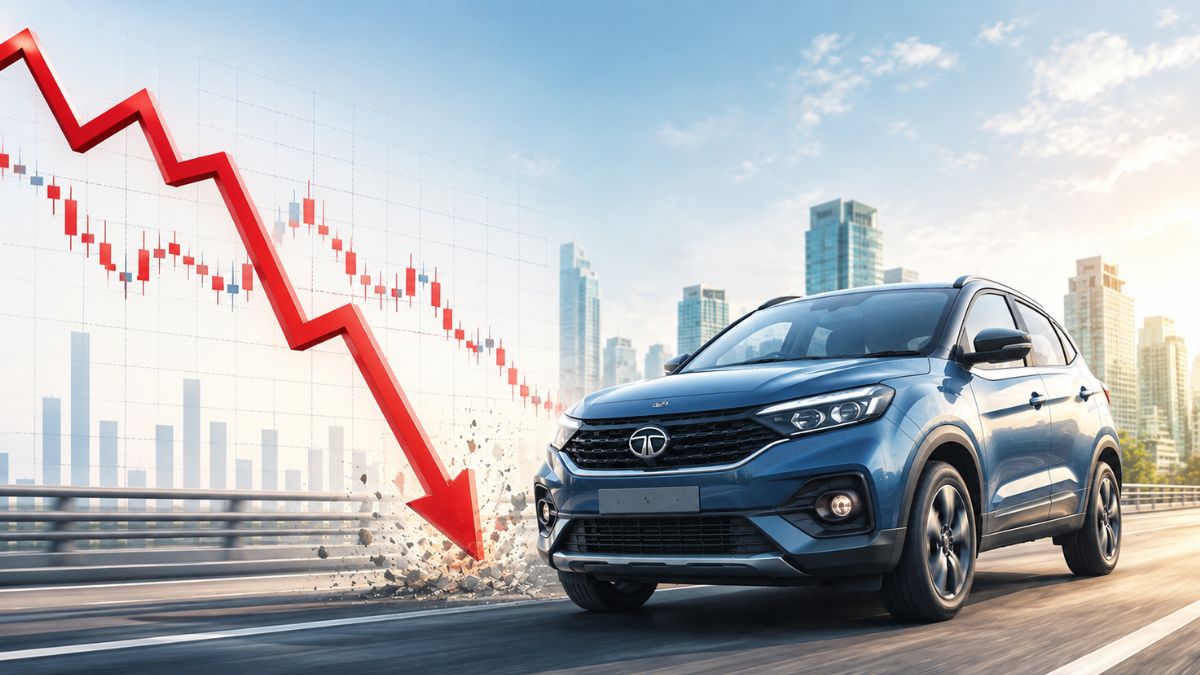
The share price of Tata Motors Passenger Vehicles (TMPV) came under significant selling pressure in early trade, falling over 5%. This has put the spotlight on the stock after the disappointing Q1. The latest plunge in the Tata Motors Passenger Vehicles stock comes even as the company’s first-quarter performance offered some positives, particularly from Jaguar Land Rover (JLR).
The Tata Group stocks have been in focus after Tata Sons Chairman N Chandrasekaran decided not to seek reappointment beyond February 2027. The move has brought the Group’s succession plan into focus, with investors now watching for the next move by the Tata Group and what it could mean for listed Tata group stocks.
Three major brokerages have taken three different views on the stock. Motilal Oswal has a ‘Sell’ rating, Nomura remains ‘Neutral’, while JM Financial has an ‘Add’ call. Their target prices also vary significantly.
At around Rs 332, the stock is nearly 21% below its 52-week high of Rs 419 and around 13% above its 52-week low of Rs 294.30. The stock has also declined about 9% so far in 2026.
Let’s take a look at what the three brokerages are seeing –
Motilal Oswal has assigned a ‘Sell’ rating to Tata Motors Passenger Vehicles with a target price of Rs 310, implying a downside of around 7% from the current market price.
The brokerage was encouraged by the better-than-expected first-quarter performance. Adjusted Profit After Tax (PAT) came in at Rs 1,140 crore, compared with Motilal Oswal’s estimated loss of Rs 120 crore.
However, the bigger concern remains JLR.
According to the Motilal Oswal report, “JLR continues to face multiple headwinds on the demand and cost fronts.”
The company’s consolidated automotive debt also increased to Rs 42,200 crore from Rs 30,700 crore in the previous quarter, mainly because of JLR.
Motilal Oswal added, “While JLR has embarked on a major cost-reduction initiative, it is likely to only help partially offset the current headwinds.”
The brokerage has raised its FY27 Earnings Per Share (EPS) estimate by 12% after the better-than-expected quarter. But it has retained its cautious stance.
Nomura has taken a middle path. The brokerage has a ‘Neutral’ rating and a target price of Rs 389, suggesting around 17% upside from the current price.
Nomura expects passenger vehicle volumes to grow, but has cut its estimates for Earnings Before Interest, Taxes, Depreciation and Amortisation (EBITDA) margins.
It now estimates FY27, FY28 and FY29 passenger vehicle EBITDA margins at 5.9%, 7.9% and 7.8%, respectively.
For JLR, Nomura has lowered volume estimates but increased average selling price assumptions.
The brokerage said, “The stock is trading at 3.8x FY28F EV/EBITDA, which we believe is undemanding, but is fair considering the risks.”
JM Financial is more constructive, with an ‘Add’ rating and a target price of Rs 375. That indicates around 13% upside from the current market level.
The brokerage highlighted the strong performance of the domestic passenger vehicle business. Volumes jumped 46.3% year-on-year, while revenue increased 66.2%.
Electric vehicle demand was also among the contributors.
However, margins remain under pressure because of raw material inflation and increased costs.
JM Financial noted, “Management guided for high double-digit domestic volume growth for FY27.”
The brokerage has raised its domestic passenger vehicle volume growth estimate for FY27 to around 16.5%, from 12.3% earlier. However, it has reduced its EBITDA margin estimate to 6.8%.
The difference in views comes down largely to one question – Can strong domestic growth offset the pressure at JLR?
For now, investors have three different answers. Motilal Oswal remains concerned about JLR and rising debt. Nomura sees the valuation as broadly fair. JM Financial is betting on domestic growth and the company’s recovery efforts.