
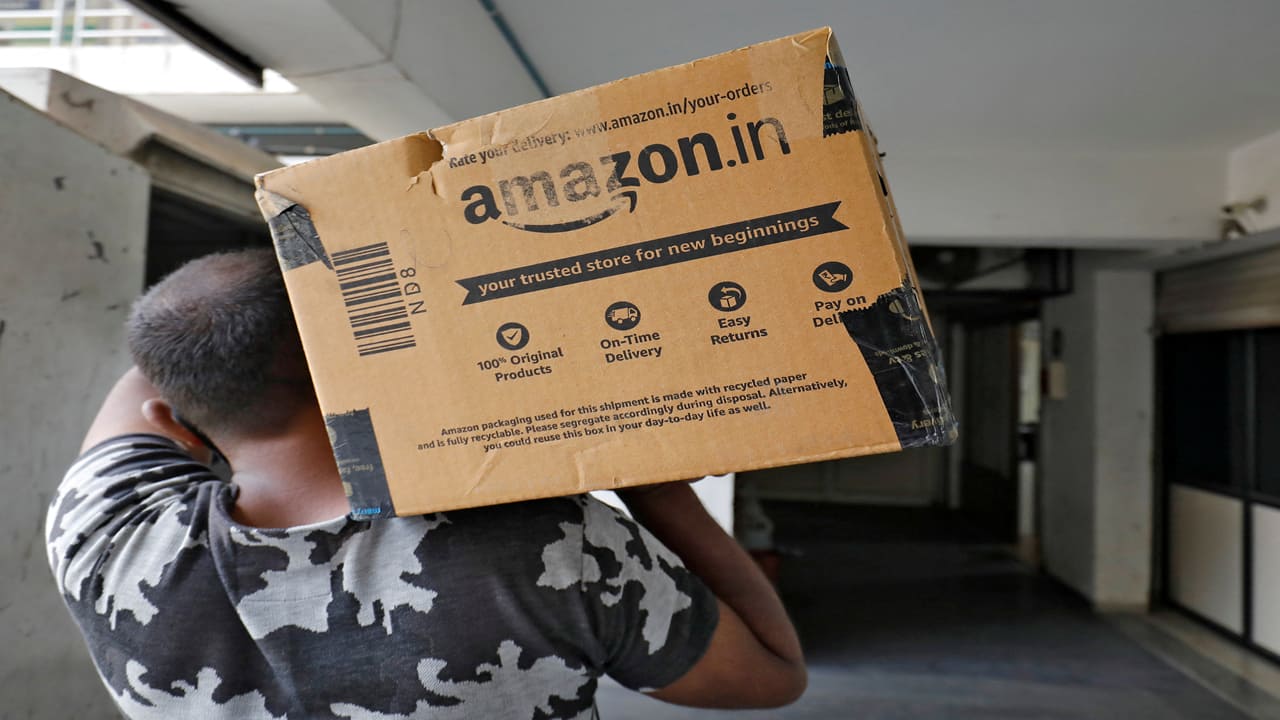
Amazon's aggressive push into quick commerce is entering a decisive phase as the e-commerce giant ramps up its battle for market share against rivals Blinkit, Swiggy’s Instamart, Zepto, Flipkart Minutes, Tata’s BigBasket, Accel-backed FirstClub and others.
The latest sign of that shift is now visible to consumers. Amazon Now has begun offering cashback of up to Rs 200 on orders above Rs 1499 and Rs 50 on orders above Rs 399 (variable in some cases) alongside free delivery and waived platform fees on several orders, as it looks to rapidly onboard customers and deepen adoption of the service.
In fact, it is also offering a cashback of Rs 100 on the first few orders above Rs 300 in some cases to capture a larger customer base.
Analysts say these new offers are less about triggering a fresh price war and more about signalling Amazon's willingness to spend aggressively to gain market share. Instead, they expect Amazon's deep pockets, rapid expansion, and growing investment commitments to keep competitive intensity elevated, forcing rivals to continue investing in customer acquisition and expansion even as profitability becomes a bigger priority.
While quick commerce in India may not be Amazon's highest strategic priority compared with AWS and its AI businesses, the company has the financial firepower to continue investing aggressively in the market. In India, its listed rivals, Eternal and Swiggy, are likely to have less flexibility, with public-market investors expected to keep a close watch on cash burn and profitability.
"The competitive intensity in this space is going to get worse before it becomes better," a senior internet sector analyst told Moneycontrol. "If you ask Blinkit or Instamart today who their biggest competitor is, it is Amazon."
The analyst added that Amazon's financial strength gives it a unique advantage at this stage of the market. "Today they are clearly in expansion mode. The real question is when they become rational. Right now, they are focused on scaling, and that makes them the biggest competitive threat."
That is already showing. According to a recent Bloomberg report, Eternal and Swiggy have together lost more than $15 billion in market value from their recent peaks as Amazon and Flipkart accelerate investments, reflecting concerns that a prolonged fight for market share could push profitability further out across the quick commerce sector.
Scaling Amazon Now
Amazon's customer acquisition push comes as it rapidly scales Amazon Now after spending years experimenting with different quick delivery models.
Last week, the company announced plans to expand Amazon Now to more than 300 cities, marking its biggest quick commerce expansion yet.
Days later, chief executive Andy Jassy announced an additional $13 billion investment in India by 2030, taking Amazon's total committed investment in the country to $48 billion. While the latest capital is largely earmarked for artificial intelligence and cloud infrastructure, analysts say it further strengthens Amazon's financial firepower as it ramps up investments across its India businesses.
The latest announcements build on Amazon's earlier Rs 2,800 crore commitment to strengthen Amazon Now's infrastructure and expand its micro-fulfilment network, underscoring how the company has moved from testing the model to scaling it aggressively.
In a recent interview with CNBC-TV18, Jassy said Amazon spent years finding the "right equation" for quick commerce before scaling the business.
"It's very unusual, and what we find with how fast our quick commerce business is growing – it is doubling every quarter," he said.
Why Amazon is spending
The aggressive incentives also reflect the fact that Amazon still has significant ground to cover operationally.
As Moneycontrol reported earlier, Amazon Now was processing an estimated 600-700 orders per dark store per day as of May. That compares with more than 1,300 for Blinkit, around 1,200 for Zepto, 900-1,000 for Flipkart Minutes and 1,034 for Swiggy Instamart, as per estimates from Satish Meena of Datum Intelligence.
Lower order density means Amazon has to drive significantly more demand through every dark store before it can match the operating efficiency of incumbents. Analysts say cashback, fee waivers and free delivery should, therefore, be viewed as customer acquisition tools rather than a long-term pricing strategy.
"Discounting is a tactic to get customers, not a strategy," the analyst, cited above, said. "Today Amazon is in expansion mode and not worrying too much about economics. But once it starts focusing on monetisation, it will have to follow the same path as everyone else."
However, Amazon's immediate objective is to leverage its existing ecosystem rather than build a customer base from scratch.
"The first target is to get the Amazon Prime customer back into the fold," Satish Meena, founder of e-commerce consultancy Datum Intelligence, said. "Amazon already has a large base of Prime members and regular shoppers. Discounts are one lever, but convenience, categories and the broader Amazon ecosystem are equally important."
A more crowded battlefield
Notably, Amazon is not the only large e-commerce company accelerating its quick commerce ambitions.
As Moneycontrol reported earlier, Walmart-owned Flipkart is also rapidly scaling Minutes, recently crossing 1,000 dark stores and targeting 1,500 by the end of 2026.
Unlike Blinkit, Instamart, and Zepto, which continue to focus on metro densification, Flipkart, like Amazon, has increasingly shifted its attention to tier-II and tier-III cities, betting that Bharat will drive the next phase of quick commerce growth.
The result is that India's largest retail and e-commerce companies are now competing head-on with specialised quick commerce players for the same pool of customers.
"Everybody is chasing the same set of customers in the same cities. That is why it is a zero-sum game," said Ankur Bisen, senior partner at retail and consumer advisory firm The Knowledge Company. "Amazon and Flipkart have deep pockets and a long-term strategic view of India. That should be a matter of concern for independent quick commerce players. The battle won't be won through price wars, but through better service, convenience and wider assortment."
Profitability under pressure
For incumbents, the bigger concern may not be the cashback offers themselves but the prospect of a longer battle.
Blinkit has emerged as the first major quick commerce platform to achieve operating EBITDA profitability, while Swiggy has repeatedly said it is balancing rapid expansion with improving contribution margins. Zepto, meanwhile, is preparing for a public listing.
Analysts believe Amazon's willingness to continue investing could delay profitability timelines across the industry.
"If Amazon is taking a portion of the industry's growth, it, by definition, reduces the growth Blinkit and Instamart would have had without this competition," said Bisen of The Knowledge Company. "They will have to spend a little bit more. There is no option here."
That does not necessarily mean every player will mirror Amazon's cashback campaigns. But with Amazon expanding rapidly, Flipkart pushing deeper into Bharat and incumbents continuing to add dark stores, analysts expect competitive intensity to remain elevated through the coming quarters.
For consumers, that could translate into richer offers and faster deliveries. For companies, it signals that India's quick commerce race is entering a longer, costlier and significantly harder-fought phase.