
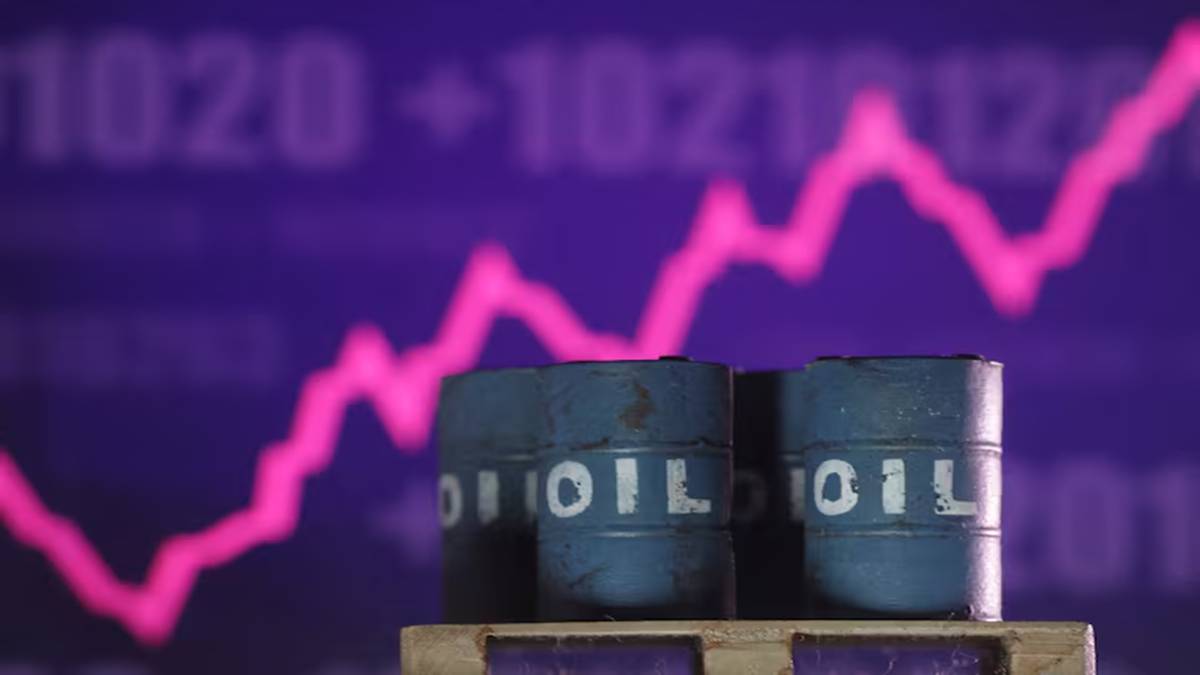
Amidst escalating hostilities in West Asia, Brent crude hit the $100-a-barrel mark on Wednesday, the first time since July 24, roiling the stock markets and weakening the rupee. Spooked by rising oil prices, which have left the Indian crude basket at $108.91 a barrel, investors chose to take risk off the table. India imports more than three-fourths of its requirement of crude oil.
Benchmark equity indices slumped by about 1% while the rupee lost 27 paise, or 0.29%, against the dollar to close at 95.1012. The Sensex tanked 813.35 points to close at 74,764.23 while the broader Nifty plunged 203.6 points to end the day at 23,431.50. Over the past three sessions, the Sensex and Nifty have fallen 2.29% and 1.95%, respectively, while the rupee has depreciated by 0.65% in just two sessions.
The surge in oil prices will intensify the pressure on oil marketing companies (OMCs) and India’s crude import bill as the US-Iran conflict continues to disrupt West Asian supplies. Analysts believe another round of hikes in pump prices of petrol and diesel would depend on which way prices are headed and for how long they sustain at these levels.
“Historically, retail fuel price revisions have occurred when the Indian crude basket averaged around $106/barrel. Therefore, unless crude prices sustain levels well above $110/bbl, a further increase in retail fuel prices appears unlikely,” Pankaj Srivastava of Rystad Energy told FE.
Dilip Parmar, senior research analyst, HDFC Securities, noted that the relentless four-day surge in global oil prices had reignited fears of inflation pushing the rupee into defensive territory. “Swift intervention by the Reserve Bank of India through onshore dollar sales, coupled with expectations of central bank sell-buy swaps, helped the local currency trim its early losses,” Parmar said.
Foreign portfolio investors who had turned buyers in August have sold close to $750 million worth of shares in September so far. “Today’s market sell-off reflects a combination of rising geopolitical risks, crude oil rising above the $100-per-barrel mark and renewed FPI selling,” said Vikram Kasat, chief business officer – advisory and dealing, PL Capital.
The benchmark indices have declined in seven of the past eight sessions. During this period, the Sensex lost 3.24% while the Nifty fell 3.08%. Investors’ wealth eroded by Rs 8.62 lakh crore over these eight sessions, including Rs 2.01 lakh crore on Wednesday alone. The total market capitalisation of BSE-listed companies stood at Rs 484.20 lakh crore on Wednesday.
The broader indices, however, outperformed the benchmarks, with the BSE Midcap falling 2.06%, while the BSE Smallcap gained a modest 0.34%.
All sectoral indices have declined over the eight-session period. The IT sector led the losers with a 7.6% fall, followed by auto, realty, consumer durables and financial services.
Around 2,400 stocks, or 60%, out of 4,100 actively traded stocks declined over the eight sessions. Barring three, all Sensex constituents declined, while 42 of the 50 Nifty stocks fell during the period. Indian benchmarks were the worst performers among major Asian equity indices on Wednesday.
Market experts observed that the spike in oil prices was expected to drive up prices of a range of imported good, especially oil derivatives, which could stoke inflation and results in a rise in interest rates.
The last price revision for auto fuels was undertaken on May 25, when state-run OMCs raised petrol and diesel prices, taking the cumulative increases since May 15 to around Rs 7.5/litre. Since then, prices have remained unchanged, with petrol at Rs 102.12/litre and diesel at Rs 95.20/litre in New Delhi.