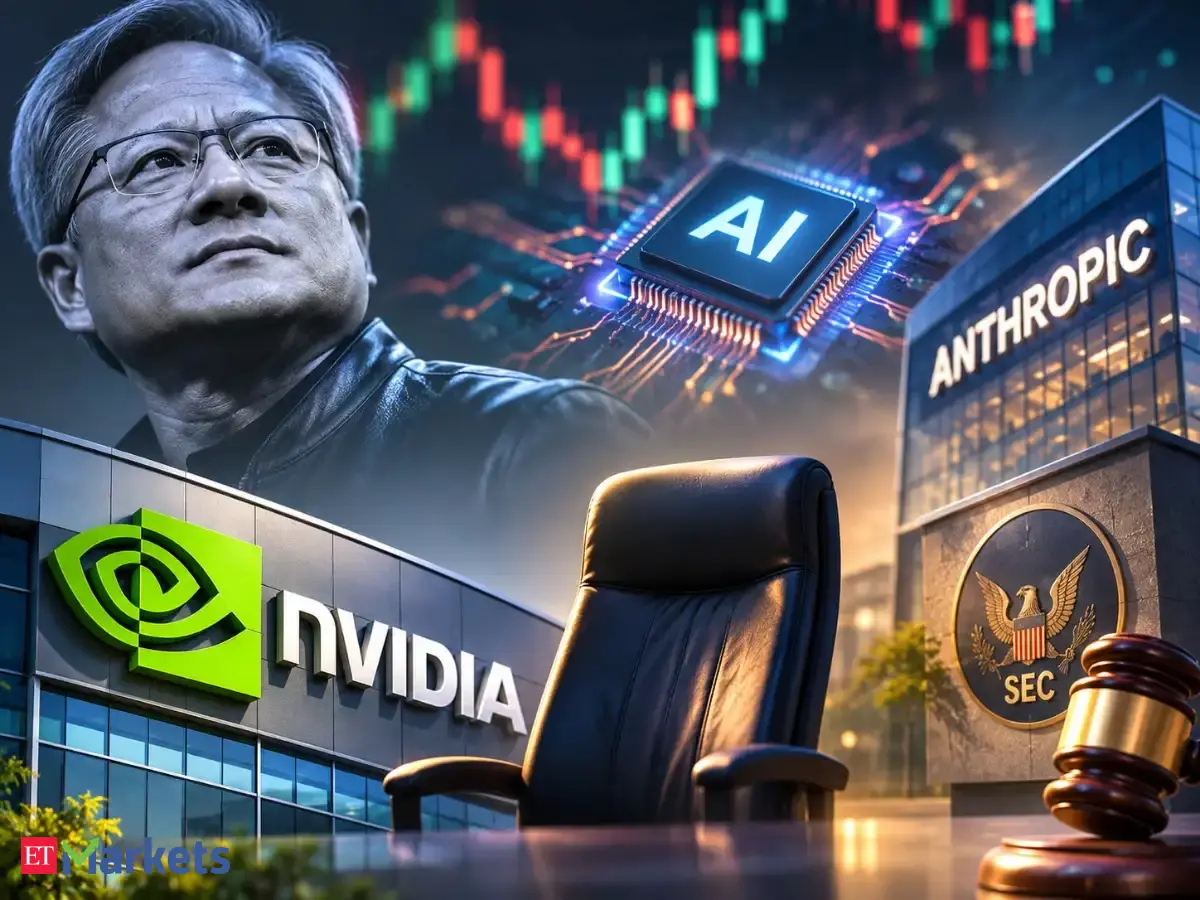
Nvidia's stronger-than-expected revenue forecast has temporarily eased concerns about the sustainability of artificial intelligence (AI) demand, but uncertainty over who will succeed former CEO Jensen Huang has emerged as a major overhang for the chipmaker's shares and the broader technology sector.
The company, which sits at the centre of the global AI boom, forecast sales well above Wall Street expectations on Tuesday. The outlook initially lifted Nvidia shares nearly 5% in extended trading, triggering gains in US stock futures and Asian technology stocks. However, the optimism soon faded as investors shifted their attention to the leadership vacuum and the upcoming market debut of AI startup Anthropic.
Huang's sudden departure last week, following revelations about his personal relationships, ended nearly three decades of founder-led leadership at Nvidia. His exit has raised concerns about the company's ability to maintain its technology roadmap, customer relationships and political connections under new leadership.
Nvidia's dependence on Huang has become a particular concern for investors, given his central role in shaping the company's strategy and its position in the global AI industry.
Nvidia begins search for permanent CEO
Nvidia Chairman Harvey Jones addressed the leadership uncertainty at the beginning of the company's post-results conference call, ruling out the possibility of bringing Huang back.
Jones said the company wanted to appoint a permanent chief executive as quickly as possible but would not rush the process before identifying the right candidate.
Nvidia has appointed an executive search firm to help identify a successor but has not provided a timeline for the appointment. Chief Financial Officer Colette Kress is currently serving as interim CEO.
Analysts believe the company's near-term investor sentiment could remain fragile despite its strong financial outlook.
Jamie Cox, managing partner at Harris Financial Group, said Nvidia's latest results were not sufficient to reverse the negative sentiment surrounding the stock.
Investors are expected to seek greater clarity on the company's leadership transition, regulatory developments and the stability of its engineering workforce.
Armina Rosenberg, portfolio manager and co-founder of Minotaur Capital, said the strong results had helped stabilise the company's outlook but that investors still needed clarity on its future leadership and strategy, Reuters reported.
Regulatory scrutiny adds to investor concerns
Huang's departure has coincided with a series of developments that have added to uncertainty surrounding Nvidia.
US intelligence agencies are examining the extent of the reported ties between Chinese businesswoman Alice Huang and China's Ministry of State Security, including whether any information may have been shared with Beijing, two people familiar with the matter told Reuters.
Separately, the US Securities and Exchange Commission was investigating Nvidia, the Wall Street Journal reported, citing people familiar with the matter.
The developments have added to pressure on Nvidia shares, which were already facing headwinds amid concerns about the sustainability of AI infrastructure spending and the growing debt used to finance data centre expansion.
Nvidia shares have fallen around 17% this year, compared with a roughly 4% gain in the broader Nasdaq index.
Anthropic IPO emerges as next test for AI trade
Investors are now turning their attention to Anthropic's planned market debut on Thursday, with the AI company targeting a valuation of as much as $1.4 trillion.
The offering could provide another indication of investor appetite for companies seeking to monetise the growing adoption of artificial intelligence.
The contrasting developments are likely to shape sentiment across the technology sector in the coming sessions, as investors assess both the durability of AI spending and the valuations of companies positioned to benefit from the technology.