
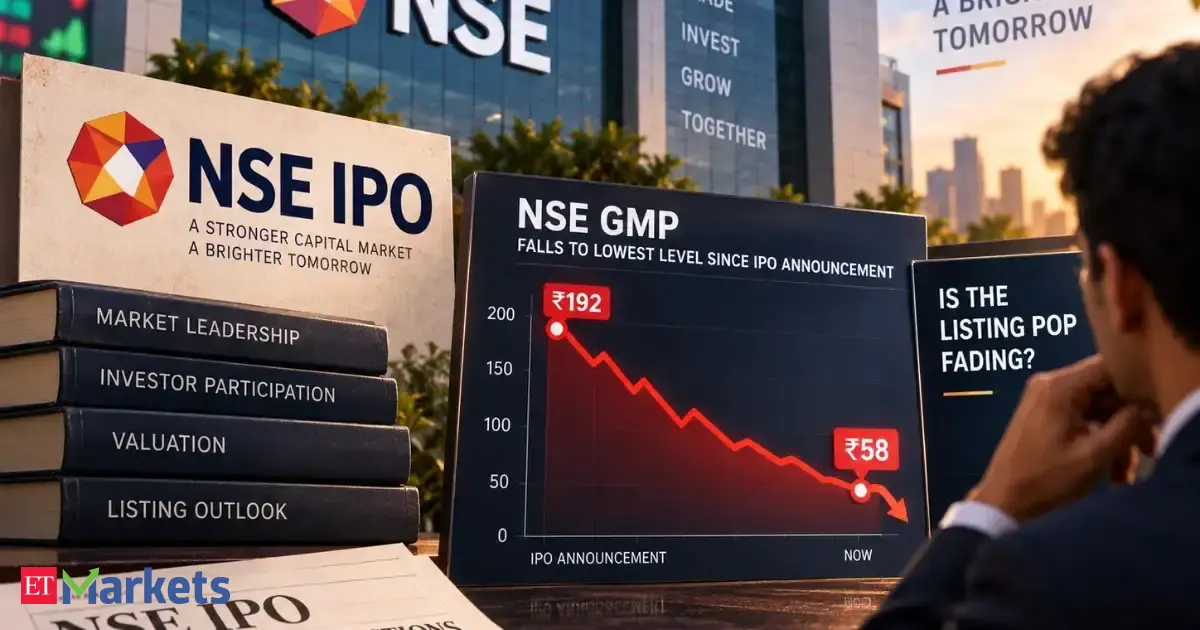
NSE IPO 's grey market premium has fallen to its lowest level since the price band was announced, raising some doubts over whether the listing-day excitement around India’s biggest public issue of 2026 is cooling. The GMP, which was around Rs 192 when the price band was announced, has slipped to about Rs 58 now. At the upper end of the IPO price band of Rs 1,785, this implies a premium of just over 3%. That is a sharp fall of nearly 70% in the informal market premium.
The fall in GMP comes even as the Rs 22,562 crore IPO was fully subscribed on the second day of bidding. As of September 18, the issue was subscribed 1.15 times, led by qualified institutional buyers and non-institutional investors. The QIB portion was subscribed 1.32 times, while the NII portion was subscribed around 1.36-1.44 times. Retail subscription, however, was weaker at around 66-68%.
The IPO, which opened on September 17 and closes on September 21, is entirely an offer for sale. NSE will not receive any fresh money from the issue. Existing shareholders are selling about 12.64 crore shares. The price band has been fixed at Rs 1,700-1,785 per share, and the stock is expected to list on BSE on September 24.
Why GMP is falling
The sharp fall in GMP suggests listing expectations have become more sober. NSE remains one of India's strongest market infrastructure businesses, but the IPO is large, fully priced and entirely an OFS. That makes the listing pop harder to stretch.
A smaller IPO with limited float and a growth story can see a sharper GMP build-up. NSE, however, is a Rs 22,500 crore-plus issue. The size itself can absorb a large amount of demand and cap extreme listing gains, according to analysts.
Avinash Gorakshakar, Founder and Head of Research at Avinash Mentor Research Services, had earlier said that the grey market and structural hype indicated a positive listing outlook, but investors should keep expectations measured.
He said the massive size and absence of a fresh-issue growth engine could mean upside "right out of the gate may be more measured compared with smaller, high-growth niche IPOs. That view now appears to be playing out in the grey market.
OFS structure becomes a talking point
Since NSE is not raising fresh capital, the IPO does not directly fund expansion, technology spending or new business lines. The proceeds will go to selling shareholders. This changes how investors view the IPO. In a fresh issue, investors can argue that the company is raising capital for growth. In an OFS, the story is more about price discovery, liquidity and exits for old shareholders.
Ishan Tanna, Senior Associate at Ashika Capital , had earlier said NSE’s lower pricing looked like a pragmatic move to leave some upside for public-market investors rather than push for a higher valuation and risk weak demand or poor post-listing performance.
At the upper price band, NSE is valued at about Rs 4.42 lakh crore. Analysts have pointed out that this implies about 43 times FY26 earnings. That is rich compared with many global exchanges, but investors are also paying for NSE’s dominant position in India’s capital markets.
Subscription is decent, not euphoric
The subscription trend is not weak, but it is also not euphoric so far. The issue was subscribed 42% on the first day, with retail and NII demand ahead of institutional demand at that stage. Around 3.7 crore shares were bid for against 8.86 crore shares available on day one. Institutional investors usually place larger bids closer to the end of the offer, so the final day will be crucial.
By the second day, the IPO had crossed full subscription. Still, retail demand remained below full subscription. This matters because NSE was expected to draw strong retail interest due to its brand recall and long wait for listing.
The minimum application at the upper band is Rs 14,280 for one lot of eight shares, which may have kept some small investors cautious, especially with GMP falling.
Is the listing outlook getting darker?
A Rs 58 GMP still points to a positive listing, but the expected gain is now likely modest. At current grey market levels, the stock would list around Rs 1,843, compared with the issue price of Rs 1,785. That is far from the earlier expectation when GMP was close to Rs 192.
Dr Ravi Singh, Chief Research Officer at Master Capital Services, said NSE is a strong business, but investors still need to watch valuation and derivatives dependence. He pointed out that options transaction fees contribute a large part of NSE’s operating revenue, making regulatory changes and participation trends important for future earnings.
Paresh Bhagat, Chairman of Mangal Keshav Financial Services, had also said NSE should not be treated as an automatic subscription despite its quality. He said investors must distinguish between business quality and IPO valuation.