
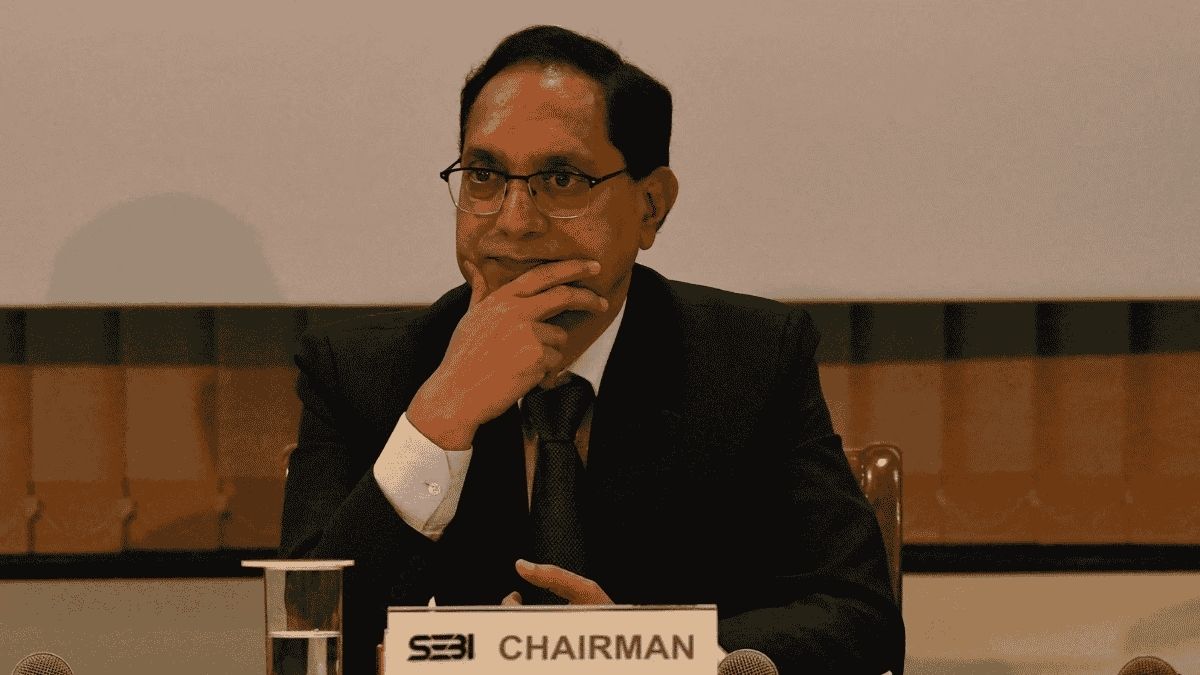
Securities and Exchange Board of India (SEBI) Chairman Tuhin Kanta Pandey on Wednesday called for greater focus on longer-term derivative contracts, including futures, stock futures and longer-dated stock options, saying the derivatives market is currently heavily skewed towards options trading, particularly index options.
“Unfortunately, the market is quite tilted in favour of options trading and that too particularly around index options,” Pandey said at the SBI Banking and Economics Conclave 2026 in Mumbai.
Speaking to reporters on the sidelines of the event, Pandey said the Securities and Exchange Board of India (SEBI) is examining issues such as margins in longer-term derivatives as part of efforts to develop these segments.
Pandey said a large number of young investors have entered the markets since the Covid pandemic, creating new challenges for the regulator as it seeks to make the derivatives market more balanced. Acknowledging the losses suffered by retail investors in derivatives, he said SEBI was looking at ways to address the issue without disrupting the market.
“We would like to develop the market in a more positive sense than just doing something which will unnecessarily disrupt it,” he said.
Pandey also stressed the need for companies to diversify their sources of capital by tapping the corporate bond market. SEBI, he said, has been working to improve liquidity in corporate bonds, broaden investor participation and strengthen price discovery.
He urged market participants not to view banks and other sources of capital — including mutual funds, insurers, pension funds, alternative investment funds, REITs and InvITs — as competing with one another. Instead, they should be seen as different pools of savings providing different forms of capital to the economy.
On tokenisation of corporate bonds, Pandey said SEBI’s pilot is recording issuance, ownership and transfers on a permissioned shared ledger while enabling atomic settlement.
The next phase of the pilot will focus on secondary-market trading in tokenised corporate bonds, while the third phase will seek to develop frameworks for pledges, liens and other transactions involving such securities.