
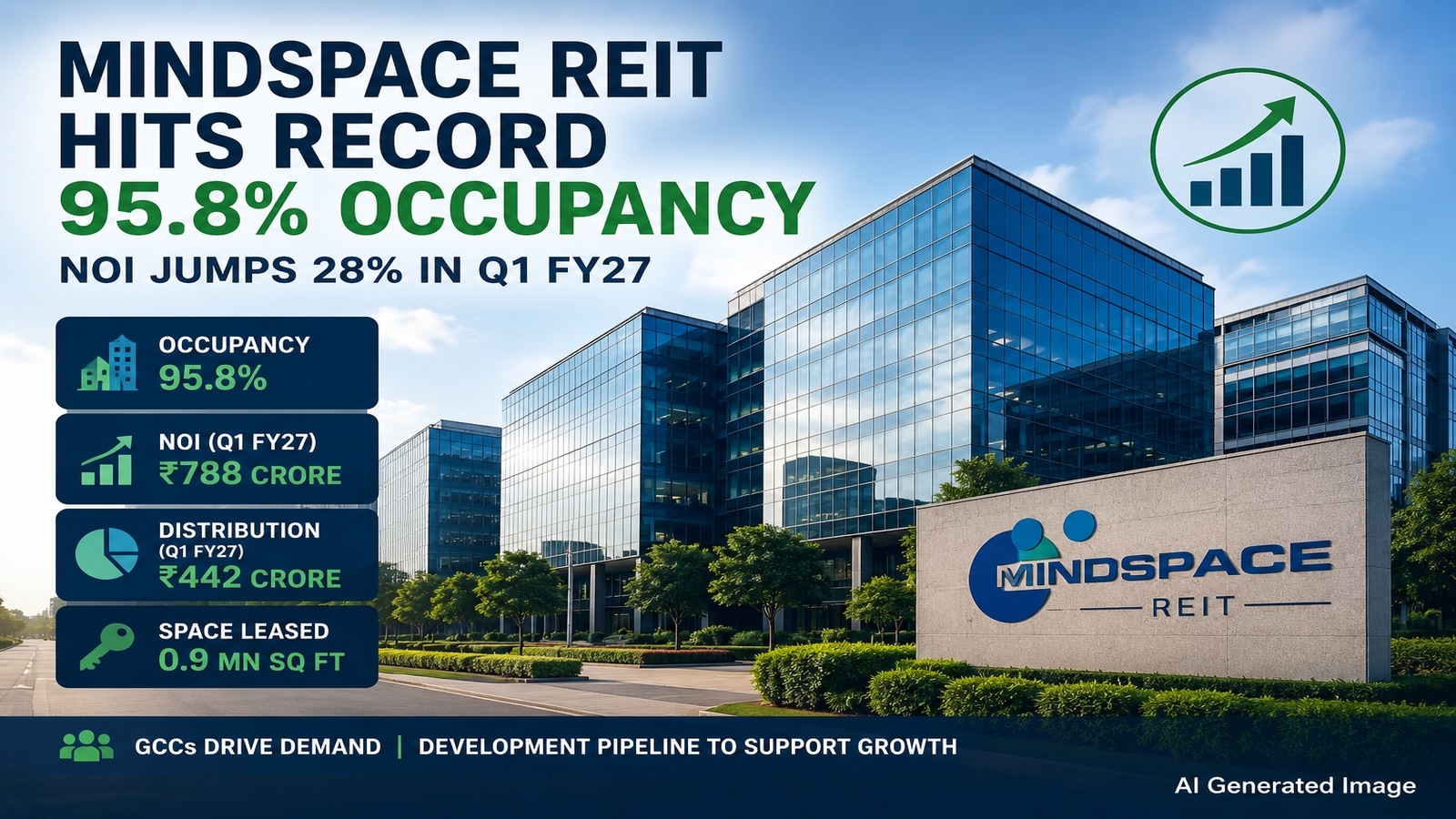
8%, MD and CEO Ramesh Nair told CNBC-TV18. 9 million square feet of commercial space during the April-June quarter. 8%. He attributed the strong performance to robust office demand, particularly from global capability centres , which now account for 53% of Mindspace REIT's tenant profile.
Office absorption across these markets has remained strong despite macroeconomic and geopolitical challenges. The tightening availability of quality office space is also supporting the market. GCCs are currently driving around 40-45% of overall office demand, according to Nair.
The company also expects its development pipeline to support NOI and DPU growth in the coming quarters. 7 million sq ft is expected to be completed during FY27. IT services companies continue to take up office space despite relatively muted headcount growth.
Mindspace REIT's tenant mix currently comprises 53% GCCs, 18% foreign multinational companies and 27% domestic companies. 2% from last year. What's your target for FY27, and how is the leasing landscape looking currently? Ramesh Nair: DPU went up 15%.
One interesting aspect is that over the last four quarters, we've been giving double-digit DPU growth. This quarter, like I said, it was 15%. Before that, again 15%, and two quarters before that, 13% and 10%. So, we typically don't give guidance. 7 million square feet is due this year, and most of that is already leased.
Q: Give us a sense of the occupancy and leasing trends. So, number one, last quarter we understand it was close to 94%. You know, has there been any uptick or downtick over there? 8%. This is the highest we've been. The absorption in all the markets, the four markets where we are present, the absorption numbers have been phenomenal.
Over the last three years, actually, we've seen all these markets across the country - the absorption numbers grew at 18%, 16% and 15%. So, another good data point which I saw recently was the relevant vacancy today, which is good-quality space. India today has around 950 million square feet of office space.
In that relevant stock, the relevant supply is around 530 million square feet. 9%. Everyone knows about the GCC story. Today, GCCs have around 40 to 45% of the demand in the market. Q: A couple of quick questions. Number one, you know, when you speak about GCCs, we understand growth there has been quite strong, but we also understand that additions, as far as traditional IT services are concerned, have been quite muted.
So, has that offset each other, or will you be net positive on account of demand coming in from IT services and GCCs? Ramesh Nair: So, from a GCC point of view, today our tenant profile, if you break it up, 53% is GCCs, foreign MNCs are at around 18%, domestics at around 27%.
One very interesting trend I have seen is that in the last one year, we've actually seen many IT services companies come in and take space with us. So, two things we have realised. When the IT services companies are pitching for GCC kind of work, global work, there's a lot of decision-making internationally where those clients want to be in the main cities.
Secondly, previously, IT services companies would typically go to their own campuses. They would go to Tier 2 cities or be in far-flung locations. So, both those things are definitely benefiting us. Definitely, the growth rates of GCCs are much higher.
Previously, our portfolio used to have around 25 to 27% IT services; today, that's dropped to around the 18% mark.