
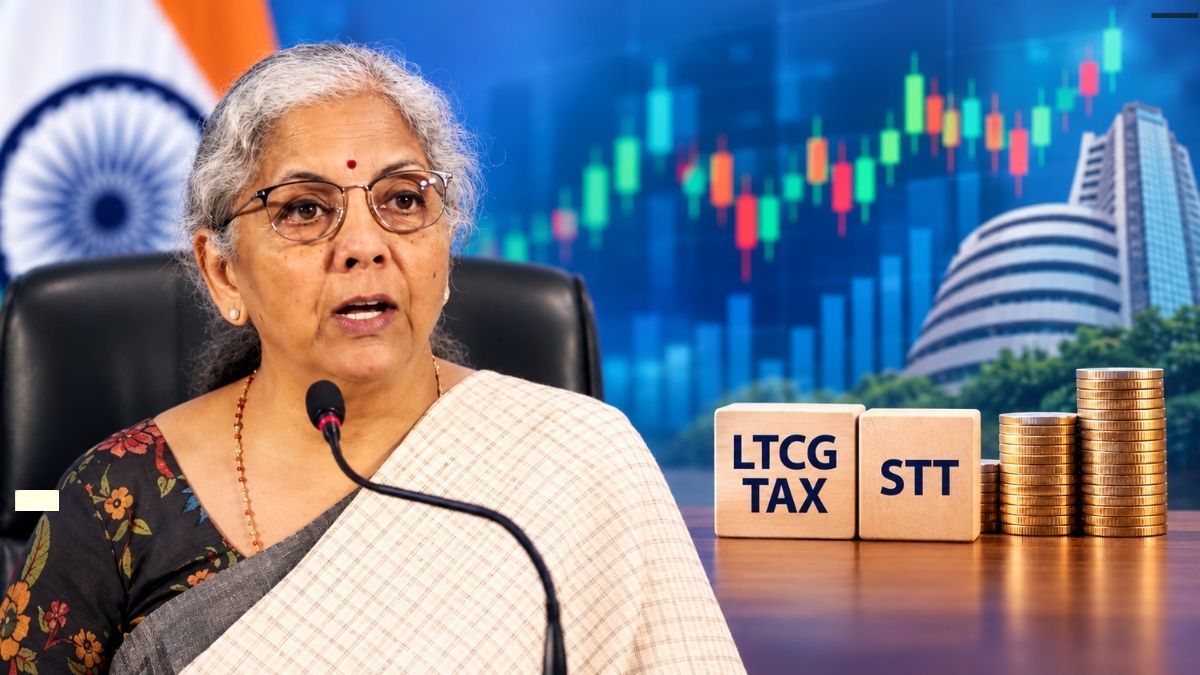
Finance Minister Nirmala Sitharaman on Tuesday said the government was open to deliberations on long-term capital gains (LTCG) tax and securities transaction tax (STT), signalling a willingness to hear investors’ concerns. “So, these are things on which there’s a lot of debate. It’s healthy to have this debate, and I will be keenly hearing them,” she said at a Bloomberg event here.
Following her remarks, the stock markets rebounded sharply, with the benchmark Sensex surging 1,109 points and the Nifty closing above 22,720, led by gains in IT, financial and FMCG shares.
“We are very close to the Budget, and the preparation for the Budget has started. It may not be the best time for me to say what I will or what I will not consider,” she said, responding to a question on whether the government was considering investors’ demands for LTCG tax relief. “So I’ll tread cautiously on that, but of course, the long-term capital gains tax is something on which a lot of people have been commenting, both investors within India and also those who meet me occasionally outside.”
Foreign portfolio investors (FPIs) and other market participants have been urging the government to lower capital gains tax rates and raise exemption limits to improve the competitiveness of Indian markets. Many market participants and analysts have also questioned the rationale for levying both capital gains tax and STT. SBI Research on Tuesday advocated that the government seriously consider measures to anchor short-term capital flows into equities, including extending the holding period to, say, two to three years and abolishing LTCG tax on equities.
The minister’s remarks come as FPIs withdrew Rs 1.64 lakh crore from the secondary markets in H1FY27, with selling intensifying in October.
The Union Budget 2024-25 overhauled India’s capital gains tax regime, with the changes taking effect on July 23, 2024, to simplify taxation across asset classes. It raised the short-term capital gains tax on specified listed equity shares, equity-oriented mutual funds and business trusts from 15% to 20%, and increased the LTCG tax on these assets from 10% to 12.5%. It also raised the LTCG exemption threshold to Rs 1.25 lakh from Rs 1 lakh.
“Two years ago, we had brought all asset classes similarly, and people thought I was increasing the tax. I wasn’t increasing the tax; I was bringing all of them to be at par with one another, so that an investor is not speculating as to which one gives them greater leverage,” the minister said.
Sitharaman acknowledged the debate over STT and whether it should coexist with capital gains tax. The government levies STT of 0.1% on both the purchase and sale of listed equity shares in delivery-based trades.
However, abolishing or reducing LTCG tax on equities would be a difficult decision for the government. Capital gains have been among the fastest-growing sources of tax revenue in recent years. Revenue from capital gains tax rose from a little over Rs 26,000 crore to Rs 1.29 lakh crore in FY25, while annualised collections are currently estimated to exceed Rs 1.5 lakh crore.
The government has previously argued that capital gains tax is a “necessity in terms of equitable collection of taxes”. Reintroduced for equities in 2018, LTCG tax has since become an “elastic source” of revenue, with collections growing faster than national income, salaries and business income. Justifying its reintroduction, government officials had argued that capital gains were a source of rising inequality.
“The Finance Minister’s willingness to openly debate long-term capital gains tax and STT is a welcome signal. Listed equity gains in India bear LTCG at 12.5%, layered over STT, a cumulative burden that competing hubs such as Singapore and Hong Kong do not impose through capital gains tax on listed shares,” said Naitik Doshi, director, Nangia Global.
“Any rationalisation, whether through LTCG relief, STT calibration or parity across asset classes, would improve post-tax returns, deepen domestic participation and make India more attractive to foreign investors,” Doshi said.
The 30-share BSE Sensex jumped 1,109.10 points, or 1.54%, to settle near the day’s high at 73,033.78, posting its biggest single-day gain in four months. During the session, it surged 1,120.99 points, or 1.55%, to hit a high of 73,045.67.
The 50-share NSE Nifty climbed 358.60 points, or 1.60%, to close at 22,721.95, marking its strongest single-day rebound in more than two months. The index also touched the day’s high of 22,721.95.