
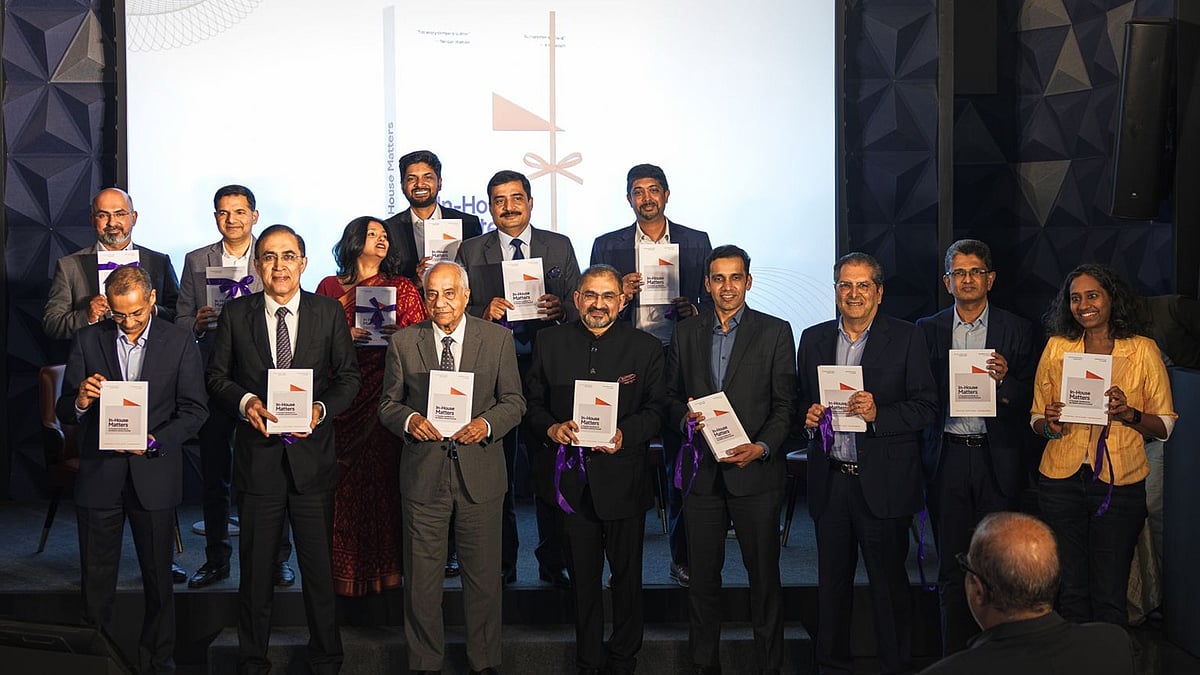
Published by OakBridge Publishing, In-House Matters: A Complete Handbook for the Modern General Counsel, is authored by former SEBI Executive Director and ex-ICICI Group General Counsel Pramod Rao, along with Vahura co-founder and CEO Ritvik Lukose and Counselect director and Vahura consulting head Balanand Menon.
It draws on interviews with 30 leading Indian GCs and is structured around ten questions that track a GC’s journey from the first 100 days to earning a seat at the table.
Former Supreme Court judge Justice BN Srikrishna who endorsed the book, used his remarks to press for recognition of legal privilege for in-house counsel. He likened the GC to a “Rajpurohit” who warns the king what is right and wrong.
“GC's role today is very much necessary, very much important. The GC must be an AI expert also in the coming days. GC is not the only thing; it should be GC AI,” he remarked, to applause.
When the discussion opened up for audiences to interact with the authors, Justice Srikrishna urged the GCs to approach the Supreme Court to review its recent ruling that denied privilege to GCs.
“The Supreme Court has brushed them all with the same tar and said that GCs have no such privilege at all. In fact, I would suggest that you should fight for that, get the Supreme Court judgment to change, and GC should be established as persons who have privileged communications with their board, with their CEOs, which cannot be summoned by the police for questioning,” he said.
Rao endorsed this view, describing ‘privilege’ as the umbrella under which the most candid conversations happen.
“Privilege actually is misunderstood by most folks. It is the freest and frankest conversations that occur under the umbrella of privilege. That being deprived of the GC actually deprives the organization, the board, the CEOs, of all of that,” Rao said.
During the event, several business leaders endorsed the book calling it a playbook for GCs as business partners.
Lakshmi Iyer, Group President, Investments at Bajaj Finserv and CEO of Bajaj Mutual Fund, said, “Something which is so technical as legal, he’s given amazing anecdotes and story form in such a lucid form,” adding that the book is packed with quotes from GCs at many of India’s best-known companies.
Former ICICI Prudential Life MD & CEO N.S. Kannan emphasised that it weaves together perspectives from GCs across sectors into interviews, caselets and frameworks.
Tata Capital MD & CEO Rajiv Sabharwal highlighted Rao’s solution-oriented approach, noting that he always came out with a solution which was right for the business.
Jio Financial Services MD & CEO Hitesh Sethia underlined the cost-conscious appeal of a GC-written manual: “I haven’t seen more expensive things than lawyers, but I must thank you that you brought this entire wisdom and knowledge at such a price point,” he said on a lighter note.
Co-author Menon outlined the Observe, Orient, Identify, Act loop (OIA loop) as a discipline for new GCs to resist the urge to prove yourself from day one. “The GCs that we spoke with spoke about how important it is to first observe how the business is run orienting yourself to the ways of working, then identifying the ways to kind of improve it, and also at the same time what do you need to preserve,” he said.
Lukose situated the book in what he called three overlapping stages of in‑house evolution: Legal 1.0 - where companies “build an in‑house law firm,” focused mainly on legal talent; Legal 2.0 - GCs become business partners and are benchmarked against functions like HR and finance; Legal 3.0 - GCs are the chief executive, running legal like a business. “The focus starts to become innovation, efficiency, use of technology,” he said.
Rao hoped the book would nudge sitting GCs to think beyond their companies: “I’m hoping people who are already in that chair [start] thinking beyond the enterprise. There are larger things, whether within the sector or the society, that you can contribute to,” he said, concluding the discussion.