
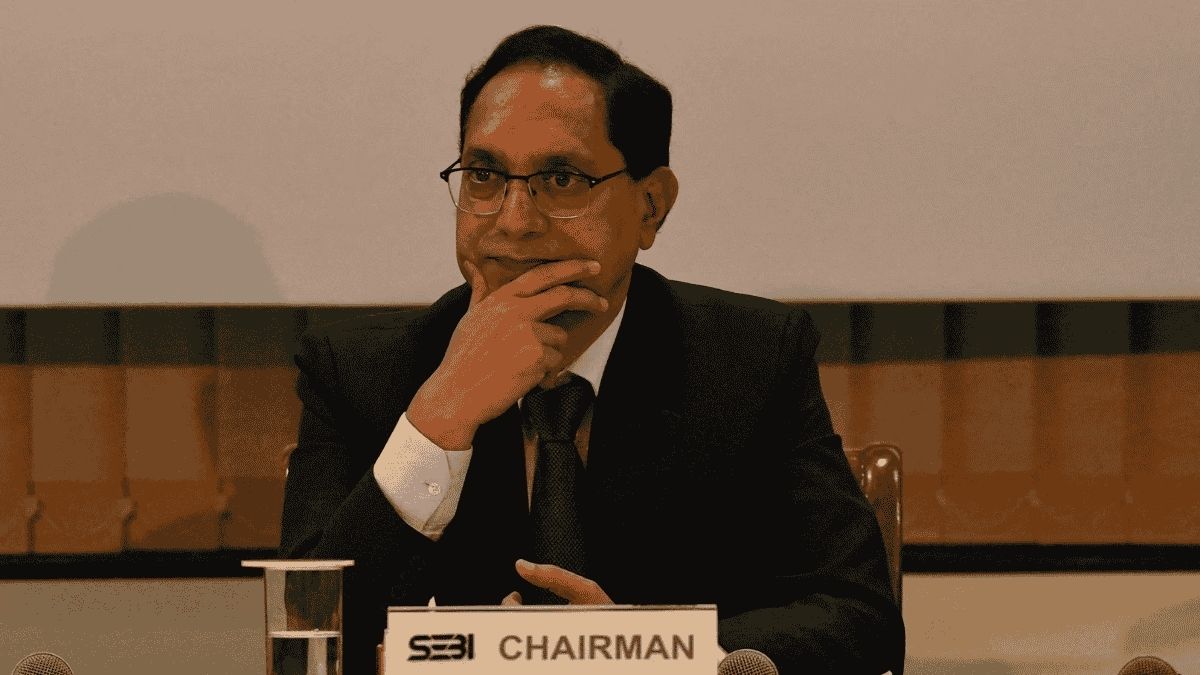
Indian investors have displayed growing maturity by continuing to back primary markets and mutual funds despite prolonged market headwinds and global uncertainty, Securities and Exchange Board of India (Sebi) Chairman Tuhin Kanta Pandey said on Wednesday.
Pandey said the resilience of investor participation showed that Indian investors understood market cycles better than they were often given credit for.
“I think Indian investors in general have been far more intelligent. Sometimes we underestimate them, but they are aware of these things — market cycles, how things will pass and how things will improve for the better,” Pandey said at the annual conference of the Association of Portfolio Managers in India (APMI) in Mumbai.
He said this confidence was particularly visible in the primary market, where companies across sectors have continued to raise capital despite an uncertain global environment.
“Notwithstanding the headwinds, in several areas — infrastructure, industry and services — entrepreneurial talent is quite visible in the kind of companies coming to the primary market to raise capital, and investors are supporting them,” he said.
Pandey also struck an optimistic note on the broader economy. While acknowledging that Indian equities may appear relatively disadvantaged in the current environment, he said the country’s macroeconomic foundations remained strong at a time when economies globally were grappling with uncertainty.
“People are grappling with uncertainty in different countries in different ways, but I would be optimistic in terms of what we have in India. In terms of macroeconomic indicators, we have solid foundations,” he said.
He pointed to opportunities emerging across traditional industries, infrastructure, energy transition and new-age sectors. Indian companies were also increasingly building artificial intelligence capabilities and moving towards practical implementation of AI use cases, he added.
Pandey said the strong participation of investors in primary markets over the past two years needed to be seen against this backdrop.
The Sebi chief also stressed the need for greater coordination among financial-sector regulators, citing the regulator’s work with the Reserve Bank of India (RBI) to ease foreign portfolio investor onboarding.
The two regulators are working on simplifying other processes, including transfer of power of attorney, allowing branches of foreign banks to certify documents and facilitating the use of SWIFT for certification and transfer of documents, he said.
Addressing portfolio managers, Pandey cautioned that merely meeting the minimum investment threshold should not determine whether a portfolio management service is suitable for an investor.
“A strategy may be perfectly legitimate and still not suitable for a particular investor,” he said.
Portfolio managers, he added, must look beyond headline returns and assess the risks taken to generate them, the appropriateness of benchmarks, portfolio concentration and drawdowns, as well as whether performance is consistent with the stated investment philosophy.
Pandey also expressed optimism about the portfolio management industry, saying it could potentially grow at more than 20% annually as India’s investment universe expands.
Speaking to reporters on the sidelines, Pandey also clarified that Sebi is not constituting any panel to examine whether stock exchanges should be allowed to trade in their own shares, Pandey said, “We are not considering self-listing at this point. If it happens and when it happens, you’ll come to know.”
He also added that Sebi was sticking to the proposals outlined in its September 12 consultation paper on changes to the closing auction session (CAS).