
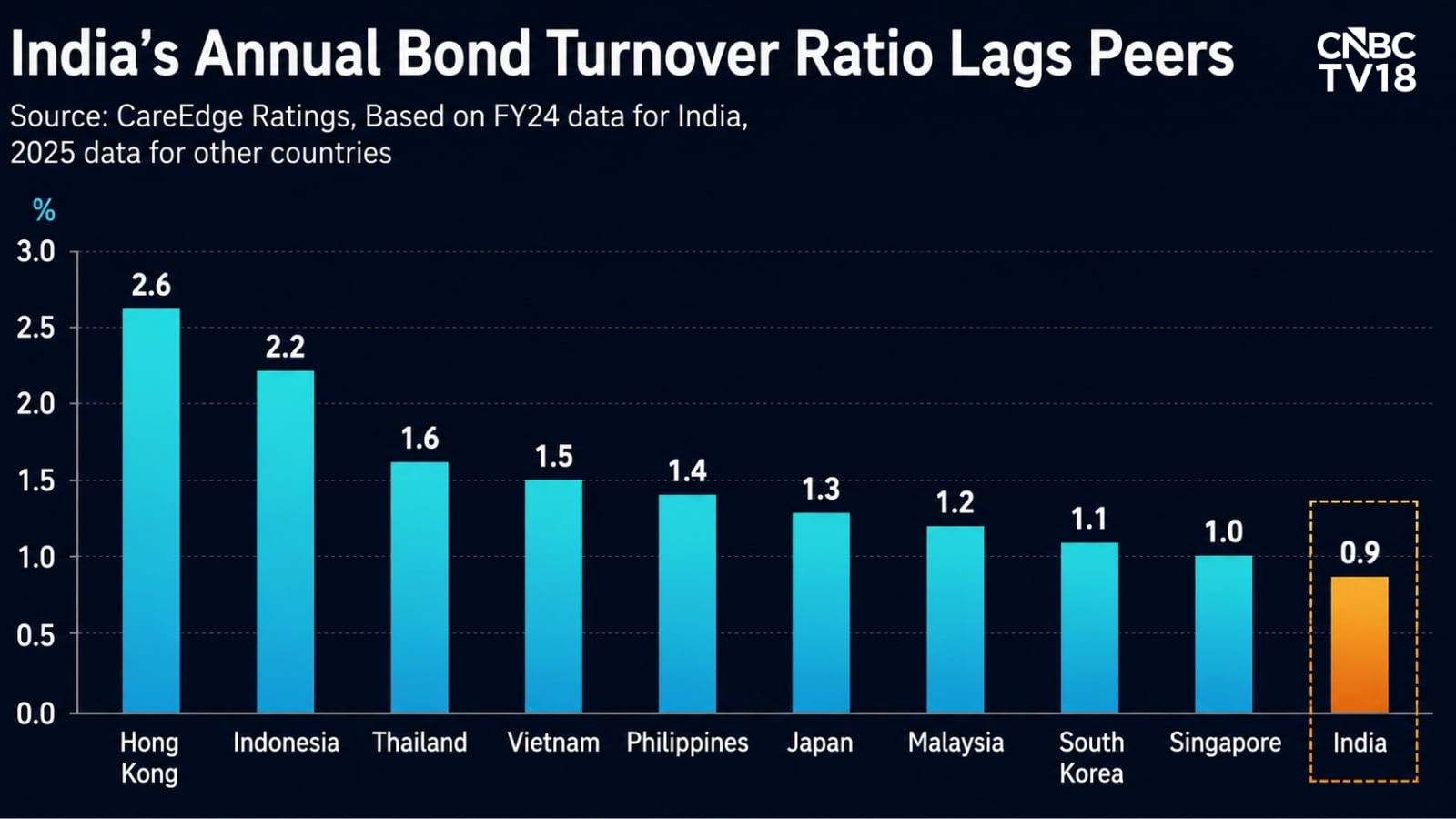
India's bond market can't remain a buy-and-hold club if it wants to fund the country's growth, according to former SBI Chairman Dinesh Khara, who has taken over as the chairman of the Corporate Bonds and Securitisation Advisory Committee under the Securities and Exchange Board of India.
The committee will advise the market regulator on issues related to corporate bonds, securitisation and related market developments. A more liquid bond market is necessary for a country undergoing a massive infrastructure upgrade, which banks alone can't fund.
The National Bank for Financing Infrastructure and Development estimates that India needs ₹40 lakh crore in annual infrastructure investment, twice the current level. The government has consistently pushed for greater private-sector participation in financing these projects.
Yet, very few bonds are actually traded. "When we look at the trading in the bond market, it is just about 0.16 to 0.17%," Khara said in a conversation with CNBC-TV18 on August 28. According to Khara, the market functions relatively well for highly rated AAA and AA bonds.
However, trading activity drops sharply for lower-rated investment-grade securities, even though many companies seeking capital operate in these segments. Supply-side issues persist, too. "Lower-rated issuers avoid bonds and preferbank loans, which offer more flexible terms and lower disclosure burdens.
India's corporate bond disclosure requirements are extensive, particularly for lower-rated or infrequent issuers," a NITI Aayog report released in late 2025 said. One of the biggest developments has been the emergence of Online Bond Platform Providers , regulated platforms that let retail investors buy bonds digitally.
SEBI introduced a regulatory framework for OBPPs in 2022, and the regulator now maintains a list of registered platforms through stock exchanges. However, it only solves half the problem. For individual investors, buying a bond is only half the equation.
They also need confidence that they can exit when required, he noted. Without an active secondary market, bonds struggle to compete with other financial products. The SEBI committee Khara heads has been tasked with solving this problem. "Credit enhancements, backstop arrangements and other risk-mitigation mechanisms could help improve investor confidence, particularly in lower-rated but investment-grade securities," he added.
He hopes growing interest among family offices and high-net-worth investors will filter down to retail investors seeking diversified yet more predictable income streams. After years of institutional and long-term dominance, the market's next chapter may depend on whether it can convince ordinary investors that bonds deserve a permanent seat at the table, not just a place on the financial sidelines.