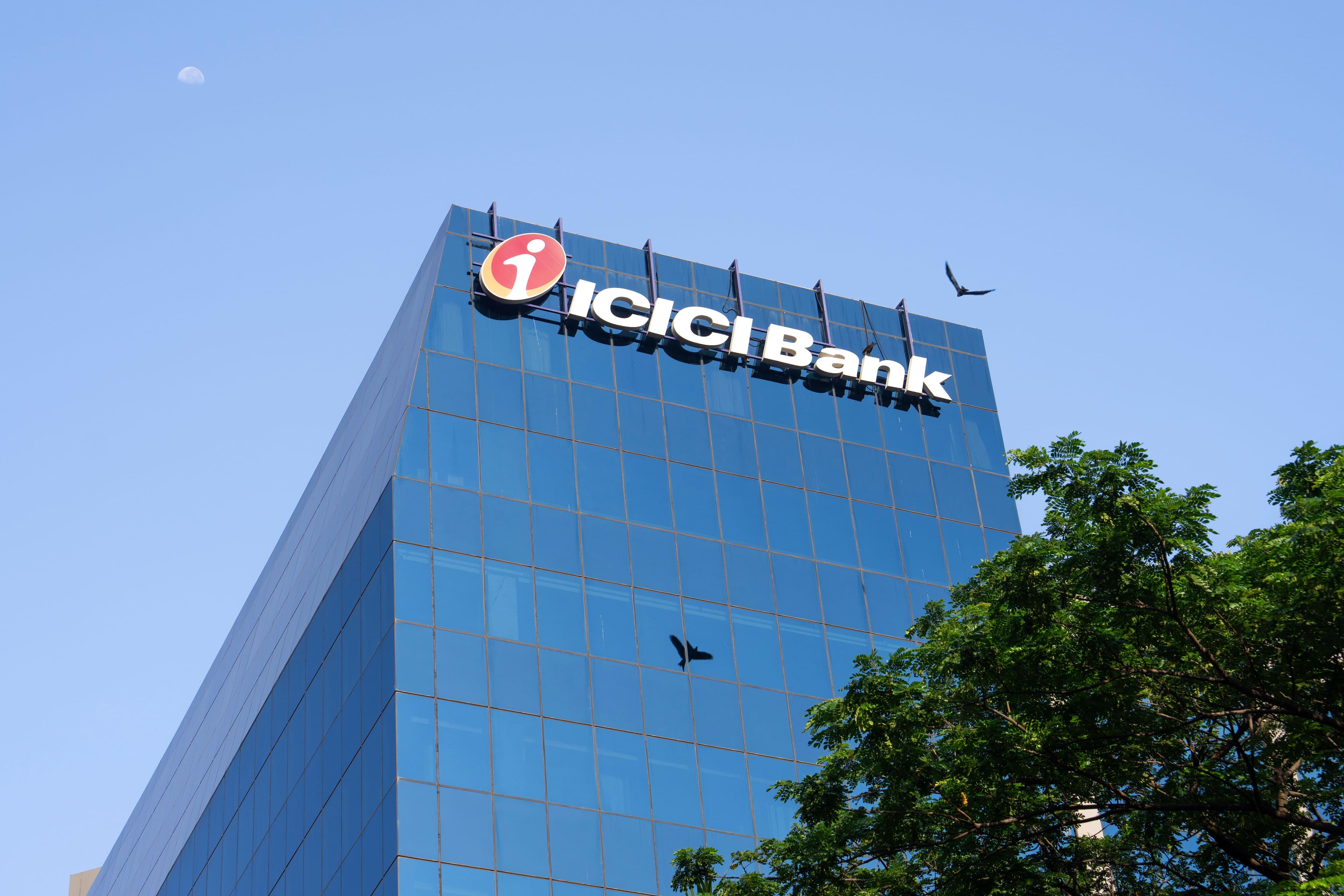
ICICI Bank share price movement ICICI Bank’s share price hit an all-time high of ₹1,647, rallying 4 per cent on the BSE in Wednesday’s intraday trade. The stock price of the private sector lender surpassed its previous high of ₹1,644.90 touched on November 20, 2026.
Thus far in November 2026, the market price of ICICI Bank outperformed the market by soaring 18 per cent, against a 12.8 per cent rise in the BSE Sensex. A sharp rally in ICICI Bank’s stock price has seen its market capitalisation inch toward ₹12 trillion-mark.
In intraday deals on Wednesday, the market capitalisation of ICICI Bank stock hit ₹11.83 trillion. At 10:22 AM, with a ₹11.8 trillion market capitalisation, ICICI Bank traded 3.6 per cent higher at ₹1,642.50 on the BSE. In comparison, the BSE Sensex was up 1.8 per cent at 83,929.
What’s driving ICICI Bank’s stock price? ICICI Bank remains among the largest private sector banks in India with consolidated asset base of ₹32.9 trillion as on September 30, 2026 (standalone asset base of ₹27.3 trillion). With gross advances and domestic deposits of ₹18.5 trillion and ₹20.5 trillion, respectively, as on September 30, 2026, on a standalone basis.
It is also one of the three banks that has been classified as domestic systemically important banks (D-SIBs) by the Reserve Bank of India (RBI), highlighting its significance to the overall financial system, Crisil Ratings said in its rationale dated November 18, 2026.
As a leading full-service universal banking group with a pan-India footprint, the group has a strong presence in life and general insurance, asset management, private equity and retail broking. Wide geographical spread is reflected in its network of 7,656 branches as on September 30, 2026.
The bank’s established market position shall continue to benefit from its strategy of expanding penetration and coverage in the domestic lending space, particularly in retail lending, while maintaining a strong liability franchise, the rating agency said.
Asset quality has also improved over the years and remained stable, with gross and net non-performing assets (gross nonperforming assets (GNPAs) and net non-performing assets (NNPAs)) of 1.3 per cent and 0.3 per cent, respectively, as on September 30, 2026.
The bank’s ability to maintain this metric at sound levels, alongside sustained growth, will remain monitorable, Crisil Ratings said. The bank’s, profitability remained stable with a consolidated net profit of ₹31,773 crore for the half year ended September 30, 2026, as compared with ₹26,915 crore for the corresponding period of the previous fiscal.
ICICI Bank has demonstrated resilience in the past while tiding over asset quality pressures across cycles by putting in place an institutionalised risk assessment framework involving enhanced control and monitoring mechanisms. Apart from this, various schemes launched by the Government of India and the RBI, such as the emergency credit line guarantee scheme that have benefitted micro, small and medium enterprises, have also aided asset quality for lenders, including ICICI Bank, within this segment, the rating agency said.
Meanwhile, analysts at Axis Securities have a ‘Buy’ rating on ICICI Bank with a target price of ₹1,865 per share. ICICI Bank continues to distinguish itself from its peers through its consistent execution capability, underpinned by well-diversified growth, superior asset quality performance, resilient and well-managed margin delivery, and robust operating efficiency.
Q2FY27 was another such quarter, reflecting strong underlying business momentum, robust core earnings growth, and pristine asset quality, the brokerage firm said. ICICI Bank has consistently demonstrated its ability to outperform peers even during periods of heightened uncertainty, reinforcing the strength of its franchise and execution capabilities, analysts said.
Consequently, they believe the bank continues to deserve its premium valuations vs peers, and remains preferred pick amongst the large private banks. The brokerage firm expects superior return on asset (RoA)/return on equity (RoE) delivery of 2.2-2.3 per cent/16-18 per cent to continue over FY27-29E.
Disclaimer: Views and outlook in this report belong to the brokerages and analysts cited. They do not reflect the views of Business Standard. Readers are advised to exercise discretion.