
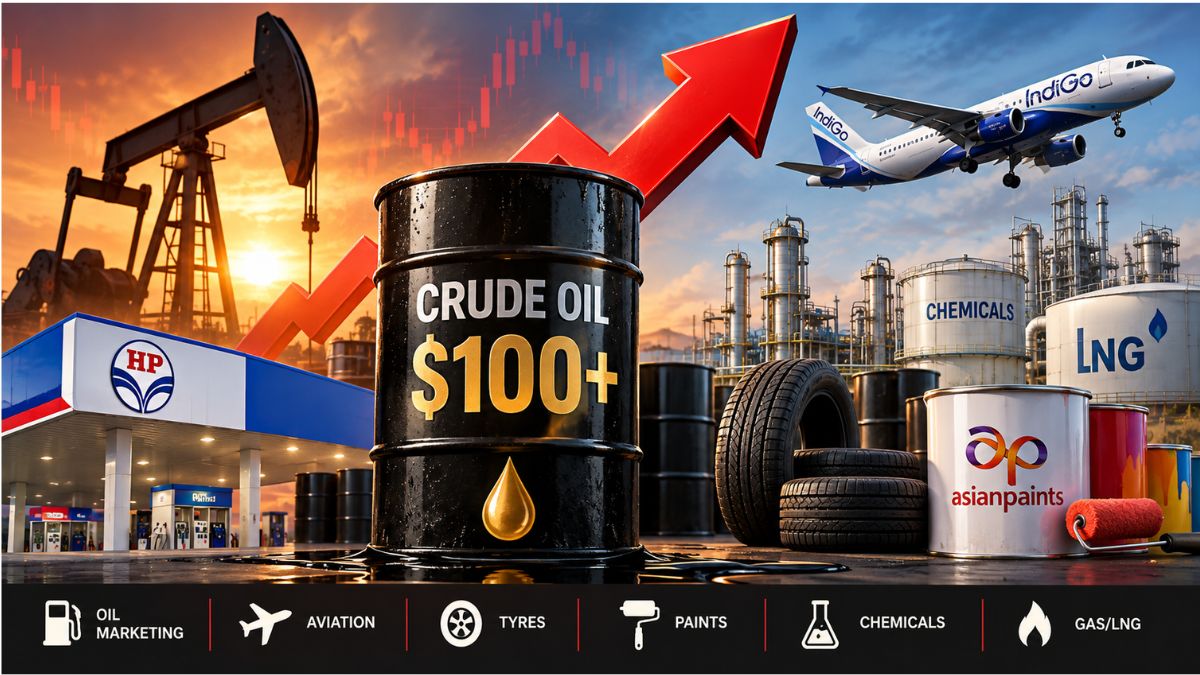
Oil prices surged further above $100 a barrel on Monday. Brent crude prices are now trading close to $108 after fresh strikes in Saudi Arabia and ships in the Gulf raised concerns over worsening disruption to global energy supplies. The pressure is now being felt across sectors linked to crude.
Oil marketing companies face the most immediate earnings risk, while airlines, tyre makers, paint manufacturers and some chemical companies could see their margins squeezed by higher fuel and raw-material costs.
The recent surge in crude makes the impact even more worrying. Brent crude futures rose 3.46%, while WTI futures gained 3.15%. Brent had already touched a three-month high of $109.97 a barrel on September 11, up over 30% from levels seen in early July.
HPCL faces the biggest pressure among OMCs
Oil marketing companies are at the centre of the crude-price shock because they have to procure crude at higher prices while retail petrol and diesel prices may not rise at the same pace. What makes it worse is that the Indian crude basket is now trading consistently above $100 for some days now.
Nilesh Ghuge, Research Analyst at HDFC Securities, said, “If you look at the near term, crude oil price is negative for oil marketing companies because the retail price is fixed, but crude price, which is a key raw material for oil marketing companies, has already touched $100. Definitely, it is negative for oil marketing companies.”
Sunny Agrawal, Deputy Vice President – Fundamental Research at SBI Securities, said the biggest earnings risk from crude above $100 is with India’s downstream fuel retailers.
“If Brent sustains above $100/bbl, the biggest earnings risk remains with India’s downstream fuel retailers: (a) HPCL, (b) Bharat Petroleum Corporation Ltd. and (c) Indian Oil Corporation. In such a scenario, marketing margins can turn negative,” Agrawal said.
Although Brent has already crossed that level, the key question for OMC earnings is how long crude stays there and whether retail fuel prices are adjusted to reflect the increase.
Agrawal said HPCL has historically shown greater earnings volatility during crude spikes because of its smaller balance sheet and lower diversification compared with IOC and BPCL.
“Historically, HPCL has shown the highest earnings volatility during periods of crude spikes because of its relatively smaller balance sheet and lower diversification compared with IOC and BPCL,” he said.
Maulik Patel, Head of Research at Equirus Securities, also sees HPCL as the most vulnerable among the three major OMCs, followed by IOCL and Bharat Petroleum Corporation.
“Impact depends primarily on retail-price pass-through, gov policies and refining cracks. If crude remains elevated while petrol, diesel and LPG prices are held unchanged, OMCs would face greatest direct pressure, with vulnerability ranking at: HPCL > IOCL > BPCL,” Patel said.
HPCL’s lower refining-to-marketing ratio means it has less internal refining cover and a greater dependence on purchased and imported products, Patel said.
“HPCL is most vulnerable because its refining-to-marketing ratio is only 51%, vs 74% for BPCL and 80% for IOCL so consequently has lowest internal refining cover and greatest dependence on purchased/imported products,” he said.
For OMCs, the impact of crude above $100 is not confined to the cost of buying crude. Higher LPG under-recoveries, crude-landing costs, freight and insurance expenses can add to the burden, while working-capital requirements and debt can rise.
“At sustained $100-plus crude, with restricted retail-price increases, the major risks are: Negative petrol and diesel marketing margins. Higher LPG under-recoveries. Higher crude-landing, freight and insurance costs. Working-capital and debt accumulation. Inventory losses once crude corrects sharply,” Patel said.
Sumit Pokharna, VP Fundamental Research at Kotak Securities, also expects the strongest pressure among downstream companies to be felt by BPCL, HPCL and IOC.
“The biggest concern is for oil marketing companies such as BPCL, HPCL and IOC. Their raw material, working capital, interest and operating costs will rise. Among downstream companies, HPCL could be impacted the most. BPCL and IOC could also be impacted,” Pokharna said.
The impact on individual OMCs will depend on refining margins, the mix of refining and marketing operations and the extent to which higher crude costs can be passed through to consumers.
Airlines are another major source of crude-price exposure because ATF is one of their largest operating expenses. A sustained rise in crude can therefore feed directly into fuel bills.
“ATF remains one of the largest operating costs and spikes in crude quickly impacts profitability,” Agrawal said.
SBI Securities identified InterGlobe Aviation and SpiceJet among the airlines exposed to the increase.
Pokharna put the fuel-cost exposure in context, saying, “Higher crude prices also increase ATF prices, which account for around 35-50% of airlines’ operating costs, putting pressure on airlines.”
For airlines, the impact on earnings will depend on the extent to which higher fuel costs can be recovered through ticket prices and other cost savings.
Tyre manufacturers are exposed to crude through carbon black and several petroleum-linked chemicals used in production. If those costs rise faster than selling prices, EBITDA margins can come under pressure.
“Tyre makers use carbon black and several petroleum-linked chemicals. Input costs typically rise with crude, putting pressure on EBITDA margins unless pricing actions compensate,” Agrawal said.
The companies identified by SBI Securities include MRF, CEAT, Apollo Tyres, JK Tyre and Balkrishna Industries.
Pokharna also included tyre companies among businesses where higher crude and crude derivatives can raise raw-material and operating costs.
“Crude oil is a raw material for refineries, while base oil and lubricants are also linked to crude. Companies where crude or crude derivatives are a direct raw material will see their raw material and operating costs rise,” he said.
The extent of the margin hit will depend on how quickly tyre makers can pass higher input costs through to customers.
Paint manufacturers are exposed to crude through solvents, resins and petrochemical intermediates, making higher oil prices a direct concern for their raw-material costs.
“Paint manufacturers are among the most directly crude-sensitive sectors because solvents, resins and petrochemical intermediates are oil-linked. Crude-derived inputs can account for roughly 35-45% of paint raw material costs, making sustained oil inflation a direct margin headwind,” Agrawal said.
Asian Paints and Berger Paints are among the companies identified as exposed to the increase in crude-linked costs.
Pokharna also named both companies while discussing businesses where crude or crude derivatives form part of the raw-material base.
“This includes oil marketing companies, tyre companies, paint manufacturers such as Asian Paints and Berger Paints, and lubricant companies such as Castrol,” he said.
Specialty chemical manufacturers that use naphtha and petrochemical feedstocks could also see costs rise as crude prices remain elevated.
“Many downstream chemical manufacturers use naphtha and petrochemical feedstocks. Margin impact depends on pass-through ability. The actual impact varies by contract structure and export exposure, but feedstock inflation remains a risk,” Agrawal said.
SBI Securities named SRF, Navin Fluorine, PI Industries and Aarti Industries among the companies exposed to this risk.
The impact is likely to vary across companies depending on their feedstock requirements, contracts and ability to pass higher costs on to customers.
Some gas-linked companies could also come under pressure as higher crude prices feed into LNG costs, particularly where sourcing is linked to Brent or spot LNG prices.
“Among gas-linked companies, CGDs face near-term margin risk from rising spot LNG price and crude link LNG contract,” Patel said.
Gujarat Gas is exposed to higher Brent-linked spot LNG and rupee depreciation, although gas-trading profits can partly offset the pressure, he said.
“Gujarat Gas: Exposed to higher brent linked spot LNG and INR depreciation, partly offset by gas-trading profits,” Patel said.
Petronet LNG is more exposed to LNG affordability and regasification volumes, while MGL has some cushioning through Henry Hub-linked sourcing and pricing action.
“Petronet LNG: More exposed to LNG affordability and regasification volumes,” Patel said.
GAIL has a more defensive earnings mix because transmission earnings provide a buffer, according to Patel. Pokharna, meanwhile, included IGL, MGL, GAIL and Petronet LNG among midstream companies that could face pressure if supply remains constrained and prices continue to rise.
“Midstream companies such as IGL, MGL, GAIL and Petronet LNG could also face pressure if supply remains constrained and prices continue to rise. Margins for IGL and MGL could be negatively impacted, while this would also be negative for Petronet LNG,” Pokharna said.
If crude remains at elevated levels for an extended period, companies with limited pricing power could see a sustained squeeze on margins, while higher working-capital and financing requirements could add to the pressure on earnings.
Overall, with Brent already above $100 a barrel, HPCL, IOC and BPCL face the most immediate earnings pressure, while airlines, tyre makers and paint companies are likely to see higher fuel and raw-material costs. The extent of the hit will depend largely on how long crude stays elevated and how much of the cost increase companies can pass on to customers.