
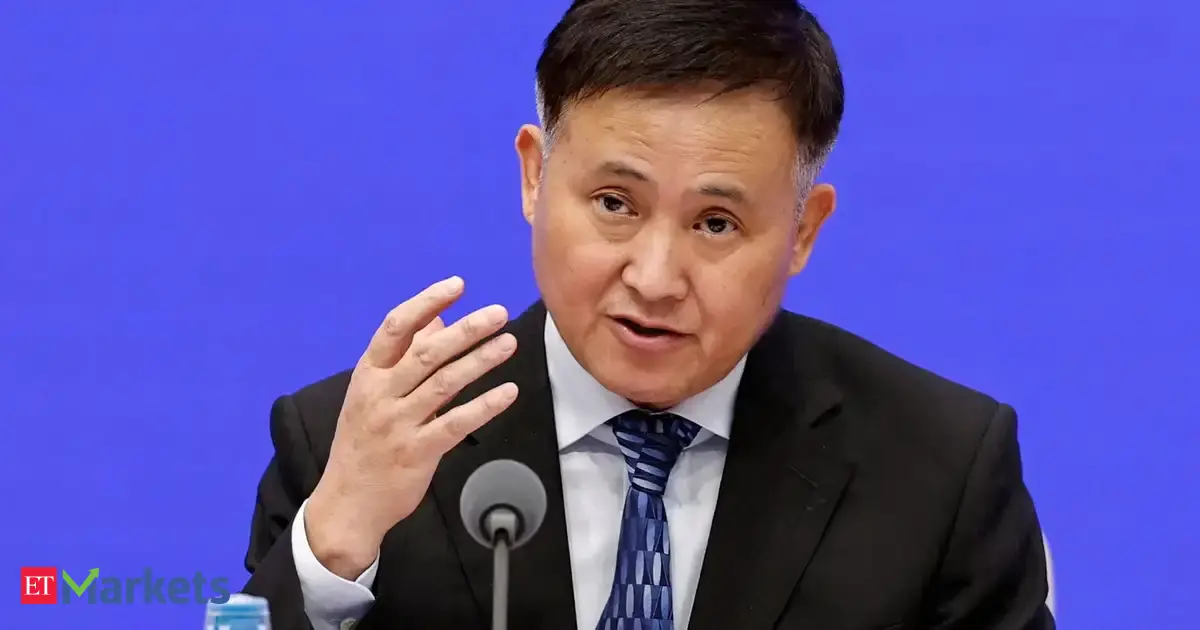
China’s slower loan growth is becoming a new normal as shrinking property and local government sectors weaken demand for credit faster than emerging industries can compensate, People’s Bank of China Governor Pan Gongsheng said, according to Reuters.
Pan’s comments come after official data showed that new bank lending recovered in August from a record contraction in July, but remained well below market expectations. Weak borrowing demand from households and businesses continues to weigh on overall credit expansion.
Structural shift in China’s credit demand
According to Reuters, the slowdown reflects a broader transformation in China’s economy. Lending to the property sector and local government financing vehicles is declining, while newer sectors have not yet generated enough demand for bank credit to fully offset that contraction.
China’s outstanding yuan loans stood at more than 280 trillion yuan ($41.73 trillion), with a substantial portion linked to property and local government financing vehicles. As these sectors shrink, maintaining the rapid pace of overall loan growth seen in previous years is becoming increasingly difficult.
Pan has argued that the shift does not necessarily indicate a shortage of financing. Instead, the central bank is placing greater emphasis on the quality and efficiency of credit allocation rather than simply expanding the volume of loans.
August lending highlights weak demand
China’s banks extended 60 billion yuan ($8.95 billion) in new loans in August, according to Reuters. While that represented a recovery from July’s record 340 billion yuan contraction, the figure was far below the 400 billion yuan expected by analysts.
Household borrowing contracted for a sixth consecutive month, reflecting continued weakness in mortgage demand and limited appetite for debt-funded consumption. From January through August, new yuan loans totalled 10.44 trillion yuan, down from 13.46 trillion yuan during the same period a year earlier. Outstanding yuan loans grew 4.9% year-on-year in August, the slowest pace on record, Reuters reported.
Focus shifts beyond bank lending
The changing composition of China’s economy is also reducing the importance of bank loans as the sole indicator of financing conditions.
Pan has highlighted the growing role of bonds and equity financing in China’s financial system. In 2025, bank loans accounted for 45% of the increase in total social financing, while bond and equity financing together represented 47%, surpassing bank lending for the first time, according to Reuters.
The shift is particularly relevant as China seeks to direct capital towards high-tech manufacturing, green industries and other emerging sectors. These businesses tend to rely more heavily on technology, data and intellectual property than on land and physical assets, making them less dependent on traditional bank borrowing.
PBOC sees efficiency as key
The People's Bank of China has increasingly framed the credit slowdown as part of a longer-term adjustment in the country's financial structure. Pan has previously said that China has moved from an era of rapid economic expansion towards higher-quality growth, meaning the role of finance is increasingly focused on improving the allocation of existing resources rather than continually expanding aggregate credit.
According to Reuters, Pan also warned that excessive financial expansion could increase leverage, keep funds circulating in speculative activities and delay the exit of inefficient companies and excess capacity.
The policy shift therefore suggests that slower aggregate credit growth may persist even as authorities continue to ensure that viable sectors and businesses have access to financing. The central bank's focus is increasingly on directing capital towards productive uses rather than maintaining a high headline rate of loan growth.