
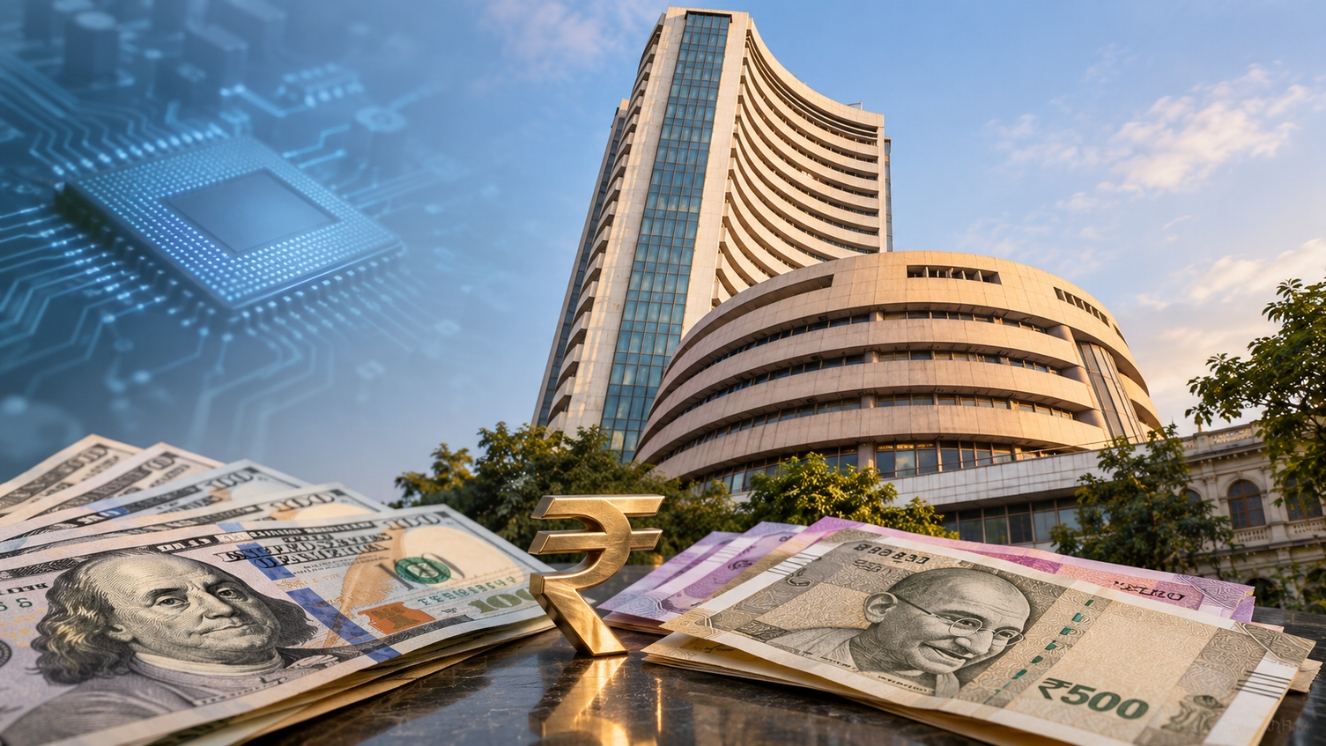
For months, India was on the wrong side of the global investment trade. Foreign portfolio investors (FPIs) were chasing the artificial intelligence boom in the US and technology-heavy Asian markets, leaving Indian equities out in the cold. Now, as doubts creep into the AI frenzy, India’s biggest disadvantage may be turning into its greatest strength.
Foreign investors are putting serious money behind the India as an AI-hedge narrative. Since October 16, net FPI inflows into Indian equities have crossed Rs 1 lakh crore. November alone has attracted Rs 78,803 crore so far — the highest since November 2020. If the momentum holds, the month could rewrite the record books for foreign investment in Indian equities.
The reversal is particularly striking against a broader exodus from Asian markets. In the second half of October, FPIs pulled nearly $50 billion out of Asian equities, including $14.6 billion from South Korea and $31 billion from Taiwan. India, too, suffered outflows of $3.2 billion.
November has brought more of the same for much of Asia, but with one crucial difference: India has emerged as a beneficiary. While foreign investors have withdrawn $8.32 billion from South Korea and $19.72 billion from Taiwan, India has attracted net inflows of $8.5 billion.
The shift away from crowded AI trades is only part of the story. Falling crude oil prices, a strengthening rupee and improving corporate earnings have made India increasingly attractive. Valuations, too, are looking less intimidating. The Nifty 50 is trading at around 18 times one-year forward earnings, compared with more than 23 times at its recent peak.
Sanjeev Prasad, managing director and co-head of Kotak Institutional Equities, believes corporate earnings are finally beginning to deliver. “Earnings have been good in the first quarter and better in the second quarter. The next mega returns must come from earnings growth,” he said.
Kotak Institutional Equities expects earnings growth of 19% in FY27 and 13% in FY28.
Manishi Raychaudhuri, CEO of Hong Kong-based Emmer Capital Partners, agreed that the earnings picture is improving. “The India story is not looking as bad as it was made out to be. Earlier, the macroeconomic growth in India had an earnings problem,” he said.
In 2024-25, earnings initially projected by analysts at 100 would eventually end up at 80, he pointed out. That pattern of persistent earnings downgrades now appears to be reversing.
The retreat in crude oil prices could be another game changer for India, a major oil importer. Lower oil prices would ease inflationary pressures, support the rupee, improve corporate margins and strengthen the country’s appeal to foreign investors.
But a question hangs over the spectacular turnaround: Is this the beginning of a sustained foreign investment cycle, or merely a sharp rebound driven by short-covering?
Prasad is firmly in the first camp. “This is proper buying with cash inflows and can be sustainable,” he said.
Samir Arora of Singapore-based Helios Capital is less convinced. “Since the reversal of FPI flows happened so fast, a major part must be short-covering,” he said.
Arora has long argued that India needs to do more to compete for global capital. Among his proposals is the abolition of long-term capital gains tax for foreign investors, which he believes would make Indian equities more attractive.
Prasad, too, believes policy stability will be critical to sustaining the momentum. He wants the government to press ahead with administrative reforms while avoiding regulatory overreach in sectors such as healthcare and insurance, where policy uncertainty has unsettled investors.
“Any clarity of stable regulations and benign taxation could help the market,” he said.
U R Bhat, founder of Alphaniti Fintech, said FPIs typically seek returns of 15-16% in US dollar terms. Stronger earnings, cheaper crude and a stable or appreciating rupee could make those expectations more achievable.
V K Vijayakumar, chief investment strategist at Geojit Investments, believes India Inc could emerge from a prolonged period of low-single-digit compounded earnings growth and return to mid-teen growth by March 2027.
The India trade, however, is hardly risk-free. A renewed surge in crude prices, disappointing earnings or a reversal in global risk appetite could quickly test the strength of the FPI comeback. And if foreign money continues to pour in at the current pace, India could soon confront a familiar problem: Expensive valuations. But for now, the pieces appear to be falling into place.