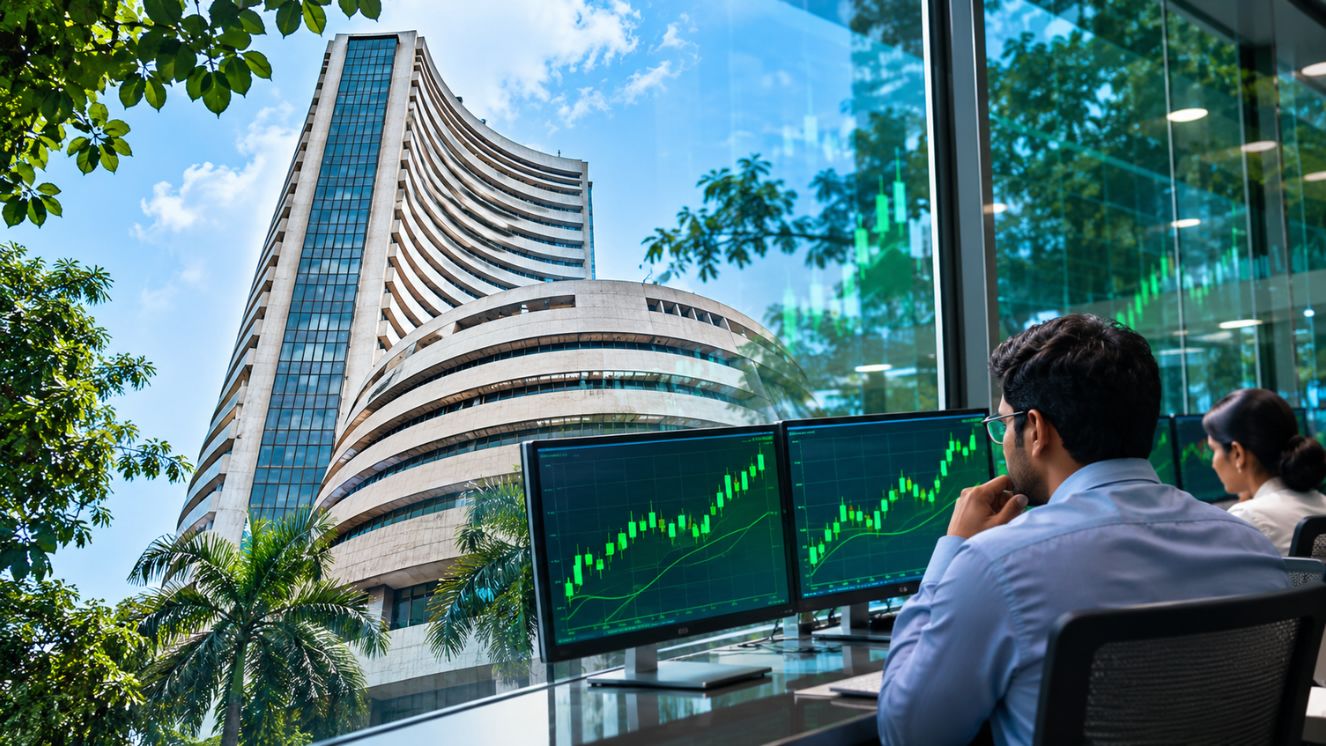
The return of foreign portfolio investors (FPIs) to Indian equities has sparked a rally in capital market stocks, with exchanges, depositories and brokerages emerging as major beneficiaries of renewed investor interest and rising trading activity.
Shares of Angel One (intraday jump of 8.9% over previous close), National Stock Exchange (+3%), BSE (+3%), National Securities Depository (+2.7%), Central Depository Services (+3.2%), and Groww’s parent Billionbrains Garage Ventures (3.85%) were in the limelight.
Shares of the newly listed NSE touched a fresh all-time high of ₹2,134 on Tuesday, pushing the NSE’s market capitalisation past the ₹5-lakh-crore mark to ₹5.12 lakh crore. However, the stock erased its gains, closing 0.4% lower at ₹2,061.
The rally in capital market stocks reflects expectations that sustained foreign inflows will boost trading volumes, brokerage income and transaction-related revenues across the market ecosystem.
Trading activity has already picked up since FPIs turned net buyers on October 16. According to NSE data, average daily cash market volume rose to 5.20 billion shares in the month prior to 16 November 2026, up from 5.02 billion shares in the comparable period to 15 October 2026, indicating a recovery in market participation. The daily value of shares traded rose to Rs 1.20 lakh crore from Rs 1.14 lakh crore for the same period.
Foreign investors continued their buying spree on Tuesday, pumping ₹4,195 crore into equities. Domestic institutional investors (DIIs) were also net buyers, although their purchases were far more modest at ₹195 crore.
The Sensex gained 427 points, or 0.52%, even as several Asian markets, particularly South Korea and Taiwan, remained under pressure for the second consecutive session.
The resurgence of foreign buying has also altered the dynamics of domestic institutional flows. Mutual funds, which had been reducing their cash holdings over the past several months, have used the market recovery to rebuild liquidity in their portfolios, creating room to deploy funds during future corrections.
“When the foreigners have come, they are building their coffers,” said Vikash Kumar Jain, head of research at CLSA India.
According to Jain, the average cash holding in equity mutual fund schemes had fallen to around 5% a month ago, compared with 7.5% in April 2025. The decline helps explain why domestic funds have been booking profits and rebuilding cash reserves even as foreign investors have stepped up purchases.
Manish Bhandari, founder and CEO of portfolio management firm Vallum Capital, likened market buoyancy to “liquid hydrogen” for the earnings of capital market companies.
“The segment was non-existent so far. However, now investors can take an exposure to the entire capital market ecosystem,” he said.
Bhandari pointed out that investors seeking exposure to India’s financial sector were earlier largely restricted to banks and conventional financial services companies. The emergence of listed exchanges, depositories and technology-driven brokerages has widened that opportunity considerably.