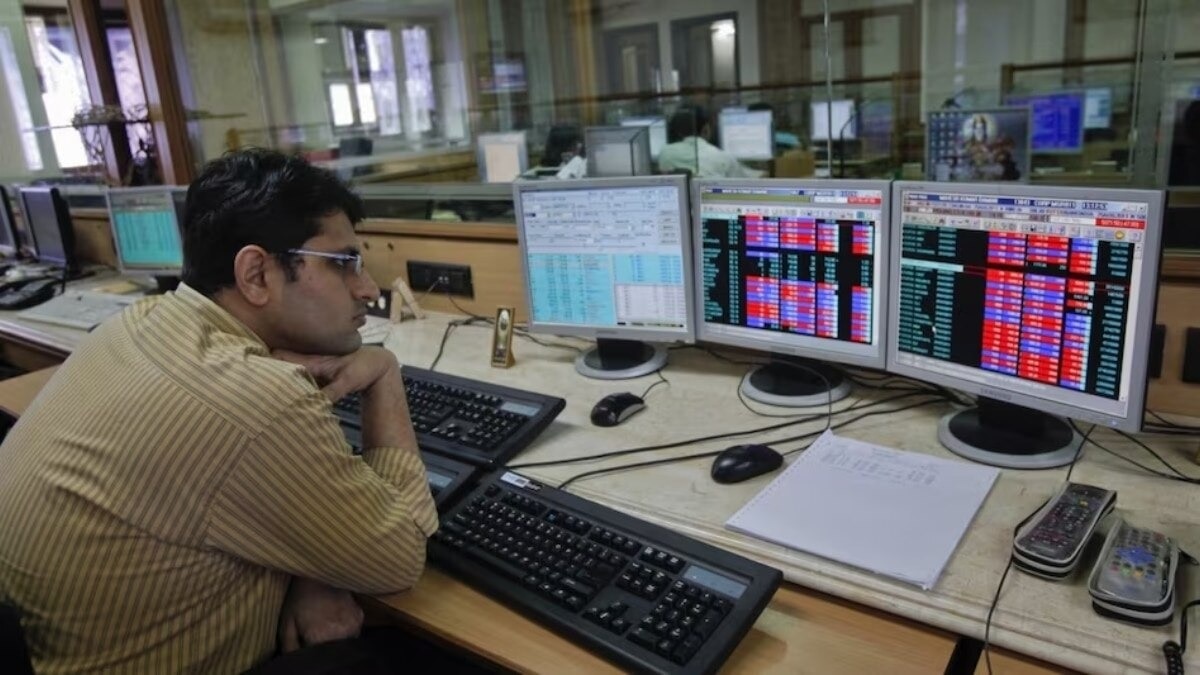
Indian equity benchmarks ended sharply lower on Monday, reversing their gains from the opening session as selling pressure across banking, financial, metal and energy stocks dragged the indices down. The decline also came amid profit-booking following the sharp rally in domestic equities in recent weeks.
The 30-share BSE Sensex pack plunged 1,483.72 points or 1.77 per cent to close at 82,435.99, while the NSE Nifty index declined 450.95 points or 1.75 per cent to settle at 25,349.65.
The broader market also ended in the red. Nifty Midcap100 fell 1.02 per cent, while Nifty Smallcap100 declined 0.70 per cent.
Among the Sensex constituents, HDFC Bank Ltd, ICICI Bank Ltd, Axis Bank, Reliance Industries Ltd (RIL), State Bank of India (SBI), Tata Steel, Larsen & Toubro (L&T), Kotak Mahindra Bank, Bharti Airtel and Bajaj Finance were among the key laggards on the BSE.
The sharp decline in benchmark indices weighed on notional investor wealth. The total market capitalisation (m-cap) of BSE-listed companies fell by around Rs 5.24 lakh crore to Rs 508.94 lakh crore on Monday, compared with Rs 514.18 lakh crore in the previous trading session.
Vinod Nair, Head of Research at Geojit Investments, "Last week's late global sell-off, triggered by concerns over an AI bubble and tighter US monetary policy, weighed on Indian equities today. Selling was concentrated in heavyweight banking and commodity stocks amid weak FII sentiment. The domestic market also remains vulnerable to profit booking after the recent sharp rally and a holiday-shortened week. Mixed Asian markets and a positive European opening helped limit losses."
Nair added, "The outlook hinges on whether the AI-led sell-off remains contained. Although valuations have corrected significantly, concerns over the sustainability of debt-funded data-centre investments continue to weigh on global sentiment. Further weakness in global equities could spill over into India, though the impact may be relatively limited given India's lower exposure to AI-driven investment and resilient domestic economy. Improving manufacturing activity and expectations of robust Q2 GDP growth of around 7.7 per cent remain key fundamental supports for a constructive medium- to long-term outlook."
Kranthi Bathini, Equity Strategist at WealthMills Securities, said, "Domestic equity benchmarks have witnessed a sharp upmove in recent weeks, supported by strong buying interest in the banking segment. Against this backdrop, some near-term correction would be healthy for the market. Investors should maintain a selective approach and focus on quality large-cap stocks going forward."
Despite Monday's sharp fall, the benchmarks have registered substantial gains over the past month. Sensex has advanced 12.73 per cent, while Nifty has gained 12.17 per cent during the same period.
The recent recovery in domestic equities has been supported by strong foreign institutional investor (FII) buying, a steep decline in crude oil prices and positive corporate earnings.