
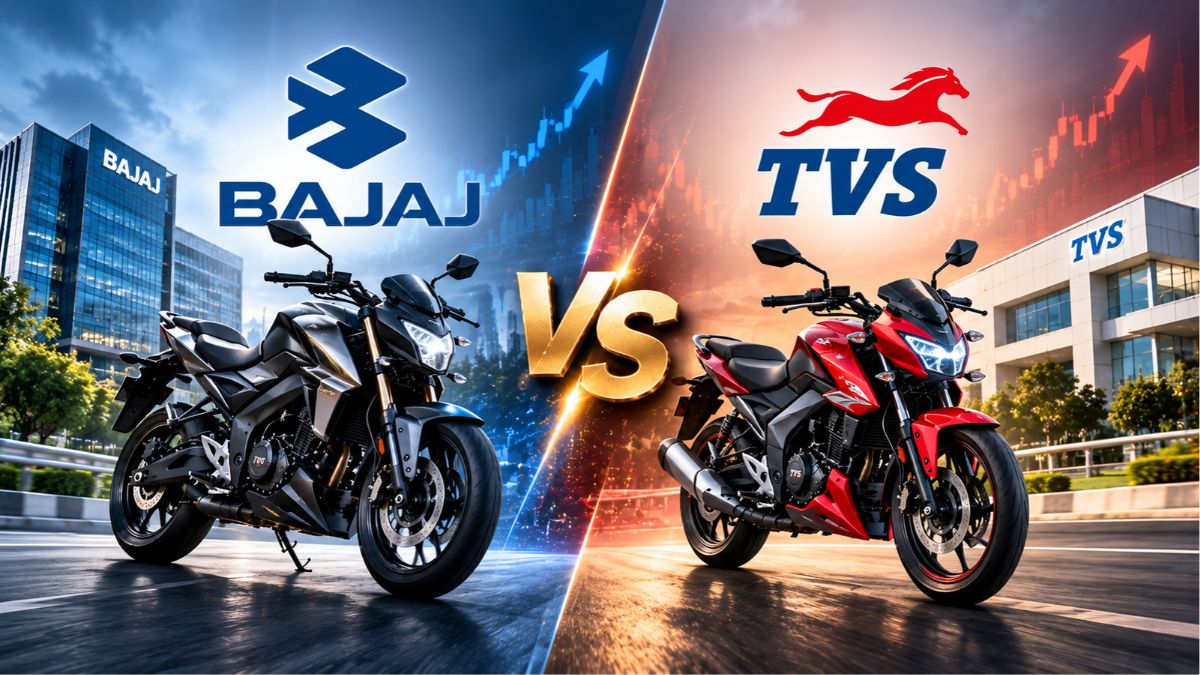
The two-wheeler manufacturers have seen a strong Q2 despite cost pressures. Bajaj Auto and TVS Motor Company delivered robust performances in the September quarter of FY27. Bajaj Auto reported record quarterly revenue and profits, and TVS Motor grew revenue by 44% while increasing profit after tax by 52%. The difference lies in what happened beneath the sales numbers: TVS Motor improved its operating margin while Bajaj maintained a strong standalone margin.
The companies’ earnings calls and results statements offer a closer look at how management plans to sustain momentum. Bajaj Auto spoke about records across its business and the need to recover rising costs. TVS credited its product range, pricing actions and cost-control measures for its performance. Their next challenge is to sustain demand without allowing higher costs to erode earnings.
Bajaj Auto’s September-quarter performance was marked by growth across revenue and profit. Consolidated revenue from operations rose 59.7% year on year to Rs 25,125.6 crore, while profit attributable to owners increased 61.9% to Rs 3,436.1 crore. On a standalone basis, revenue reached Rs 20,003 crore, and EBITDA stood at Rs 4,172 crore, giving the company an EBITDA margin of 20.9%, compared with 20.5% a year earlier.
TVS Motor, meanwhile, reported revenue of Rs 17,103 crore, EBITDA of Rs 2,219 crore and profit after tax of Rs 1,377 crore. Revenue grew 43.7%, rounded to 44%; EBITDA increased 47% and profit after tax rose 52%, with the EBITDA margin improving to 13.0% from 12.7%.
Bajaj delivered strong growth and a high standalone margin; Hyundai’s record sales came with a substantial decline in profitability, and TVS combined rapid revenue growth with an improvement in its margin. Each company now has a different task: managing costs at Bajaj, restoring margins at Hyundai, and sustaining growth at TVS.
Bajaj Auto’s earnings call on October 27, 2026, carried a celebratory tone, with Joint Managing Director Rakesh Sharma describing the quarter as “a festival of records in Q2.” The comment referred to the company’s performance across volumes, revenue, EBITDA, profit after tax and free cash flow. Chief Financial Officer Dinesh Thapar also spoke about the scale of the quarter, with volumes exceeding 15 lakh units, revenue crossing Rs 20,000 crore and EBITDA exceeding Rs 4,000 crore.
The record performance came against a backdrop of higher input costs. Management discussed calibrated price increases to recover part of the inflationary impact, while acknowledging that cost pressures and currency movements remained relevant. The company’s challenge is to maintain its sales momentum while protecting margins in a market where price increases must be balanced against demand and competition.
TVS Motor’s results announcement on October 28 focused on its record sales and earnings. Chief Executive Officer K. N. Radhakrishnan said, “We are delighted to share that during this quarter, we achieved the highest-ever sales volume, revenue, and profits.” The company’s sales rose to 1.9 million units from 1.5 million units a year earlier, while revenue and profit after tax grew faster than volumes.
Radhakrishnan also discussed the company’s response to commodity inflation, saying, “While there were commodity price increases in Q1 and Q2, we were able to take up some prices. We were able to partially mitigate through cost reductions. Also, optimization initiatives on product mix.” His comments connect the sales performance with the company’s margin improvement. Higher volumes helped drive revenue, while pricing, cost reductions and product mix helped contain the effect of rising input costs.
Bajaj Auto’s growth was spread across domestic and international markets and across its internal-combustion-engine and electric products. Its business spans motorcycles, three-wheelers and electric scooters, giving it exposure to several categories rather than relying on a single vehicle segment. Management also discussed capacity constraints in high-end motorcycles, exports and electric vehicles. These constraints make production and supply important considerations alongside demand, particularly if the company continues to record strong volumes.
TVS Motor sold 1.9 million units, up 27% year on year. Motorcycle sales increased 28%, scooter sales rose 29%, and international business grew 35%. Electric two-wheeler volumes reached 186,186 units, compared with 80,009 units a year earlier. Growth across motorcycles, scooters and electric products gives TVS several sources of demand, although sustaining this pace will depend on market conditions, product availability and the company’s ability to manage costs as volumes rise.
Bajaj Auto’s standalone EBITDA margin increased to 20.9% from 20.5%, while standalone EBITDA rose 36.6% to Rs 4,172 crore. The margin performance indicates that the company maintained operating profitability as revenue and volumes expanded. Management’s comments on inflation and calibrated price increases nevertheless show that cost recovery remains an ongoing task. The extent to which Bajaj can continue passing on higher costs will depend on consumer demand and competitive conditions.
TVS Motor’s EBITDA margin increased to 13.0% from 12.7%, despite higher input costs. The company said pricing actions, cost reduction and product-mix optimisation helped offset some of the pressure. This improvement is relevant alongside its 43.7% revenue growth, because it shows that operating earnings grew faster than revenue. Maintaining that relationship will depend on future pricing, the mix of vehicles sold and the level of input costs.
Bajaj Auto’s electric-vehicle business is part of a broader portfolio that includes motorcycles and three-wheelers. During the October 27 earnings call, management discussed growth across ICE and EV products and said the company had begun exporting electric vehicles. It also discussed eligibility for an enhanced incentive rate under the electric-vehicle production-linked incentive scheme after crossing the required cumulative revenue threshold. The benefit will depend on eligible sales and the applicable scheme terms, while the pace of EV growth will also depend on production capacity and demand.
TVS Motor’s electric two-wheeler volumes more than doubled year on year to 186,186 units. Its international business also grew 35%, and management expects exports to benefit from product availability, new market entries, launches and dealer-network expansion. The company’s electric range and export operations offer routes to growth beyond the domestic conventional two-wheeler market. However, sales expansion alone does not determine profitability: production costs, pricing, product mix and the spending required to support growth will continue to influence earnings.
Most leading brokerages seemed upbeat about the Bajaj Auto and TVS Motor Q2 performance.
Both Jefferies and Motilal Oswal have a Buy rating on TVS Motor. Jefferies has reiterated its ‘Buy’ rating on TVS Motor with a target price of Rs 5,425 per share on strong two-wheeler demand momentum in both India and export market. This implies about 28% upside. According to them, “TVS invested 1,280 crore in subsidiaries in Q2” and this “continued high investment with limited visibility of improvement in subsidiary profitability is a concern, and success of new Norton bikes would be crucial.”
For TVS Motor, Motilal Oswal maintained a ‘Buy’ rating and a target price of Rs 5,200 in its October 28 report. Against a reference share price of Rs 4,239, the target implied upside of 23%. The brokerage valued TVS at 36 times FY28 estimated earnings per share and raised its FY27 and FY28 earnings estimates by 11% and 10%, respectively.
It cited stronger-than-expected EBITDA, higher realisations, product mix and cost control. The target depends on continued growth in domestic two-wheelers and exports, along with the company’s ability to sustain its margin performance.
For Bajaj Auto, Motilal Oswal and Jefferies have different recommendations.
Motilal Oswal maintained a ‘Buy’ rating with a target price of Rs 12,600, implying an upside of 21% from the current market price of Rs 10,390, in its report dated October 27, 2026. The brokerage valued the company at 24 times its FY28 estimated core earnings per share, citing stable margins, strong revenue growth and a healthy product pipeline.
Motilal Oswal raised its FY27 earnings per share estimate by 5%, supported by better-than-expected revenue performance and higher income from production-linked incentives and export incentives. It expects Bajaj Auto to deliver a compound annual growth rate of 22% in revenue, 24% in EBITDA and 24% in profit after tax between FY26 and FY28. The brokerage also expects the company to gradually recover domestic motorcycle market share, with exports remaining healthy and management targeting around 2.5 lakh units per month in the near term.
Jefferies, on the other hand, has a ‘Hold’ rating. They have a target price of Rs 11,500 per share implying about 10% upsie from current levels. The global investment bank is betting on strong demand momentum. According to them “Bajaj is doing well in EVs and has regained some share in exports, although domestic motorcycle market share has been under pressure. It plans to launch two new brands in 125-250cc bikes in FY27. Stock is trading at a reasonable 20x FY28E PE.”
Bajaj Auto enters the second half with strong reported growth, but commodity inflation, currency movements and capacity constraints remain relevant to its operating performance. Management has discussed price increases as a way to recover part of the higher costs, although the amount that can be passed on depends on demand and competition. Its EV incentive eligibility and export activity provide additional growth opportunities, while production capacity will influence how quickly the company can meet demand in some categories.
TVS Motor must sustain its strong sales growth while maintaining the gains from product mix and cost control. Motilal Oswal expects domestic growth to remain above the two-wheeler industry and exports to improve. These expectations will need to be tested against reported results, particularly as the company continues to expand its electric two-wheeler business.
Bajaj Auto and TVS Motor Company enter the second half of FY27 with strong sales but different challenges. Bajaj must manage rising costs while sustaining its earnings momentum, and TVS must maintain its rapid growth without losing its profitability gains. The real test in the coming quarters will be which company can turn demand into sustained profit growth.