
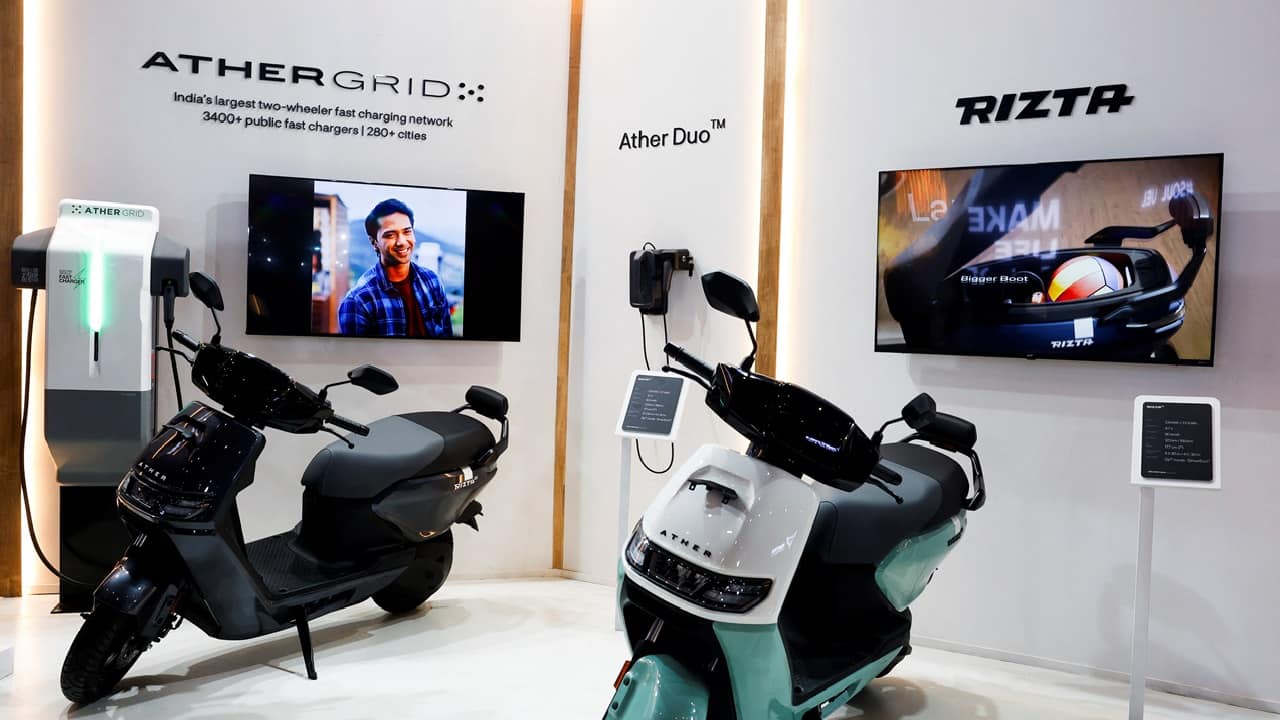
When Ather Energy announced fresh capital raise, one of the names that stood out among the investors was the India-Japan Fund (IJF), an investment vehicle backed by the Government of India and Japan Bank for International Cooperation (JBIC).
So, why has the government invested in a listed electric two-wheeler maker? The answer lies not in rescuing a company or picking market winners but in the government's broader industrial strategy — one that seeks to build globally competitive EV manufacturers, reduce dependence on imported oil and position India as a clean mobility manufacturing hub.
Not a direct government investment
At first glance, it may appear that the government acquired a stake in Ather but that is not the case.
The investment is being routed through the India-Japan Fund (IJF), a $600-million fund established in 2023 by the National Investment and Infrastructure Fund (NIIF) and JBIC.
While the Government of India backs NIIF and contributes 49 percent to the fund's corpus, JBIC provides the remaining 51 percent.
The fund was created with a mandate to invest in businesses that advance clean energy, sustainable infrastructure, advanced manufacturing and low-carbon technologies. Rather than functioning as a conventional government investment arm, it operates like a long-term institutional investor, identifying companies that align with India's strategic economic priorities.
Why Ather fits the bill?
Few companies fit that mandate as closely as Ather. Unlike many manufacturers who primarily assemble products using outsourced technology, Ather has built much of its technology stack in-house.
Its battery management systems, software platform, connected vehicle ecosystem, charging infrastructure and vehicle electronics have been developed internally.
For policymakers, supporting companies with indigenous technology capabilities is increasingly becoming as important as promoting electric vehicles themselves.
As countries race to localise critical technologies, India, too, is attempting to build domestic champions instead of relying heavily on imported platforms.
Building India's EV champions
The investment also reflects a shift in how governments are approaching industrial policy. China nurtured companies such as SAIC into global EV leaders. Vietnam has backed VinFast, while Saudi Arabia has invested in US-based Lucid Motors.
India's approach is market-driven but government-backed funds such as the India-Japan Fund are increasingly being used to channel patient capital into sectors considered strategically important.
Electric mobility sits at the centre of that strategy. India imports nearly 85 percent of its crude requirements, making the country vulnerable to global energy price shocks, as has been seen recently.
Policymakers have long viewed faster adoption of EVs as a way to reduce oil imports, improve energy security and lower transport emissions.
Encouraging domestic manufacturing of EVs, batteries and associated technologies support the government's broader “Make in India” ambitions and creates high-value manufacturing jobs.
A signal to investors
The investment is also significant because of the message it sends to the market. Government-backed investment platforms often play the role of anchor investors, helping attract additional institutional capital into emerging sectors. Their participation can improve investor confidence by signalling that a company operates in a sector with long-term policy support.
The strategy has already been visible in other investments made by the fund, including Mahindra Last Mile Mobility and electric commercial vehicle maker EKA Mobility. By backing companies across different segments of electric mobility — from three-wheelers and commercial vehicles to premium electric scooters — the fund is effectively helping build a broader EV ecosystem rather than placing a bet on a single company.