
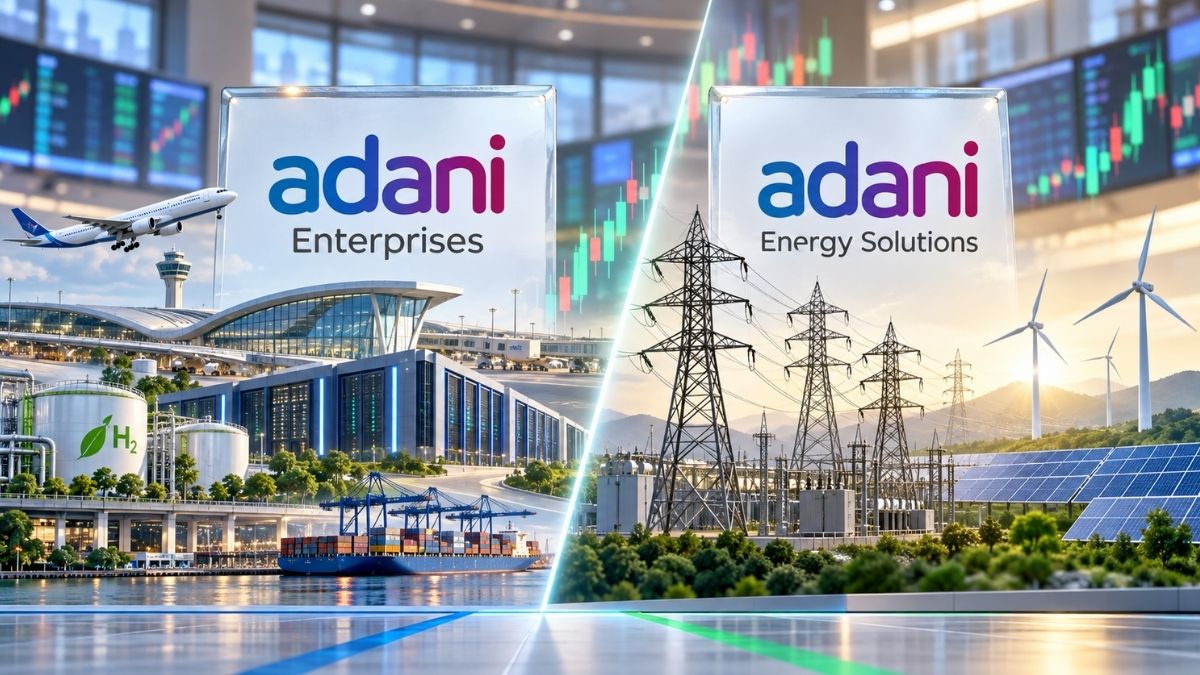
Two Adani Group stocks have found their way onto Jefferies Buy list, but the reasons behind the calls are quite different.
Adani Energy Solutions has a potential upside at 46%, while Adani Enterprises offers around 29% upside based on the brokerage’s target prices.
The common thread is infrastructure. But beyond that, the investment cases split in two directions. One is trying to make its power-trading business more predictable. The other is investing heavily across airports, data centres, defence and energy transition.
Jefferies has retained its ‘Buy’ rating on Adani Energy Solutions with a target price of Rs 2,060, implying around 46% upside from current levels.
A major trigger is the company’s latest power-supply agreement with Maharashtra State Electricity Distribution Company (MSEDCL). Adani Energy Solutions has tied up 2.5 gigawatts (GW) of round-the-clock power supply for 25 years.
The share of tied-up volumes in the trading segment is expected to rise to 57% in FY28, compared with just 20% at the end of the first quarter of FY27.
Power trading can be volatile because merchant prices can move sharply depending on demand and supply. Long-term contracts can provide greater earnings visibility.
Jefferies said, “Increasing tie-ups in the trading segment is in-line with management vision.”
The brokerage also sees some near-term support from higher merchant power prices. Average prices in the second quarter of FY27 so far are estimated at Rs 5.8 per unit, up 48% year-on-year and 14% from the previous quarter.
The brokerage said, “Merchant power prices are up 2.1x YoY in Sept 2026 till date.”
Jefferies currently values the trading business at only 5 times September 2028 estimated enterprise value to EBITDA, against 22 times for the company’s non-trading business.
The brokerage believes the trading business could become less risky and attract a higher valuation multiple.
Jefferies has retained its ‘Buy’ rating and set a target price of Rs 3,830, implying around 29% upside.
The company is developing businesses across airports, data centres, defence, energy transition, logistics and mining. Several of these projects are still in the investment or early-growth phase.
Jefferies described the company as “A unique infrastructure incubator, building & scaling businesses across critical infra, energy transition, logistics, & import substitution.”
According to the brokerage report, the company could invest around Rs 2 lakh crore between FY26 and FY31 across its different business platforms.
Jefferies expects EBITDA to grow at around 23% CAGR between FY26 and FY31. Airports, defence and data centres are expected to be among the key contributors.
The brokerage said, “Current valns capture only part of the story.”
The growth assumptions vary sharply across Adani Enterprises’ businesses.
Jefferies expects the airports business to deliver around 25% EBITDA CAGR. Defence could grow at more than 40%, while data-centre EBITDA could rise by more than 100%, albeit from a relatively small base.
The company’s energy-transition platform and other infrastructure businesses add further optionality.
The two stocks offer two different types of exposure.
For Adani Energy Solutions, the main argument is improving earnings visibility. More long-term power contracts could reduce dependence on unpredictable merchant prices.
For Adani Enterprises, the case is about building multiple large businesses and scaling them over several years.
That also creates different risks. Jefferies has flagged interest-rate pressure and market-share losses as risks for Adani Energy Solutions. For Adani Enterprises, the key concerns include execution delays, cost overruns, slower monetisation, regulation and the possibility of leverage rising during the investment phase.