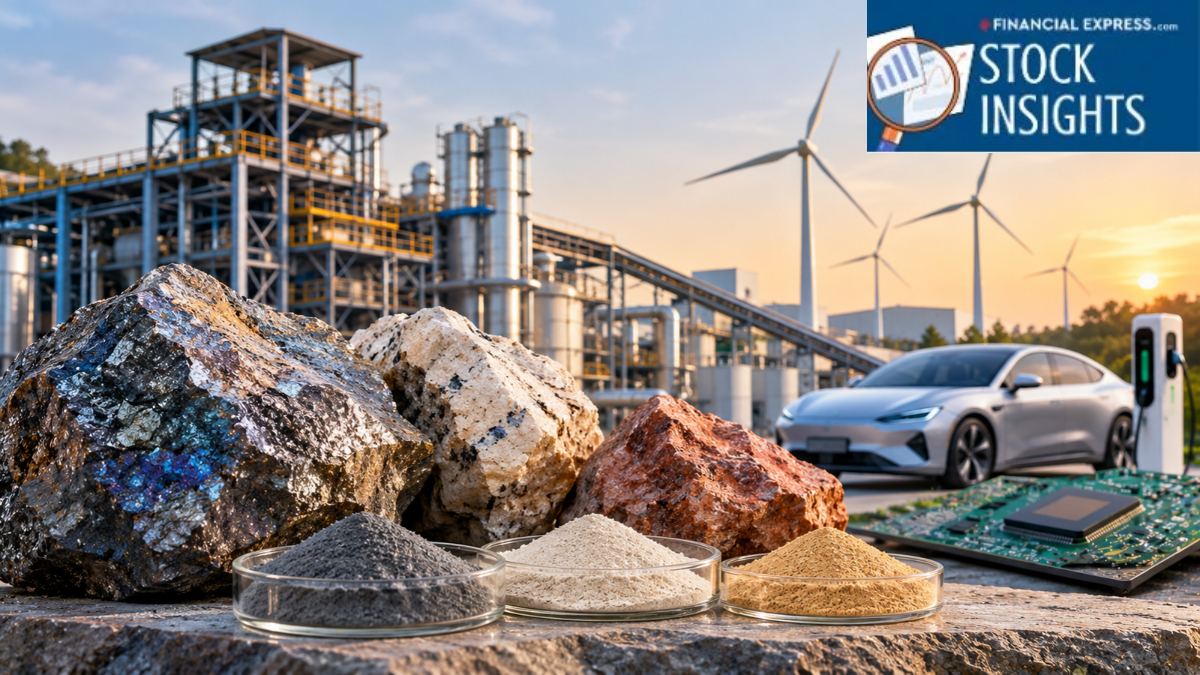
India’s push to reduce dependence on China for rare earth minerals and permanent magnets could create significant opportunities over the coming years.
Government initiatives, including incentives for domestic permanent magnet manufacturing and the development of dedicated rare earth corridors, are expected to encourage exploration, processing, and downstream manufacturing.
Growing demand from electric vehicles, wind energy, electronics, defence, and renewable energy could provide long-term growth opportunities for the sector.
However, building a domestic rare earth supply chain will require substantial capital investment, advanced technology and time.
Investors should watch developments in mining, mineral processing and magnet manufacturing, while remaining cautious about execution delays, commercial production timelines, global price fluctuations, and competition from established international suppliers.
Here are 5 companies venturing into rare earths. Please note, these are diversified companies, and some may currently have no presence in the space.
#1 Gujarat Mineral Development Corporation
First on our list is the stock of Gujarat Mineral Development Corporation.
The company is one of India’s leading state-owned mining enterprises and a Public Sector Undertaking of the Government of Gujarat. The Corporation operates five lignite mines across Kutch, South Gujarat, and the Bhavnagar region, supporting critical energy and industrial requirements.
The company is making significant inroads into rare earth. It has entered into a Memorandum of Understanding (MoU) with NMDC, a Government of India Navratna PSU, to explore opportunities for collaboration in the Rare Earth Elements sector.
The collaboration will focus on assessing the potential development of an integrated rare earth value chain in Gujarat, including exploration, mining, beneficiation, processing, and downstream applications. The engagement will primarily explore opportunities associated with GMDC’s Ambadungar Rare Earth deposit.
Under the MoU, both organisations will work together to evaluate opportunities for technical collaboration, project development and potential business structures.
The partnership is also expected to facilitate knowledge exchange, technical evaluation and coordinated efforts towards advancing rare earth resource development.
This collaboration forms part of GMDC’s broader rare earth development roadmap for the Ambadungar deposit, where the Corporation has been progressively advancing in resource utilisation, indigenous processing capabilities and pilot-stage technology validation initiatives.
Source: Gujarat Mineral Development Corporation, Annual Report FY26
Recognising that long-term competitiveness in rare earths requires an integrated industrial ecosystem, GMDC is pursuing the development of a Rare Earth Processing Hub in Gujarat.
The proposed ecosystem is envisaged to support common processing infrastructure, advanced separation facilities, pilot-scale processing, research and development, analytical laboratories, and downstream industries, creating a platform for domestic value addition and future investments across the rare earth value chain.
The proposed REE Hub: Advanced REE Separation Plant Estate at PCPIR, Bharuch is intended to provide the downstream counterpart to the upstream resource development effort at Ambadungar. While Ambadungar can establish the mineral-resource and concentration base, the proposed Bharuch ecosystem can enable the next stages of the value chain through advanced separation capabilities, supporting infrastructure, technology development, and downstream linkages.
Gujarat Mineral Development Corporation Financial Highlights (FY23-26)
On the financial front, the company reported revenues of Rs 9,030 m in Q2FY27 m vs Rs 5,280 m YoY. Net profits fell to Rs 1,710 m vs Rs 4,660 m YoY.
Next on our list is the stock of Vedanta Ltd.
With operations spanning India, Africa, the Middle East and East Asia, Vedanta is embedded in high-growth geographies. The company has ambitious plans in rare earth elements.
Hindustan Zinc, the company’s subsidiary, recently secured a Letter of Intent for the Gundlupet Rare Earth Element and Yttrium Block in Karnataka, for the company’s critical minerals diversification.
Management says that even though the country imports over 80% of its critical mineral requirements, India’s demand for critical minerals and rare earth elements could grow fourfold to tenfold by 2047.
Addressing this growing dependence, the company says it has placed itself at the forefront of the country’s critical minerals push, becoming the only company to have secured 10 critical mineral blocks across commodities including copper, nickel-chromium-PGE (Platinum Group Elements), tungsten, graphite, vanadium, rare earth elements and potash.
With exploration already underway across five blocks, Vedanta is building domestic access to materials that will become increasingly important for vehicular safety, fuel efficiency, sustainability, and ergonomics.
On the financial front, Vedanta achieved its highest-ever quarterly revenue of Rs 258.12 bn, up 57% YoY and 10% QoQ, taking half-yearly revenue to a record Rs 492.68 bn, up 54% YoY.
The company also delivered its best-ever quarterly EBITDA of Rs 99.38 bn, up 106% YoY and 17% QoQ, taking half-yearly EBITDA to a record Rs 184.07 bn, up 103% YoY.
It also achieved its highest-ever quarterly net profit of Rs 62.02 bn, up 151% YoY and 17% QoQ.
Vedanta’s net debt reduced by Rs 46.24 bn QoQ to Rs 36.75 bn, from Rs 82.99 bn in June 2026, mainly driven by Cash Flow from Operations.
The management says that Vedanta has multiple growth engines across Hindustan Zinc, Zinc International, FACOR, Copper, and Ports and with a rich portfolio of critical mineral blocks, positioning the company to charter the next phase of growth while maintaining financial discipline and creating long-term value.
Vedanta Financial Highlights (FY23-26)
Next on the list is Coal India, the nation’s largest coal producer.
Coal India is steadily expanding beyond its conventional coal-mining operations to build a diversified, technology-driven portfolio spanning energy, minerals, advanced materials and research and development (R&D).
The company’s Business Development portfolio is organised around five mutually reinforcing platforms: coal gasification and coal-to-chemicals; thermal power; renewable energy and storage; critical minerals and advanced materials; and diversified minerals, including iron ore.
The portfolio already includes projects of national scale, including approximately Rs 693.46 bn across four coal-to-chemicals initiatives, a 2×800 MW Chandrapura ultra-supercritical expansion, around 550 MW of commissioned solar capacity, grid-scale Battery Energy Storage System (BESS) initiatives, and opportunities in critical minerals and downstream materials.
In rare earth elements, Coal India’s domestic opportunities include graphite assets in Madhya Pradesh and Chhattisgarh, as well as rare earth element (REE) and rare-metal opportunities in Andhra Pradesh and Maharashtra.
The focus areas include resource definition, geometallurgy, beneficiation, recovery, product specification, waste management and market linkage. These efforts are being supported through collaborations with Indian Rare Earths Limited (IREL), the Non-Ferrous Technology Development Centre (NFTDC), Curtin University, Hindustan Copper and State entities.
Overseas opportunities will be evaluated through stage-gated technical and financial due diligence.
Coal India also aims to establish an integrated graphite value chain covering mining, beneficiation, purification, spheronisation and coating, and the production of anode materials.
In collaboration with NFTDC, a demonstration plant for coated spherical purified graphite (CSPG) with a purity of at least 99.95% has been proposed as a qualification platform. Commercial scale-up will follow consistent product quality, process performance and customer qualification.
Coal India has also incorporated a Singapore-based wholly owned subsidiary, viz. CIL Global Pte. Ltd in August 2026, to explore and develop overseas opportunities in the field of critical minerals asset acquisition, enable an efficient management of overseas investments, and provide structural flexibility for future acquisitions.
Coal India Financial Highlights (FY23-26)
On the financial front, Coal India reported a 21% revenue growth in Q2FY27, while the net profit jumped to Rs 65.47 bn, up 57% YoY.
Moving ahead, in the first half of FY27, the newly constructed Bhojudih Coal Washery at BCCL, with an annual capacity of 2 million tonnes (MTPA), commenced commercial operations. With this addition, BCCL’s total coal washing capacity has increased to 17.35 MTPA, including 1.7 MTPA operated through TSL.
Coal India has commissioned 200 MW of Solar Power Capacity out of the 300 MW Solar Power Project at Khavda, Gujarat, on 08.07.2026.
The company is a Navratna PSU under the Ministry of Coal, primarily engaged in lignite mining and power generation. The company has begun making strides in the rare earth space.
The company is looking to extract Rare Earth Elements from Fly Ash. According to the company’s annual report, NLC India’s work to extract strategically important, rare earth elements from lignite fly ash has progressed from agreement to implementation.
An MoU was signed with BARC, under which BARC is providing technical support for demonstrating the extraction of rare earth elements from fly ash.
Studies have confirmed the presence of appreciable quantities of these elements in the company’s fly ash, and the project is progressing towards pilot scale implementation.
BARC will provide technological and R&D support, including process design, engineering, and operational guidance, while NLC India is responsible for infrastructure creation, plant execution, operation, and maintenance.
The tender for the pilot plant is in progress. As per the management, this positions NLC India to contribute to national self-reliance in critical materials from a byproduct of its own operations.
Moving ahead in other areas, the management has outlined clear strategies to move the company forward. In thermal power, stabilisation of Ghatampur thermal units and improving availability, reliability and efficiency of existing units will remain priorities.
In mining, the management says continuous coal production from Pachwara South OCP, the TalabiraII & III and Kurwa railway sidings, progress on Machhakata (Revised) and New Patrapara South, and securing critical land at Neyveli for mining operations will strengthen fuel security and logistics.
Renewable energy will remain a key growth engine, with focus on the commissioning of 600 MW GUVNL Solar Project, 250 MW/500 MWh BESS in Tamil Nadu, 200 MW Solar Project in Gujarat and 150 MW wind-solar hybrid projects, while pursuing further capacity through competitive bidding.
NLC India will also expand its critical minerals portfolio and pursue green hydrogen, digitalisation, Artificial Intelligence and strategic partnerships.
Under Corporate Plan 2030 and Vision Document 2047, the aspiration is to move towards 20 GW of power generation capacity, beyond 100 MTPA of mining capacity and a significantly larger renewable energy and storage portfolio.
NLC India Financial Highlights (FY23-26)
Midwest has more than four decades of expertise in dimensional natural stone exploration, mining, processing, and global distribution across 17 countries and 5 continents, with key markets in China, Italy, and Thailand.
Midwest is India’s largest producer & exporter of Black Galaxy Granite, a premium granite variety.
It also has India’s largest integrated Quartz Processing Plant, supplying raw materials to solar glass and engineered stone manufacturers in domestic and export markets.
This is another company that has ventured into rare earth elements. The company was selected as a Lead Consortium Partner by The Kerala Minerals and Metals Ltd. (KMML), a Government of Kerala undertaking, for strategic technology development and establishing a pilot plant project focused on rare earth elements.
This milestone reinforces the company’s diversification strategy to establish a meaningful presence in the rare earth ecosystem.
The project involves setting up a pilot project for the processing of monaziterich tailings and residue to produce rare earth mixed compounds, followed by the downstream separation of Rare Earth Elements (REEs).
The company will explore end-to-end execution, including mineral processing to produce high-purity monazite concentrate (≥96%), extraction of rare earth mixed compounds (≥99%), and their separation into individual rare earth elements.
It’s also focused on with technology development, pilot plant design, installation, and optimization, as well as R&D, regulatory compliance, and technical data management.
Source: Investor Presentation, November 2026
Moving ahead, the company is targeting 3-fold profitability growth over the next 3 to 4 years, with revenue growth of nearly 2.5 times. The company is also aiming for a ROCE of 35%, while expected capex is slated to be around Rs 3 bn during the period.
The rare earth sector offers an interesting long-term opportunity as demand for electric vehicles, renewable energy, electronics and defence equipment continues to grow.
India’s efforts to reduce dependence on imported critical minerals could also create opportunities for domestic companies.
However, investors should exercise caution. Many projects are still at the exploration, technology-development or early investment stage, and commercial production may take several years. High capital expenditure, extraction challenges, regulatory hurdles, and volatile global mineral prices could affect profitability.
Therefore, investors should examine project progress, financial strength, and actual revenue contributions rather than investing purely on future expectations.
The website managers, its employee(s), and contributors/writers/authors of articles have or may have an outstanding buy or sell position or holding in the securities, options on securities or other related investments of issuers and/or companies discussed therein. The content of the articles and the interpretation of data are solely the personal views of the contributors/ writers/authors. Investors must make their own investment decisions based on their specific objectives, resources and only after consulting such independent advisors as may be necessary