An IPO is not just a financial event; it is a perception event. The moment a private company decides to go public, it enters an entirely new arena where market sentiment, brand credibility, and investor confidence matter as much as revenue figures or EBITDA margins.
IPO marketing before listing in India has developed into a comprehensive strategic campaign. While companies that view their IPOs solely as financial processes tend to overlook valuation, others that focus on storytelling, brand building, and strategic communication have achieved strong subscription levels and price discovery, as well as stability after listing.
The transformation from being a private entity to telling the public story is very important. When your company remains private, your audience may consist of only a few investors and other stakeholders. Once your DRHP is filed, your audience extends to millions of retail investors, fund managers, analysts, and journalists in one go.
This transforms the IPO branding strategy from a mere marketing exercise into a boardroom decision-making process. Businesses that have established strong governance structures before going public, ensuring financial transparency, proper policies for related-party transactions, and accountability at the board level, will find it much easier to tell an effective marketing story to investors.
In this guide, we cover all aspects of IPO marketing before listing in India, ranging from branding basics to the roadshow, media, investor relations, and even the mistakes to avoid.
IPO marketing is the structured process of building investor awareness, demand, and confidence in a company before its shares are listed on a stock exchange. It involves branding, investor communication, roadshows, public relations, digital presence, and narrative crafting, which coordinate to support successful price discovery and strong subscription.
Think of it this way: your DRHP tells regulators your story in numbers. IPO marketing tells investors your story in meaningful terms.
An effective IPO marketing strategy directly influences three critical outcomes:
Investor demand: How many investors want to subscribe to your offering
Subscription levels: Whether your issue is 2x subscribed or 150x subscribed
Pricing power: Whether you can price at the upper end of your band with confidence
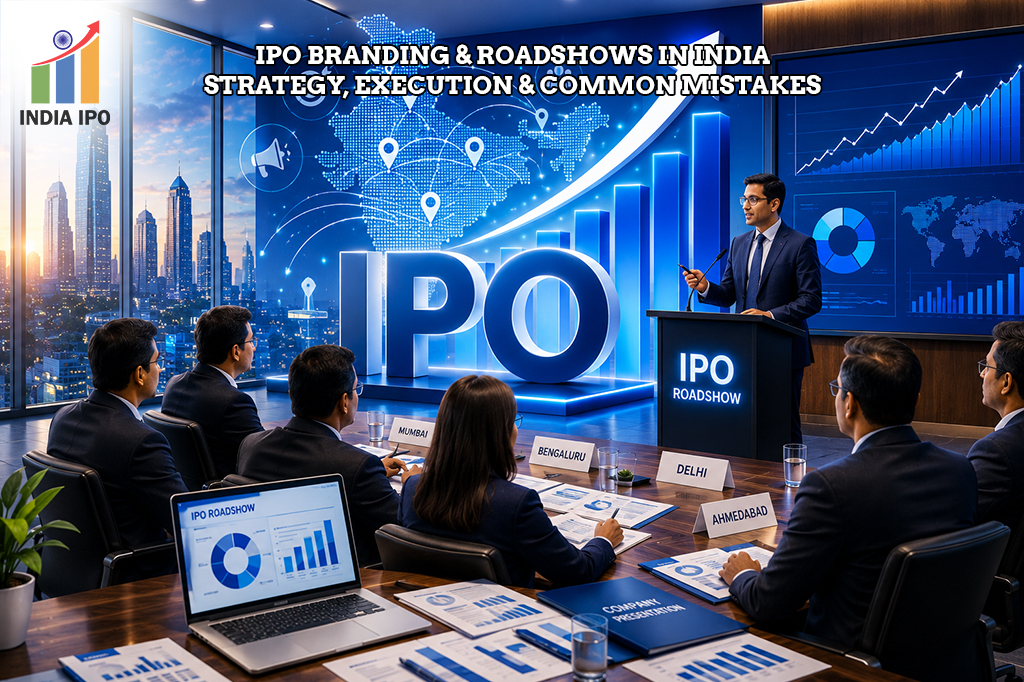
At the centre of any strong IPO marketing strategy sits the IPO roadshow — a structured series of presentations and meetings where company leadership directly engages with institutional investors, fund managers, and analysts before the listing. Roadshows are where the company's story gets stress-tested, where investor objections surface, and where confidence is built in real time.
In India, roadshows have grown significantly in sophistication. Companies like Zomato and Nykaa ran domestic and international roadshows that helped shape institutional anchor investor participation well before their public issues opened.
Investor communication IPO begins not on Day 1 of the public offering, but months before, through every touchpoint from analyst briefings to media interviews to digital content.
A successful IPO marketing strategy needs to be built on the foundation of four pillars. Each of these pillars will complement one another – a good story helps the roadshow, good investor communication enhances the PR effort, and vice versa.
|
Pillar |
Component |
Key Activities |
|
1. Branding & Positioning |
Brand Identity |
Define visual language, logo, colour palette, and tone of voice |
|
Messaging Framework |
Craft a core positioning statement and value proposition |
|
|
Competitive Positioning |
Benchmark against listed peers, highlight differentiators |
|
|
2. Investor Communication |
Messaging Docs |
Standardise narrative across all investor-facing materials |
|
Investor Decks |
Build a pitch deck (30–40 slides) with a growth story |
|
|
FAQs & Q&A |
Prepare responses to the top 20–25 investor questions |
|
|
Leadership Voice |
Train the founders and the CFO for consistent public messaging |
|
|
3. Roadshows & Presentations |
Domestic Tours |
Investor meetings in Mumbai, Delhi, Bengaluru |
|
International Roadshows |
Engage FIIs/FPIs in Singapore, Hong Kong, London, New York |
|
|
Virtual Sessions |
Webinars and video meetings for wider investor reach |
|
|
Anchor Meetings |
Pre-IPO one-on-ones with large institutional investors |
|
|
4. Media & PR Strategy |
Press Releases |
Coordinate IPO announcement and milestone coverage |
|
Analyst Coverage |
Brief financial analysts; support research initiation |
|
|
Digital Content |
LinkedIn, investor relations microsite, YouTube, financial media |
Define your company's unique value in the market. Why should an investor choose your stock over a competitor? What is your growth thesis?
Establish consistent messaging across all materials for investors, including the pitch book, summary of the DRHP, investor FAQs, and investor presentations by leaders.
Ensure a good structure for interactions between your leadership team and investors. Each question-answer session can help you establish investor confidence.
Manage your public image through press conference organisation, working with journalists, analysts, and online content.
IPO branding is the process of creating a company’s image in the minds of potential investors before they look at its balance sheets. Branding starts with building a consistent brand identity, including brand language, communication, and story.
Brand consistency is crucial when you want to take your business public. If there are inconsistencies between what you say in your DRHP, on your website, in your presentations, on social media, in your press releases, and in your leader interviews, your IPO will fail. So, IPO branding is all about communicating the same stories & narrative everywhere because inconsistency creates doubt, and doubt kills subscription momentum.
An effective pre-IPO branding strategy in India involves:
Positioning statement – a crisp statement of what your company does, for whom, and why they’re better than others
Visual identity consistency – ensuring websites, pitches, and marketing materials all look the same
Competitive differentiation – understanding what sets you apart from listed companies
Leadership profiling - Building public credibility for founders and key management through thought leadership and media presence
Nykaa (FSN E-Commerce Ventures), along with being a successful IPO, is one of the best Indian companies when it comes to IPO branding. Even before its November 2021 IPO, Nykaa had created a great brand among consumers. The focus of its IPO branding strategy was much more about its established brand value than about its e-commerce platform. The founding CEO, Falguni Nayar, also earned celebrity status in the media, making investors more confident in their choice. The result: Nykaa was subscribed 82x overall, with the QIB portion subscribed over 91x.
Zomato's 2021 IPO is another landmark case in brand perception IPO strategy. Zomato had already built massive consumer visibility through aggressive digital marketing over the years. Its IPO branding translated this consumer familiarity into investor familiarity - investors to understand the business intuitively. The result: 38x overall subscription, with strong institutional participation.
The lesson is clear: IPO branding is not created at the time of listing. It is built over the years, and deliberately sharpened in the 12–18 months before filing.
The IPO roadshow is arguably the most critical execution element in the entire IPO marketing process. It is where company leadership, typically the CMD/CEO, CFO, and sometimes independent directors, directly presents the company's investment thesis to institutional investors, fund managers, and analysts.
|
Type |
Description |
Best For |
|
Domestic Roadshow |
Meetings with Indian institutional investors, MFs, and HNIs in cities like Mumbai, Delhi, Bengaluru |
Building a domestic institutional book |
|
International Roadshow |
Investor meetings in Singapore, Hong Kong, London, New York |
Attracting FII/FPI participation |
|
Virtual Roadshow |
Video-based investor meetings and webinars |
Wider reach, cost-effective, post-COVID standard |
|
Anchor Investor Meetings |
Pre-IPO one-on-one meetings with large institutional investors |
Securing anchor allocations before the issue opens |
|
Element |
Purpose |
|
Pitch Deck (30–40 slides) |
Communicate the growth story, financials, market opportunity, and management vision |
|
Q&A Session |
Build investor confidence by addressing concerns directly and transparently |
|
Management Presentation |
Demonstrate leadership credibility, operational depth, and strategic clarity |
|
Financial Deep Dive |
Walk investors through unit economics, margin trajectory, and capital allocation plan |
|
Peer Benchmarking |
Position the company relative to listed comparables on key valuation metrics |
How IPO roadshows work in India follows a fairly structured SEBI-guided process. After DRHP filing and SEBI observations, the company enters a pre-IPO marketing period. Book-running lead managers (BRLMs), typically investment banks such as Kotak, Axis Capital, ICICI Securities, or Goldman Sachs, organise roadshow schedules.
The process of IPO roadshow strategy in India takes between 1 and 2 weeks:
Meetings with anchor investors (1–2 days before issue opens)
Road shows with domestic institutions (Mumbai, Delhi, Bangalore)
International road shows (Singapore, Hong Kong, London/New York for larger issues)
Road shows with retail investors and media contacts
Price discovery process and setting the final range
An effective road show ensures competitive rivalry between institutional investors, which drives demand and support pricing at the upper end.
When it comes to IPO, numbers tell investors what you've achieved, but storytelling tells them why they should believe in what comes next. This is the essence of IPO communication strategy.
Building an effective IPO story involves transforming the financial figures into a relatable narrative that includes stories about the problem you solve, the size of the market opportunity, the strength of the business model, and the integrity of the team driving it forward.
A company that offers only a 45% CAGR in revenue over five years provides information. But one company that provides details on how this growth was achieved – through product differentials, customer acquisition strategies, and pricing power – gives them conviction. IPO narrative creation is what bridges the gap between these two
The process of building a strong level of trust with investors through IPO communication involves:
Messaging consistency - The same core narrative across DRHP, pitch decks, media interviews, and investor FAQs
Leadership credibility - Founders and CFOs able to speak openly about risks and challenges, not just opportunities
Accessible language - Using simple financial language when addressing investors
Proactive risk disclosure - Identifying industry risks and competitive challenges before investors bring them up
Design a three-layer messaging structure:
Core message - A single sentence summarising your investment story
Supporting pillars - Three to five supporting facts (market opportunity, competitive advantages, financial results, growth drivers)
Validation layer - Evidence such as data, examples, validation from others, and credentials to substantiate your claims
The structure allows you to consistently communicate the same message to investors, whether it’s in press releases, leadership interviews, or face-to-face conversations at roadshows.
An exhaustive IPO marketing checklist helps ensure that nothing gets overlooked. This is your pre-IPO marketing readiness checklist 3–6 months ahead of your expected listing date.
Core positioning statement finalised
Brand messaging framework finalised
Branding consistency across all media ensured
Website upgraded with investor-friendly information
Differentiation from competition identified
Leadership bios and profiles released
Investor pitch deck (30-40 pages) prepared and reviewed by BRLMs
DRHP summary document created for retail investors
Investor FAQ document covering the top 20–25 anticipated questions
Narrative of the financial model developed
Communication of risk factors mapped out
Domestic roadshow schedule finalised with BRLMs
International roadshow cities and dates confirmed
Virtual roadshow platform and format decided
Target investor list segmented (domestic MFs, FIIs, HNIs, family offices)
Management spokespersons trained for Q&A sessions
Anchor investor meetings scheduled
Relationships built with tier-1 financial media
Press release calendar for IPO period drafted
Analyst briefing plan ready
Plan for analyst briefings prepared
Digital content strategy activated (LinkedIn, blog on website, YouTube)
Crisis communications plan finalised
SEBI norms for communications followed
This pre-IPO marketing checklist for India should be reviewed monthly from 6 months out and weekly in the final 4–6 weeks before listing.
A well-executed IPO marketing timeline is not built in weeks; it is built in months. Here is a phase-by-phase breakdown of an ideal IPO launch strategy.
This is the foundation-building phase. Most companies underinvest here, and it shows in weaker-than-expected listing performance.
Identify the essence of the brand story and investment thesis
Launch thought-leadership content – opinion pieces, market reports, executive interviews
Develop contacts with financial journalists and analysts
Conduct an audit of the website and make improvements to investor-grade
Work with a PR firm that understands capital markets
Harmonise messaging between all leaders
Initiate governance housekeeping – director structure, related party transactions, and audit committee improvements
This is the preparation phase. DRHP filing often happens in this window.
Prepare a full investor pitch deck and DRHP summary
Engage Book Running Lead Managers (BRLMs)
Plan domestic and international roadshow schedules
Start selective analyst briefings (confidential before DRHP filing if possible)
Kick off the digital footprint creation process - company LinkedIn page, IR microsite
Create FAQs and risk communication materials
Soft-launch thought leadership in industry media
This is the execution phase. SEBI observations received; pre-marketing begins.
Execute anchor investor roadshows
Begin domestic and international roadshow circuit
Generate media buzz - IPO stories, founder profiles, industry analysis
Gain retail investor interest via digital outreach
Set the price range based on bookbuilding results
Initiate analyst research (if required)
This is the build-and-close phase.
Heavy investor follow-up on subscription interest
Coverage in the media on subscription numbers and momentum
Interviews by the management team on CNBC TV18, ET Now, Business Standard
Retail investor engagement through digital channels
Post-close: listing day communication strategy
Day-1 listing narrative management
Despite being well-funded, companies still commit avoidable mistakes in their IPO marketing execution. Knowing the pitfalls that may arise during the IPO promotional phase is crucial for entrepreneurs and IR professionals.
Counting solely on the financial figures without building a convincing story around the company’s growth potential. While investors can always do the math, what they need you to do is to help them see beyond the figures.
Using different languages in the DRHP, pitch deck, press releases, and management interviews. This creates confusion and signals poor internal alignment - a red flag for institutional investors.
Broadcasting the same message to all investor segments without considering the differences between them. While retail investors require simple stories, institutional investors demand rigorous financial analysis, while HNIs need both. This is a common mistake.
Exaggeration without substantiating facts - "largest in India," "fastest growth," "innovative company" - without any supporting data. Intelligent investors will ask questions about every statement during the Q&A process. Exaggeration ruins reputation faster than poor financials.
Risk disclosure is mandatory under SEBI's DRHP, but risk communication does not receive sufficient priority for most companies. Risks can be managed and communicated effectively to earn investors' trust.
Treating IPO marketing as something that begins after the DRHP filing. By then, brand perception is already formed. The best IPO marketing starts 12–18 months before listing.
In India, retail investor participation is a significant driver of subscription momentum and listing-day demand. Companies that build no retail-facing communication strategy leave substantial subscription potential untapped.
If you are a founder preparing for your company's IPO, here is the mindset shift that matters most: you are no longer selling a product or a service; you are selling a future.
What are investors thinking? “Does my money grow here?” Answering this question should be the main focus of your marketing. How big is your total addressable market? What is your competitive advantage? Is your management team the right one to implement your vision? What are the risks, and how do you mitigate them?
It’s natural to want to put only the good news in your IPO story. But don’t give in to the temptation to paint everything as sunshine and roses. The most convincing IPO stories recognise the headwinds upfront. Every business faces challenges, but founders who try to convince investors otherwise are not credible. We need to discuss the headwinds and your strategy to mitigate them.
This is the lesson that distinguishes success from failure in IPO marketing. How founders prepare for IPO marketing starts with their company’s governance framework. Good board composition, sound related-party transactions, transparent auditing, and succession planning all play an essential role. These are not just requirements set by SEBI. They are your marketing strengths. Institutional investors perform their governance due diligence before financial due diligence.
In the IPO process in India, investing occurs in both the company and its founder/leadership team. Visibility through media interviews and industry conferences plays a key role in creating an investor-friendly image. For example, Zomato's co-founder and CEO, Deepinder Goyal, and Nykaa's founder and CEO, Falguni Nayar, were both known as very credible people in the public domain before the listing of their respective companies. That visibility translated directly into investor confidence.
IPO marketing in India operates under a completely different set of circumstances compared to other markets around the world, such as the United States, the UK, and even neighbouring Hong Kong. Understanding these unique dynamics is essential for any effective IPO promotion strategy in India.
India has one of the world's highest rates of retail investor participation in IPOs. SEBI mandates a minimum 35% reservation for retail individual investors (RIIs) in the public offer. Retail subscription levels are closely watched - an issue that sees strong retail demand signals broad-based confidence and often drives institutional FOMO. This makes retail-facing communication - accessible language, vernacular media, social media, and financial influencers a critical component of any IPO marketing strategy in India.
SEBI's regulatory framework governs what companies can and cannot say during the pre-IPO marketing period. Companies must be careful about making projections or forward-looking statements outside the DRHP framework. All material communications must be consistent with the disclosures in the DRHP. Any selective disclosure of price-sensitive information is prohibited. Building an IPO communication strategy that is both compelling and SEBI-compliant requires careful coordination between the marketing team, legal counsel, and BRLMs.
The Indian financial media environment is extensive and highly significant. Media outlets like The Economic Times, Business Standard, Mint, Moneycontrol, CNBC TV18, and ET Now enjoy high coverage among retail and HNI investors. An effective media campaign will incorporate:
Proactive press briefings with financial journalists
Exclusive interviews with Tier-1 publications for founders
Analyst coverage launch & research
Digital content creation for LinkedIn and financial YouTubers
Engagement with SEBI-registered investment advisors & media personalities
Indian companies face a unique situation in the form of the Grey Market, which trades in IPO stocks before listing. Though a company can't control or influence Grey Market activity, GMP is widely regarded as a leading indicator of IPO success. A strong IPO campaign that drives authentic subscription demand yields a favourable GMP position.
Before your company enters the public domain, run through this consolidated readiness assessment:
|
Domain |
Key Actions |
Status |
|
Branding ✔ |
Positioning finalised, visual identity consistent, leadership profiles published |
Ready |
|
Roadshows ✔ |
Domestic + international schedule confirmed, anchor meetings planned, management trained |
Ready |
|
Communication ✔ |
Pitch deck ready, FAQs prepared, messaging consistent across all channels |
Ready |
|
PR ✔ |
Media relationships active, press calendar drafted, analyst engagement initiated |
Ready |
|
Digital ✔ |
Investor relations website live, LinkedIn activated, content calendar running |
Ready |
|
Compliance ✔ |
SEBI communication norms reviewed, legal counsel sign-off on all materials |
Ready |
A successful IPO in India results from three factors: perceptions, credibility, and execution. Even with a strong financial story, poor, inconsistent, or untimely communication leads to an overall sub-optimal outcome. Equally, no matter how advanced your marketing machine is, it will not help you if your company has weak fundamentals or governance gaps.
IPO marketing is not an option - it is as important as your pricing strategy, disclosure in DRHP, or allocation to anchor investors. Your IPO marketing efforts influence your company's valuation on Day One and, even more importantly, how it continues to value your business for weeks, months, and years to come.
Start building the story at least 12 months before the intended listing day in India. Get ready to present your company and its prospects before publishing your DRHP. Please prepare your management team before the roadshows. Reach out to potential investors before subscribing to the issue.
The companies that treat IPO marketing in India as a long-term strategic process, rather than a last-minute marketing campaign, are the ones that list with confidence and keep creating value well beyond the first trading day.
The INDIA IPO Publication is managed by an editorial team that includes highly experienced finance journalists, market researchers and professionals from the capital markets industry who strive to create high-quality content based on credible sources. Our editors write about IPOs, capital markets, corporate news, capital-raising strategies, regulations and other business matters to ensure our audience stays updated with the latest information. We conduct detailed research and fact-check all information before publishing any content to ensure credibility.
Next Reading
Strategic IPO Planning
Join hundreds of founders who scaled their vision with India's most trusted public listing advisory network.
Verify EligibilityQuick IPO Resources
Trending News