
India is currently witnessing an unusual entrepreneurial surge, with the startup ecosystem and SME sectors evolving into the primary engines of national economic growth. India now has over 2.23 lakh (223,000+) DPIIT-recognized startups as of March 2026, making it one of the largest startup ecosystems globally.
The growing complexity of the market launch has made structured financial planning a must-have necessity for sustainable scaling. In today’s data-driven economy, stakeholders and investors want dynamic, stress-tested insights that can withstand market volatility, not just static projections.
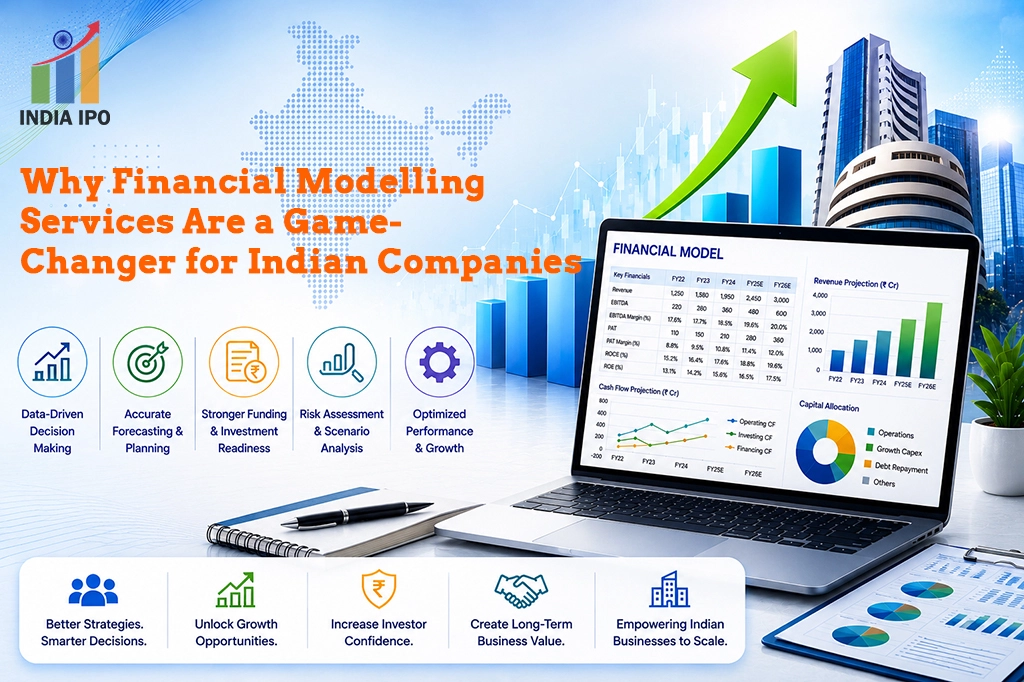
This is where professional financial modelling services emerge as a strategic necessity, not merely as spreadsheet support, but as outsourced financial architecture that transforms raw operations into auditable, capital-ready intelligence. To know that the firm aligns with modern corporate standards, the focus must transition from basic spreadsheets to strategic foresight by adapting financial modelling, where high-quality and effective financial modelling acts as a critical roadmap, transforming raw data into a compelling narrative of growth and stability.
By implementing these professional frameworks, a company can move beyond reactive management to make proactive, informed decisions that secure long-term viability. In this high-stakes environment, professional clarity serves as the ultimate competitive advantage.
Financial modelling is the process of creating a comprehensive summary of a company’s expenses and income in the form of a spreadsheet. This numerical representation is designed to reflect a smooth transition between the past, present and most importantly, the future performance of a firm. It serves as a digital twin of a business, enabling leadership to test how specific variables or market shifts might affect the bottom line without risking actual capital.
A professional model is far more than a list of numbers; it is an interconnected ecosystem of data. The primary building blocks include:
Revenue Projections: Carefully analyzed predictions on future revenues from market analysis, previous data and growth approaches.
Expense Forecasting: An intense examination of both fixed and variable expenses, enabling a company to determine its burn rate.
Cash Flow Statements: The lifeblood of every organization, monitoring liquidity inflows and outflows for the firm’s survival.
Scenario Analysis: The "What If?" tool of finance. It lets a company plan for its best-case, worst-case and most likely scenarios.
However, not every financial model serves the same purpose. The structure of the spreadsheet must align with the specific goals of the organisation; there are different kinds of financial models:
Startup Financial Modelling: It focuses heavily on "burn rate" and "runway." Since startups often lack historical data, these models rely on assumptions about customer acquisition costs and scalability to prove the concept to early-stage investors.
SME Financial Planning Models: For an SME, such types of financial planning models would enable a company to make use of its working capital efficiently while making capital investments.
Valuation Models: Using techniques like discounted cash flow (DCF), the valuation of a company is undertaken through these financial models, which become very important when mergers, acquisitions, or equity raises occur.
In today's volatile economic climate, having a precise, dynamic model is the difference between a company that merely reacts to the market and one that masters it.
The economic landscape in India is currently defined by a unique paradox: while the nation boasts one of the fastest-growing startup ecosystems globally, many businesses still struggle with capital efficiency.
Despite all the progress achieved thus far, India’s MSME sector faces an estimated addressable credit gap of around ₹30 lakh crore, roughly 24% of total debt demand, according to SIDBI and CRISIL. For any business functioning in a high-octane environment, the change from fast-paced growth to sustainability is purely dependent upon data-driven discipline.
The Indian market is characterised by intense competition and a diverse funding ecosystem, as by early 2026, startups had already raised $2.57 billion (Jan–Feb period), signalling steady momentum. While venture capital is increasingly available, it is also becoming more selective. Startups are no longer judged solely on user acquisition; they are reviewed on unit economics and paths to profitability.
Moreover, the SME sector, the backbone of the Indian economy, frequently faces severe capital constraints. MSMEs contribute around 45–48% of India’s exports, making them critical to foreign exchange earnings and global competitiveness.
For SMEs, financial planning is not just an administrative task but a survival mechanism. Without having a perspective on cash cycle flows and credit needs, even though products or services match consumer needs, the company may find itself overstretched.
Therefore, it is clear that there is a significant difference between the entrepreneurial idea and the financial implications for many businesses operating in India, such as traditional accounting methods may fail to give future projections that could help navigate through volatile markets or regulatory changes, but incorporating financial modelling in India would enable any business entity to make sense of its raw operational figures.
Professional financial modelling will assist in structuring a financial plan, thus creating trust among stakeholders, which may be private equity or local banking institutions. After testing different assumptions based on local market dynamics, including inflation rates and supply chain disruptions, a business's growth will be ensured.
For companies eyeing public markets, financial modelling becomes critical because SEBI-led disclosure requirements demand consistency across issue objects, capital deployment plans, risk factors and financial disclosures in offer documents. Professional financial modelling services help build auditable assumption sheets, scenario-linked projections and investor-ready outputs that can withstand merchant banker and auditor scrutiny.
For a business, financial modelling services help in various ways, especially by assisting with the transition from manual-based management to data-driven leadership. While a spreadsheet might seem like a basic administrative tool, the benefits of professional financial modelling services extend far deeper, providing a strict framework for assessing the viability of every business move.
By translating complex operational variables into clear financial outcomes, a professional model empowers a company to move forward with data-backed confidence rather than uncertainty.
Better Strategic Decision-Making: A robust model is a sandbox for testing your corporate strategy through "what-if" analyses, where the corporation is able to assess the implications of expanding into an untouched market, launching products, or changing pricing strategies without spending money.
Fundraising and Investor Relations: When seeking external capital, clarity is currency. Professional models demonstrate a clear path to profitability and ROI, proving to investors that the business understands its drivers and has a disciplined capital-deployment plan.
Cash Flow & Working Capital Management: An effective financial modelling allows predicting future cash flow shortages, which provides the opportunity to optimise the inventory and accounts receivable to avoid liquidity problems when dealing with seasonal variations.
Risk Identification & Scenario Planning: Sensitivity analysis in finance allows for identifying all risk sources and their effects. Thus, knowing which factors affect the project, you are protected from downside risk and ready for anything in the market.
Data-Backed Valuation: Whether for internal benchmarks or potential M&A activity, accurate valuation is essential. Utilising DCF and future-based projections ensures that the firm is valued based on its true earning potential and future cash flows, rather than just historical book value.
Integrating these services ensures that every department within the company aligns with the company's overarching financial goals, creating a culture of accountability and precision. In FY 2025–26 alone, 55,200+ startups were recognised, the highest ever annual addition since the Startup India initiative began.
Financial modelling serves as the strategic blueprint for startups in India, navigating a complex and high-growth economy. It transforms a foggy business vision into quantifiable projections, allowing a firm to evaluate unit economics, burn rates and scalability within the local regulatory framework.
But there are different types of financial models used for different purposes. For example, when one combines the historical information with the assumptions of the market, they can use that model to communicate to the investor what the company is all about as well as ensure that its cash flow is managed in times of volatility.
Developing a robust financial modeling foundation for a startup right from the start is critical for navigating the challenges that arise due to the Indian market environment. With the absence of any track record of performance for early-stage companies, there is a need for a detailed projection to prove their business model. Financial modeling turns assumptions into an actionable plan, enabling businesses to understand their future needs and avoid any issues that may come up along the way. For startups, financial modeling turns assumptions into an operating roadmap. It enables founders to estimate runway, capital requirements and milestone-linked spending before liquidity pressure becomes a growth risk.
Moreover, the financial model acts as the main tool of communication and assessment in investment negotiations. The clear connection between milestones and funding needs will allow the company to establish its worth and prove its fiscal responsibility. Early-stage funding in India remained resilient, with early-stage deals aggregating close to $4.8 billion in FY26 despite the general slowdown in investments. This evidence-based approach gives credibility to venture capitalists and allows the company to attract their investment.
The partnership between pitch decks and startup financial modelling is a cornerstone of any successful investment round. While the deck tells a compelling story, the model provides the mathematical proof to back it up. When these two elements are perfectly aligned, a company can demonstrate a deep understanding of its market trajectory, building the necessary trust with potential backers.
Moreover, in fundraising, financial modelling services are a survival mechanism to manage 18–24 months of runway, ensuring informed decision-making and long-term sustainability in a hyper-competitive, price-sensitive landscape. Instead of seeking a fuzzy sum, a firm can pinpoint exactly how much funding is needed to reach the next milestone.
Industry datasets consistently show that startup failure rates remain high in the first 5 years, where the most common reason for the failure is cash exhaustion, which is why financial modelling matters. It helps founders anticipate funding gaps, link capital to milestones and avoid raising too little or too late. The point is not that modelling alone prevents failure but that it is the primary tool for anticipating liquidity cliffs before they become fatal.
By mapping out resource allocation from talent acquisition to marketing spend, a business can justify its "ask," ensuring it raises enough capital to maintain momentum without unnecessary equity dilution.
While reviewing a company's financials, investors assess a startup's financial modelling (primarily burn rate, runway and unit economics) to evaluate a firm’s operational efficiency and survival prospects. The key to this analysis for any investor is the burn rate, which measures the monthly net negative cash flow. A high burn rate can be accepted if it clearly correlates with fast growth and high-impact milestones.
While runway calculates how many months a company can operate before it needs additional capital, making it one of the most closely watched investor metrics. The exact financial model for raising funds needs to show that these numbers are being used in a smart way to reach important goals.
Also, unit economics, especially the ratio of customer acquisition cost to lifetime value, will provide insight into the profitability of the company. Knowing how to use these metrics shows the company’s scalability and sustainability.
Financial modelling acts as the primary navigational tool for SMEs and growing businesses transitioning from survival to strategic expansion. In India, there are 7.4–7.5 crore MSMEs, which makes us one of the largest SME bases globally. Because of this, government-backed funds like the Self-Reliant India (SRI) Fund or the MUDRA kind of scheme help SMEs in raising funds.
The effective financial model allows the company to run different (market development) scenarios while maintaining sustainable growth (i. e., avoiding cash strain). By formalising a financial goal, a business enhances its credit standing for debt financing and offers clear visibility to investors on how the company will reach profitability over time.
An effective SME financial plan is critical for addressing the systemic hurdles that often prevent growth, specifically limited capital access. Many smaller firms struggle to secure funding because their financial health is not clearly articulated to external stakeholders. According to SIDBI's 2025 sector report, Indian MSMEs face an addressable credit gap of approximately ₹30 lakh crore, representing roughly 24% of total financing demand. The gap widens to 27% for services MSMEs and 35% for women-owned enterprises.
India’s SME sector is a high-employment, export-driven backbone of the economy, contributing nearly one-third of GDP while undergoing rapid formalisation and financial integration.
Without advanced forecasting tools, a company may find itself reacting to market shifts rather than anticipating them. The shift towards a data-driven approach ensures that SMEs can predict cash flow problems ahead of time, guaranteeing continuity during periods of decline. In FY26, industrial credit grew by around 15%, while MSME credit grew even faster (over 23%), which means having a strong financial model will serve as the link between the two, changing a "fragile" SME to "default alive."
To maintain a trajectory of sustainable growth, a company must move beyond basic bookkeeping toward integrated SME financial planning. In 2026, MSMEs (SMEs) account for approximately 31.1% of India’s GDP and nearly 48.6% of exports. This highlights that financial planning isn't just about survival; it’s about participating in a sector driving nearly half of the nation's foreign trade.
This process begins with strict budgeting, allowing a firm to allocate resources to high-impact departments, where industrial credit grew by 15% in FY26, while trimming operational waste.
Moreover, by allocating resources to high-impact segments and utilising platforms like TReDS to unlock working capital, firms can significantly trim operational waste. Furthermore, strict profitability tracking is required to maintain the 15–18% gross margin benchmark currently demanded by institutional lenders.
By monitoring KPIs such as the CAC Payback Period and Interest Coverage Ratio in real-time, a business remains agile. This oversight ensures that even when global commodity prices shift, the enterprise remains "default alive," adjusting tactics immediately to stay aligned with its financial roadmap.
Securing external financing is often the biggest hurdle for an expanding firm, making SME financial planning an important asset for creditworthiness. Lenders and financial institutions require structured financial data to assess risk and determine repayment capacity. A firm that presents comprehensive balance sheets, cash flow statements and debt-service coverage ratios stands a much higher chance of approval.
By providing a clear view of the company’s financial health, business financial models reduce the perceived risk for lenders. This transparency is critical in 2026, as banks strictly enforce a DSCR threshold of 1.25 for term loans, but it also empowers businesses to negotiate rates closer to the 9%–12% prime lending band, effectively saving the firm ₹2 lakh to ₹3 lakh in annual interest for every crore borrowed compared to high-risk unsecured rates.
As a business grows, managing financial strategy through informal spreadsheets becomes highly risky. Professional financial modelling services bring structure, technical discipline and decision-grade visibility to a company’s numbers. Data shows over 11,000 startup shutdowns in 2025, a 30% increase from 2024, with early-stage cash exhaustion remaining the dominant trigger.
Engaging with experts is like a guarantee that the firm’s strategic decisions are rooted in technical precision rather than guesswork. Professional services provide a level of complexity that goes beyond simple spreadsheets, offering dynamic, error-free frameworks tailored to specific industry nuances.
By collaborating with specialised expertise, like India IPO Services, a company can transform raw data into a powerful narrative, enhancing its credibility with stakeholders and ensuring that its long-term financial strategy is both resilient and scalable.
Let’s understand the benefits of an expert with some key points:
Expertise vs. In-House Models
Professional financial modelling services offer superior accuracy by utilising validated industry benchmarks. While in-house efforts often suffer from optimistic bias, experts apply realistic assumptions and stress-testing, ensuring a firm’s projections are grounded in market reality and technical precision. In 2026, models that withstand a 15% inflationary stress test are significantly more likely to secure favourable debt terms.
Business Model Customisation
Each business needs an individual approach, from a SaaS subscription-based model to manufacturing processes with supply chain management. The financial modelling service will create a model that accounts for the specific drivers of your industry.
Time Efficiency & Strategic Focus
Any business can save time and improve its productivity just by outsourcing technical tasks, which also allows it to prioritise growth and operations over manual data entry. By leveraging financial modelling services, a firm saves hundreds of hours, shifting the management’s energy from building spreadsheets to executing high-level strategy.
Investor-Ready Output
Expert services deliver clean, auditable and presentation-ready models that withstand strict and complex due diligence. These high-quality outputs provide the professional look and logical flow necessary to instil confidence in investors, streamlining the capital-raising process for the company.
|
Factor |
Value of Professional Modelling |
|
Due Diligence Readiness |
Improves documentation quality and speeds up investor review. |
|
Reporting Reliability |
Reduces spreadsheet errors through structured assumptions and linked statements. |
|
Investor Confidence |
Presents cleaner, auditable numbers during fundraising and IPO preparation. |
|
Audit Preparedness |
Makes financial logic easier to review, test and validate. |
A business should build financial discipline from day one, but the need for professional financial modelling services becomes sharper as the company scales, raises capital, enters new markets or restructures operations. A financial model does far more than summarise statements; it supports planning, capital allocation, scenario testing and lender or investor communication.
A firm should opt for these services when the complexity of its goals exceeds the capacity of standard spreadsheets, ensuring that every major decision from capital allocation to market entry is supported by strict, data-driven simulations that minimise risk and maximise stakeholder confidence. There are some key points explaining when a good time is for a company to go for financial modelling services:
Before Fundraising & Investor Pitching
Professional financial modelling services are necessary before fundraising. It is evident from research that professional modelling with sensitivity analysis and scenario stress testing can lower "Time to Close" by an average of 20 days. This offers proof of valuation and demonstrates to the investors that the firm has a proper understanding of how to achieve profitability.
During Rapid Expansion and Scaling
While scaling up, there would be high volatility in the financials of the firm. Proper financial modelling would help the firm manage the pressure that would be faced because of liquidity management when scaling through hiring more employees and having higher operational costs.
Market Entry & Scenario Analysis
Entering into untouched territory introduces various challenges such as exchange-rate volatility, local tax structures and region-specific operating costs. Specialised services use scenario analysis to evaluate feasibility, ensuring that capital is allocated only to markets with a statistically verified ROI, thereby protecting the firm’s core margins.
Strategic Financial Restructuring
During a turnaround, a firm must simulate repayment schedules to negotiate with creditors, especially as compulsory liquidations rose by 21% last year. Specialised financial modelling services enable a firm to simulate repayment schedules and identify inefficiencies, providing the clarity necessary to negotiate with creditors and maintain long-term solvency.
Launching New Product Lines
Before developing a new product line, a business needs to perform financial modelling to understand the economic life cycle and per-unit cost of the product. Professional services will assist a business in calculating the breakeven point and assessing the effect on the company’s existing product lines.
|
Milestone |
Key Data Driver |
Outcome of Expert Service |
|
Fundraising |
35% longer DD timelines |
Shorter closure cycles and higher valuation. |
|
Expansion |
15% rise in labour/construction costs |
Liquidity protection through forecasting. |
|
Restructuring |
20.02% average creditor recovery |
Avoidance of liquidation via IBC compliance. |
|
Market Entry |
₹30 lakh crore MSME credit gap |
Bankable projections for formal capital access. |
Making mistakes in financials without a structured approach to business financial modelling is akin to navigating a complex landscape without a map. In the dynamic economic environment of financial modelling in India, many firms rely on intuition rather than data, leading to avoidable strategic blunders.
Operating without a structured financial model in a volatile cost environment is like navigating without a map.
Understanding these common pitfalls is the first step toward implementing fine fiscal discipline through expert financial modelling services.
Over-Optimistic Projections
The first error in startup financial modelling is the "hockey stick" growth curve based on unfounded or unrealistic assumptions. Without a defined and relatable model, a company may overestimate market capture and revenue speed, which can significantly increase the risk of misallocation, liquidity stress and failed execution.
Ignoring Cash Flow Dynamics
A business can be profitable on paper while being functionally insolvent. In 2026, 47% of Indian startup failures were attributed to poor Cash Conversion Cycle (CCC) management. Professional financial modelling services help a company track the cash conversion cycle, ensuring that a firm maintains enough liquidity to meet its immediate obligations even during seasonal dips.
Lack of Scenario Planning
Economic conditions are rarely static. A major mistake is assuming a "best-case" path and failing to prepare for market volatility. A strong business financial modelling includes stress-testing for "worst-case" scenarios, such as rising raw material costs or sudden regulatory changes, allowing the firm to build necessary contingency buffers.
Poor Investor Communication
Lack of Clarity in financial data is a major red flag during fundraising. In the current market, investors apply a 20-25% valuation discount to firms that cannot provide a transparent, auditable narrative regarding their burn rate and capital requirements. High-quality startup financial modelling ensures that a business presents a transparent, auditable narrative that builds trust with venture capitalists and lenders, significantly improving the chances of securing a favourable valuation.
|
Common Mistake |
Metric to Track in 2026 |
Professional Benchmark |
|
Over-Optimism |
Burn Multiple |
Should be under 1.5x for Series A readiness. |
|
Ignoring Cash Flow |
Quick Ratio |
Maintain at 1.2: 1 to ensure immediate liquidity. |
|
Lack of Scenarios |
EBITDA Margin Sensitivity |
Model for a +/- 10% shift in operating costs. |
|
Poor Communication |
Runway Transparency |
Present a minimum 18-month clear runway. |
Choosing the right financial modelling provider is based on the fact that financial modelling in India requires a balance between technical expertise and local market intelligence, as investor due diligence has expanded by 35% in 2026. A company must look beyond simple spreadsheet mechanics to find a provider that acts as a strategic advisor.
The global financial modelling services market is projected to reach $2.67 billion in 2026, growing at a CAGR of 13.1%. In India, this growth is driven by a ₹1,000+ Cr weekly funding run-rate (May 2026) and a massive shift toward data-driven decision-making over intuition.
In this diversified Indian business ecosystem, from growing tech hubs to traditional manufacturing sectors, the right partner is the one who understands the specific regulatory, tax and competitive landscape of the region. Here are some key points that show what a company should look for before choosing a professional financial services provider:
Relevant Industry Experience
In-depth expertise in the concerned sector is an essential attribute for any service provider. The specialised knowledge helps in ensuring that the model reflects the appropriate business dynamics. The service provider familiar with the industry will also be aware of margins and growth benchmarks.
Proven Track Record
The most reliable indicator of quality is a clear and positive track record of successful outcomes, particularly in startup financial modelling for fundraising or SME strategic advisory. A company should seek service providers who have navigated thousands of SME IPO surges of Q1, providing an assurance of translating complex financials into "investor-ready" outputs.
Model Flexibility and Scalability
A business model loses its significance immediately when a business shifts gears. The best service providers create adaptable and scalable models that enable a firm to change variables as well as increase scalability as a business expands.
Transparency in Assumptions
The integrity of a financial model depends entirely on the logic behind its inputs. A reputable provider maintains total transparency, clearly documenting every assumption made regarding growth rates, churn and costs. This clarity is essential during investor due diligence, as it allows a company to explain and defend every figure with absolute confidence.
|
Criteria |
Why it Matters in 2026 |
Professional Benchmark |
|
Regulatory Knowledge |
New SEBI/RBI 2026 mandates for SME IPOs. |
Must include EBITDA >₹1 Cr modelling capability. |
|
Scenario Depth |
High input cost volatility (15%+). |
Must offer Worst-Case & Best-Case stress tests. |
|
Speed to Market |
VC due diligence is getting slower. |
Proven ability to reduce Time-to-Close by 20 days. |
|
Strategic Insight |
Move from "Default Dead" to "Default Alive". |
Models focused on Net Burn vs. Gross Burn ratios. |
The landscape of financial modelling in India is undergoing a transformative shift toward predictive, real-time strategic intelligence. As the Indian tech sector targets $280 billion in revenue for 2026, the integration of AI is no longer a luxury but a mechanical necessity.
Modern financial services are moving away from manual entry. Initiatives like the IndiaAI Mission are expected to expand access to data and AI tools, which can eventually support more advanced, real-time financial modelling for companies of all sizes, reducing errors and enhancing the reliability of complex corporate frameworks.
The future of financial modelling in India lies in automation, real-time dashboards and faster scenario analysis. As companies increasingly rely on integrated finance tools, models are evolving from static spreadsheets into live decision-support systems that improve speed, reduce manual error and strengthen forecasting
Ultimately, these services provide the "market currency" and strategic foresight needed to dominate both local and global markets in a data-first economy.
In the modern economic landscape, financial modelling services have transitioned from the exclusive domain of large corporations to a fundamental necessity. For any organisation aiming for long-term viability, business financial modelling is no longer just an optional exercise in bookkeeping; it is an upgraded decision-making engine. By converting raw data into a mathematical representation of performance, these models allow leaders to stress-test assumptions and evaluate total liability exposure before committing significant capital.
Whether a business uses financial modeling to demonstrate its unit economics while raising funds through the venture environment or employs financial modeling techniques as part of its SME financial planning to optimise working capital amid RBI restructuring guidelines, the underlying purpose remains strategic clarity. A strong financial model for fundraising does more than just secure capital; it provides the "market currency" and professional credibility needed to attract global institutional investors.
Ultimately, the benefits of professional financial modelling services lie in the ability to replace "gut feeling" with data-driven foresight. By leveraging specialised expertise, particularly the booming sector of financial modelling in India, businesses can ensure every move is backed by strict and complex analysis.
That is why financial modelling services are not an operational luxury for Indian companies; they are a structural prerequisite for converting growth potential into capital-backed reality.
The INDIA IPO Publication is managed by an editorial team that includes highly experienced finance journalists, market researchers and professionals from the capital markets industry who strive to create high-quality content based on credible sources. Our editors write about IPOs, capital markets, corporate news, capital-raising strategies, regulations and other business matters to ensure our audience stays updated with the latest information. We conduct detailed research and fact-check all information before publishing any content to ensure credibility.
Next Reading
Strategic IPO Planning
Join hundreds of founders who scaled their vision with India's most trusted public listing advisory network.
Verify EligibilityQuick IPO Resources
Trending News