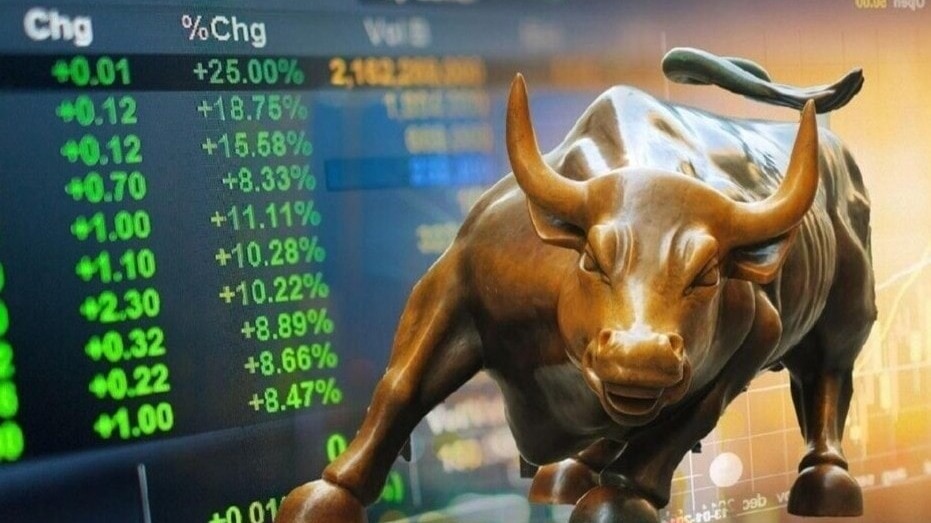
Stock market: The market capitalisation-to-GDP ratio, also known as Buffett indicator, stands at 133 per cent of FY26, at its year-end high and well above its long-term average of 87 per cent.
Sensex, Nifty: December favours bulls; what Buffett indicator, other valuation gauges hint at
Benchmark indices Sensex and Nifty are facing tough resistance after hitting record highs. If one goes by history, December often favours the bulls. Will this time be different?
Historically, seasonality favour the bulls with 70 per cent success rate wherein average return for Nifty has been to the tune of 2.5 per cent, said ICICI Securities. A host of indicators such as Buffett indicator suggested market valuations are still not reasonable. But analysts see an earnings growth rebound ahead; and, hence, continuation of the recent market rally.
Among valuation parameters, Nifty now trades at a 12-month forward P/E of 21.5 times, a mere 3 per cent premium over its long period average of 20.8 times. But on a price to book basis, the ratio stands at 3.2 times, representing a 13 per cent premium to its historical average of 2.9 times.
The market capitalisation-to-GDP ratio, also known as Buffett indicator, stands at 133 per cent of FY26, at its year-end high and well above its long-term average of 87 per cent. India's m-cap as a percentage of global market cap stood at 3.6 per cent in November compared with an average of 2.8 per cent for the period FY2007-2025. Also Nifty is trading at a 12-month forward return on equity (RoE) of 15.1 per cent, above its long-term average.
That said, in the last 12 months in dollar terms, the MSCI India Index (up 1 per cent) underperformed the MSCI EM Index (27 per cent). In P/E terms, the MSCI India Index is trading at a 51 per cent premium to the MSCI EM Index, below its historical average premium of 78 per cent.
"We expect a new leg of uptrend in markets, especially as the corporate earnings environment has improved owing to multiple factors such as stimulative fiscal and monetary measures, better liquidity, a likely thaw in the abruptly strained Indo-US relationships, and a softer base for demand and earnings. Valuations are reasonable, with Nifty trading at 21.5x, marginally above its LPA of 20.8x, and any evidence of earnings growth pickup should help valuations expand," MOFSL said.
The brokerage prefers Bharti Airtel, ICICI Bank, SBI, L&T, M&M, Infosys, Titan Company, Bharat Electronics, Interglobe Aviation, Tata Steel, TVS Motor, Tech Mahindra, Max Healthcare, and Indian Hotels, among largecaps.
VK Vijayakumar, Chief Investment Strategist at Geojit Investments said It the market is consolidating around the new record highs before breaking out to new highs. There is fundamental support for newer highs as reflected in the robust GDP numbers and the leading indicators like auto sales in November, he said.
"The continuing weakness in the rupee is a dampener which is impacting FII flows. A fair trade deal between India and the US can stem the weakness in rupee, but this has been hanging fire for too long," teh expert added.
On the technical side, said Systematix, Nifty's ability to hold above the psychological 26,000 mark and repeatedly defend 26,200 reinforced the strength of the on-going uptrend.
"A decisive close above 26,280 is likely to trigger further upside, potentially paving the way toward 26,500. The overall trend structure remains bullish, supported by the formation of higher tops and higher bottoms, with immediate structural support located near 25,800. Any dip toward the 20-day simple moving average (around 25,940) should be viewed as a healthy pullback within an on-going uptrend, offering accumulation opportunity," Systematix said.