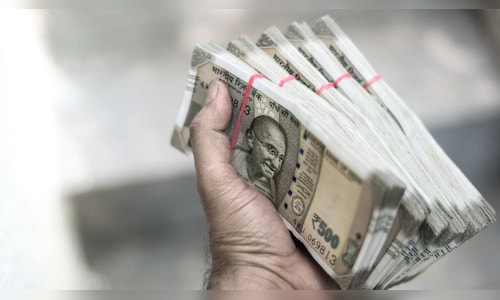
Market participants say the rupee remains under pressure due to sustained foreign investor outflows, NDF-expiry-related covering, and limited RBI intervention.
Rupee near 90 sparks earnings hit for corporates with dollar exposure
Market participants say the rupee remains under pressure due to sustained foreign investor outflows, NDF-expiry-related covering, and limited RBI intervention.
By Yoosef K
With the rupee hovering near the 90-per-dollar mark, export-driven sectors such as information technology and pharmaceuticals have some reason to cheer. But the currency’s sharper-than-anticipated volatility is emerging as a serious concern for aviation companies and firms with foreign currency borrowings.
For the quarter ended September 2025, InterGlobe Aviation, the parent of IndiGo, reported a larger-than-expected loss as foreign exchange losses wiped out gains from higher ticket revenues. The country’s largest airline posted a net loss of ₹2,582 crore, largely due to a 3.4% depreciation in the rupee during the period. Without the adverse currency movement, IndiGo would have reported a net profit of ₹104 crore.
More than 60% of IndiGo’s expenses — including fuel, maintenance, and lease payments — are directly or indirectly dollar-denominated, inflating costs from a constant-currency standpoint.
The rupee’s decline has been relatively modest at 1.2% so far in the December quarter, while global crude oil prices have dropped over 6% in the same period, likely offering some cushion for Q3 FY26. Additionally, the airline expects its growing international operations to provide a natural hedge.
“We expect the natural hedge through dollar revenues from international operations to increase, which will provide us with further insulation against currency fluctuations over time,” Pieter Elbers, CEO of IndiGo, said after the Q2 earnings.
Another company feeling the pressure is Housing & Urban Development Corporation (HUDCO), which reported a ₹176 crore loss due to currency fluctuations in the first half of FY26, compared with zero loss a year earlier. HUDCO has nearly ₹10,000 crore in external commercial borrowings (ECBs) and additional short-term FCNR loans.
“We have two kinds of foreign currency borrowings — FCNR loans with up to one-year maturity, and external commercial borrowings with five-year maturity. For our ₹9,900-crore ECB book, we have taken adequate protection through legal options and are well within the protection levels,” said Daljeet Singh Khatri, Director–Finance at HUDCO.
He noted that the company has about $400 million in FCNR loans maturing in Q3, including $175 million in November and the remainder in December. “Given the heightened volatility, we’re taking alternative measures. We are partially unwinding some positions and fully re-hedging, even if it means bearing additional costs. Leaving positions unattended could result in significantly higher losses. By unwinding and taking fresh, unlimited protection, we can save roughly 50% of the potential loss,” Khatri added.
Meanwhile, market participants say the rupee remains under pressure due to sustained foreign investor outflows, NDF-expiry-related covering, and limited RBI intervention.
“Optimism around a trade deal could help reverse some of the negative sentiment on the rupee. There could be some overshooting if the local currency breaches the 90 level,” said Kanika Pasricha, Chief Economic Advisor, Union Bank of India.
Also Read: Indian Rupee falls to a new record low of 89.95 against the US Dollar; Here's what experts said
(Edited by : Poonam Behura )
Check out our in-depth Market Coverage, Business News & get real-time Stock Market Updates on CNBC-TV18. Also, Watch our channels CNBC-TV18, CNBC Awaaz and CNBC Bajar Live on-the-go!